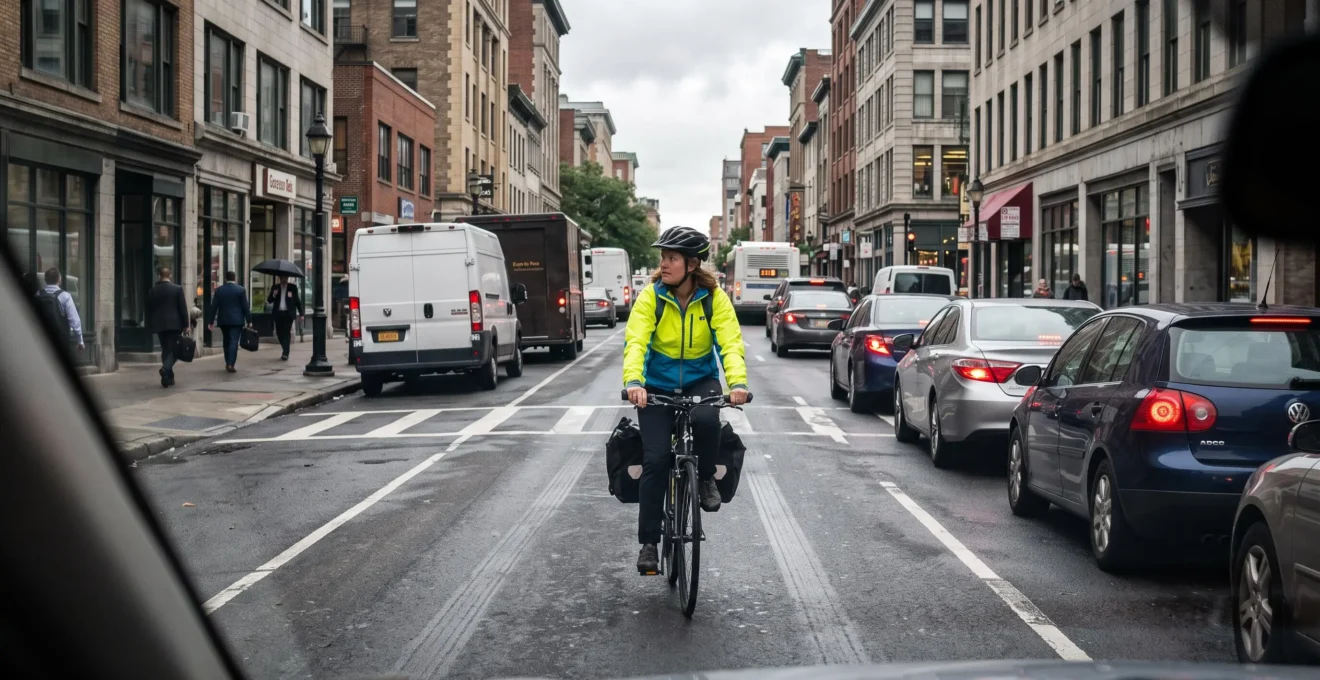
A narrow street can change the character of a cycling journey in seconds. Traffic that felt manageable suddenly compresses beside parked cars, a traffic island, or a bus stop. A driver approaches from behind, the available space disappears, and the cyclist must decide whether to move outward, slow down, or hold position.
The safest response is not automatically to ride closer to the kerb. In many narrow situations, that invites a driver to attempt an overtake where there is insufficient room. The better approach is to recognise the conflict early, choose a defensible lane position, communicate clearly, and maintain a predictable line until safe passing space returns.
These techniques apply broadly to urban cycling, but road rules differ between countries. In the UK, Australia, and other left-hand-traffic systems, cyclists generally ride toward the left side of the carriageway. In the US, Canada, and other right-hand-traffic systems, the equivalent roadside is normally the right. Always apply local cycling laws, road markings, and traffic controls.
Safer city cycling in three principles
- Take a clear, predictable lane position before a narrowing makes overtaking unsafe, rather than swerving at the last moment.
- Protect your escape space around parked cars, junctions, and large vehicles. Never assume visibility guarantees that a driver has noticed you.
- Combine road positioning with early observation, speed management, and route choices. If a road feels unmanageable, choose a safer alternative.
- Why Does Riding Too Far Left Make Drivers Pass Closer in Cities?
- How to Take the Lane at Pinch Points Without Starting a Road Rage Moment?
- Filter Up the Inside or Hold Position at Traffic Lights?
- The Parked-Car Zone Mistake That Leads to Most « Dooring » Incidents
- When Should You Leave 15 Minutes Earlier to Avoid the Most Dangerous Traffic Window?
- How to Choose Your Lane Position With Fast Traffic Without Feeling Like a Target?
- How to Position Yourself 30 Metres Before an Intersection So Drivers Don’t « Miss » You?
- How to Reduce Close Passes When You Must Ride With Fast Motorised Traffic
Why Does Riding Too Far Left Make Drivers Pass Closer in Cities?
Riding too close to the roadside can make a narrow lane appear wide enough for a driver to squeeze past without changing lanes. In left-hand-traffic countries, this often means hugging the left kerb; in right-hand-traffic countries, the same problem occurs on the right. A clear lane position can discourage unsafe overtaking, although no position guarantees adequate passing clearance.
The problem begins with how available space is interpreted. Imagine a narrow urban lane with a cyclist riding just inside the gutter. A following driver may judge the remaining strip of roadway as sufficient for an overtake, even though that judgement overlooks handlebar width, lateral movement, mirrors, and the cyclist’s need to avoid surface hazards.
This possible misreading can be described as a gap illusion, but the phrase is a practical explanation rather than an experimentally established mechanism. The fundamental issue is insufficient passing space.
An ambiguous position halfway between the kerb and the middle of a narrow lane can create another problem. It may still tempt a driver to pass within the lane while leaving the cyclist with little room to avoid a drain cover or damaged road surface. That does not make a halfway position universally dangerous: its suitability depends on actual lane width, traffic speed, and surrounding hazards.
Use a simple positioning assessment before choosing where to ride:
- Identify the usable width between lane markings, parked vehicles, kerbs, and obstructions.
- Consider whether a normal motor vehicle could pass with adequate clearance without crossing into another lane.
- Allow for your own movement around potholes, debris, and uneven surfaces.
- If a safe same-lane pass is unrealistic, adopt a clear position that does not invite a squeeze past, where permitted and safe.
This assessment is a judgement aid, not a validated width measurement. Drivers must still assess whether they can overtake safely.
The distinction between calm streets and fast roads matters. In slow traffic, riding centrally may be an appropriate way to prevent a risky pass at a narrowing. In faster traffic, cyclists should also consider opportunities to let vehicles pass safely once there is enough width. Actual vehicle speeds matter more than the number on a speed-limit sign.
The UK’s Highway Code rules for cyclists recommend the centre of the lane near junctions and narrowings where overtaking would be unsafe. On busy roads with faster traffic, Rule 72 also advises allowing safe overtaking while maintaining an appropriate distance from the kerb, normally at least 0.5 metres where applicable.
Positioning is about communicating the road’s available width, not claiming priority over everyone behind. Once that width narrows further, the timing of your move becomes especially important.
How to Take the Lane at Pinch Points Without Starting a Road Rage Moment?
Take the lane before reaching a pinch point, not as a sudden reaction inside it. Check behind, signal your intended movement when safe, and move progressively into a clear position while maintaining a steady line. After the narrowing, allow overtaking when sufficient space returns. This reduces ambiguity without requiring confrontation or unnecessary obstruction.
A pinch point may be created by a pedestrian island, roadworks, a traffic-calming feature, or a delivery vehicle beside moving traffic. The crucial moment often occurs well before the physical narrowing, while there is still room to choose your position.
A useful three-stage method is:
- Observe and communicate. Look behind while maintaining control. Check the speed and distance of following vehicles. Signal if appropriate and safe, remembering that a signal does not establish that the lane is clear.
- Move before the restriction. When there is an adequate gap, shift smoothly toward the lane position needed to prevent an unsafe squeeze past. Do not force another road user into an emergency manoeuvre.
- Hold a consistent line. Ride through the restricted section without weaving toward and away from the kerb. Return toward a suitable secondary position once safe overtaking becomes possible.
Traffic conditions influence the best moment to move. A queue already travelling slowly may provide an easier opportunity to establish your position. With faster approaching vehicles, reducing speed slightly or allowing a vehicle to pass before entering the narrowing may be preferable, provided the manoeuvre is safe.
Consider a hypothetical commute where a parked van narrows an otherwise passable street. If the cyclist waits until reaching the van to move outward, a following driver may already be preparing to overtake. Establishing the necessary lane position earlier gives both road users more opportunity to recognise the conflict and adjust.
Road rage should never be treated as something the cyclist must personally control. Calm, predictable riding may reduce misunderstandings, but it cannot prevent aggressive behaviour by another person.
Avoid deliberate obstruction, retaliatory gestures, or prolonged confrontational eye contact. A brief glance can help communicate awareness, but it is not confirmation that a driver will yield. If threatened, prioritise reaching a safe place rather than continuing an argument.
On a long restricted section, review passing opportunities periodically. A safe pull-in area or wider stretch may allow queued vehicles to pass. Do not sacrifice your own clearance by hugging a dangerous edge simply to release traffic pressure.
Once the road opens again, predictable cooperation is usually more useful than maintaining a central position unnecessarily. The same judgement becomes more complicated when traffic stops at lights.
Filter Up the Inside or Hold Position at Traffic Lights?
Hold your position when the space beside stopped vehicles is narrow, drivers may turn across your path, or large vehicles create blind spots. Filter only where local rules permit it and the available space, signals, and vehicle movements make it safe. Reaching the front of a queue is not automatically safer than waiting behind a vehicle.
At a red light, filtering can feel efficient because stopped traffic appears predictable. The danger emerges when the signal changes and multiple vehicles begin moving, turning, or changing position at once.
In left-hand-traffic countries, filtering up the left side may expose cyclists to a left-turning vehicle. In right-hand-traffic countries, the corresponding conflict commonly involves a vehicle turning right across a cyclist travelling along its right side. These conflicts are often called turning hooks.
Assess the situation using several factors rather than treating filtering as the default:
| Condition | Filtering may be reasonable when | Holding position is preferable when |
|---|---|---|
| Cycle facilities | A permitted, accessible cycle lane or advanced waiting area provides a clear route. | Reaching the facility requires squeezing beside vehicles or crossing a prohibited stop line. |
| Available width | There is continuous clearance and an appropriate route at the front. | The gap narrows or would leave no escape space. |
| Turning movements | Vehicle intentions and the signal arrangement provide a safe path. | Vehicles may turn across the cyclist’s line at the start of green. |
| Large vehicles | The cyclist can remain well clear of their turning path and blind spots. | Filtering would position the cyclist beside or immediately ahead of a truck or bus. |
| Traffic restart | The cyclist can complete the move before traffic restarts safely. | The queue is likely to move while the cyclist is alongside vehicles. |
An advanced stop area can improve positioning where it is designed for cyclists and can be entered legally. However, never cross a prohibited stop line to reach one or assume a driver in a high cab can see someone immediately ahead.
The vehicle beside you also matters. Being directly visible in front of a car whose driver has already acknowledged your presence may be preferable to remaining alongside a vehicle likely to turn. That is different from placing yourself close to a large vehicle’s front bumper, where visibility may be severely restricted.
Consider the actual time benefit. If the queue is short, traffic is about to restart, or there is no protected continuation beyond the junction, filtering may save almost nothing while creating a new conflict.
A practical question is: Will filtering leave me in a clearly safer and more visible position when the lights turn green? If not, waiting in a suitable position behind traffic is often the better choice.
Stationary vehicles create similar hidden risks away from junctions, particularly when they are parked along the roadside and their doors can open unexpectedly.
The Parked-Car Zone Mistake That Leads to Most « Dooring » Incidents
The critical parked-car mistake is riding within reach of an opening door while assuming that the narrow gap beside the cars is a safe cycling space. A door can open without enough warning for a cyclist to stop or steer clear. The practical defence is to establish a line outside the door zone before entering the row of parked vehicles.
The title highlights a common dooring mechanism, not a verified statistical ranking of all dooring incidents. The supplied evidence does not establish what proportion of such collisions arises from this specific positioning mistake.
A parked-car lane can appear deceptively wide. The cyclist may judge the distance from the vehicle body to the traffic lane while forgetting that a door could suddenly occupy much of that space.
Rule 67 of the UK’s Highway Code recommends leaving at least a door’s width or 1 metre when passing parked vehicles. This is practical British guidance; local rules and road geometry elsewhere may differ.
Watch for clues that a parked vehicle may soon become active:
- An occupant visible through a window or mirror.
- Brake lights illuminating or extinguishing.
- A vehicle that has just parked.
- Passenger drop-offs near shops, schools, or transport stops.
- Delivery activity, taxis, and frequent roadside turnover.
These observations are warning signs, not reliable predictions. A vehicle without any visible activity can still have a door opened unexpectedly.
Move away from the parked cars before reaching them, checking behind and communicating any lane movement. If insufficient space exists between the door zone and moving vehicles, reduce speed, wait for a safe opportunity, or use another suitable route rather than riding trapped between the two hazards.
The secondary danger is an emergency swerve. A cyclist surprised by an opening door may move sharply into the path of an overtaking vehicle, creating another collision risk. Maintaining door clearance from the beginning helps avoid that last-second decision.
The goal is not to ride as far from parked cars as possible regardless of other traffic. It is to maintain a usable safety margin without moving unpredictably into passing vehicles.
Where parked vehicles make an entire route consistently difficult, changing the journey’s timing or choosing a less exposed street may be more effective than repeatedly negotiating the same danger.
When Should You Leave 15 Minutes Earlier to Avoid the Most Dangerous Traffic Window?
Leave 15 minutes earlier when your own route observations show that the earlier journey has more manageable traffic, better passing opportunities, and suitable visibility. Fifteen minutes is a useful experiment, not a proven safety threshold. A quieter departure can be beneficial, but moving into darkness, school traffic, or another busy transition period may introduce different hazards.
Peak-hour danger cannot be understood through vehicle numbers alone. The speed of traffic, available lane width, junction movements, delivery activity, and lighting all influence the experience.
According to the Department for Transport’s 2025 pedal cycle casualty factsheet, weekday peaks in reported cyclist deaths and serious injuries in Great Britain occur between 7 a.m. and 10 a.m., and between 4 p.m. and 7 p.m.
These are periods with higher numbers of reported casualties, not necessarily higher risk per individual journey. The statistics do not adjust those figures into a universal personal risk measure based on cyclist exposure.
7–10 a.m. and 4–7 p.m.
Weekday peak periods for reported cyclist fatalities and serious injuries in Great Britain, according to the 2025 government factsheet. They do not establish the safest time for every commuter.
Department for Transport, Reported road casualties Great Britain: pedal cycle factsheet, 2025.
Traffic just outside the busiest period deserves attention too. A hypothetical route might become less comfortable when a slow queue clears and drivers begin travelling faster through the same narrow street. Another route might improve as soon as school drop-off activity ends.
Rather than assuming these patterns apply everywhere, collect observations along your own commute for two weeks.
Build a two-week commute safety log
- Record departure and arrival times. Produce a dated journey log that identifies the time of each ride.
- Mark recurring conflict locations. Create a route map showing pinch points, difficult junctions, and frequent close-pass locations.
- Note traffic behaviour. Record observed congestion, vehicle speeds, and uncomfortable overtaking events without taking notes while riding.
- Track visibility conditions. Add daylight, darkness, glare, rain, and street-lighting observations to each journey entry.
- Compare departure windows. Produce a short comparison of usual and earlier journeys, identifying whether the change actually improved conditions.
Lighting deserves particular consideration. An earlier winter departure may move an otherwise daylight commute into dawn or darkness. A US study of lighting conditions and cyclist injury severity examined 113,470 police-reported bicycle–motor vehicle crashes from 2000 to 2014 across four states. It found associations between lower-light conditions and greater injury severity among reported collisions.
That finding concerns injury severity once a crash has occurred, not the probability that a particular commute will involve a crash. It nevertheless supports taking low-light conditions seriously when changing departure times.
Use appropriate lights and visibility equipment under local rules, and consider whether the adjusted journey remains manageable for the whole route.
If changing the time does not improve the road environment, focus next on your position within traffic and whether that position makes your intentions easier to understand.
How to Choose Your Lane Position With Fast Traffic Without Feeling Like a Target?
Choose a lane position that preserves safe clearance, makes your path predictable, and gives following drivers time to recognise what you will do next. Do not retreat automatically toward the gutter because traffic feels intimidating. With faster vehicles, balance visibility and usable road space against the speed difference, and leave the road when conditions exceed your comfort or ability.
The feeling of being a target often comes from noticing a vehicle approaching rapidly behind while having limited control over its behaviour. Moving closer to the edge can feel instinctively protective, but it may sacrifice the space needed to avoid debris or a sudden obstruction.
A more reliable approach is to choose your position according to the next road feature rather than the immediate emotional pressure of a following vehicle.
Think in three operating positions:
- Normal travelling position: Maintain appropriate roadside clearance while giving drivers room to overtake safely where the road allows it.
- Hazard position: Move outward early to avoid parked-car doors, drainage hazards, broken surfaces, or temporary obstructions.
- Controlled lane position: Where permitted and safe, occupy enough of a narrow lane to make an unsafe same-lane overtake less attractive.
These are descriptions of practical positioning choices, not rigid measurements. The correct position may change repeatedly during one journey, but each change should be deliberate and clearly communicated.
Speed difference changes the calculation. A cyclist travelling substantially slower than surrounding motor traffic has less time to react to fast-approaching vehicles. Trying to match vehicle speeds beyond your comfortable capability is not a solution.
Where traffic is fast, continuous, and unable to pass with adequate clearance, look for a quieter parallel street, suitable cycling infrastructure, or a safe place to pause and reassess.
Visibility also involves more than clothing. A cyclist in a driver’s expected line of sight is generally easier to identify than someone emerging suddenly from behind a parked vehicle. Lights, reflective accessories, contrast with the background, and a consistent trajectory can all support detection, but none guarantees that a driver has noticed you.
Research also shows why infrastructure matters. An Australian study of bicycle lanes and overtaking distances recorded 46,769 overtaking events involving 162 cyclists in Melbourne, Perth, Geelong, and Bendigo.
Australian observations of vehicle passing clearance
Researchers fitted participating bicycles with distance sensors and video cameras and observed cyclists on their usual routes over two weeks.
Drivers generally left more lateral clearance on roads with painted cycle lanes than on roads without them. Road width, parking, and lane design were also relevant. These observational findings do not prove that one particular rider position will consistently produce wider passing distances.
Confidence grows from repeatable decisions rather than aggressive riding. Practise observation, signalling, and smooth positional changes on quieter roads before relying on those skills in faster traffic.
The next major test comes near an intersection, where visibility must be established before turning vehicles and merging traffic create competing demands.
How to Position Yourself 30 Metres Before an Intersection So Drivers Don’t « Miss » You?
About 30 metres before an intersection can be a useful point to assess your position, provided traffic speed and road conditions give you enough time. Check behind, identify your intended movement, and establish a clear line before the junction. The distance is a planning example, not a universal rule, and early visibility never guarantees that every driver has seen you.
Drivers approaching an intersection must process multiple possible movements: turning traffic, pedestrians, signs, traffic signals, and vehicles entering from side roads. A cyclist who appears only at the last moment may be harder to incorporate into that developing traffic scene.
Early positioning gives other road users more opportunity to recognise the cyclist’s intended path. This is a practical visibility principle, not proof that a specific distance produces a measurable reduction in collisions.
For a straight-ahead movement, avoid being trapped alongside a vehicle that may turn across your path. Where local rules permit, choose a position that makes your straight-ahead intention apparent and discourages unsafe overtaking through the junction.
For a turn, assess the correct lane or cycle facility in advance. Check behind before moving laterally, signal when safe, and follow the applicable turning procedure. Never cut across moving traffic to reach an ideal position.
The following checks help organise the approach:
- Identify the junction type, traffic signals, and intended direction.
- Scan behind and to the side before changing lateral position.
- Choose a visible, legally appropriate line before entering the conflict area.
- Watch vehicle indicators, wheel movements, and turning opportunities rather than relying on a single cue.
- Allow for pedestrians, other cyclists, and micromobility users approaching the same crossing.
Large vehicles require special caution. Being visible while approaching a junction does not mean remaining visible after stopping alongside a truck or bus. Blind spots can extend along both sides and around the front of large vehicles, depending on their design.
A driver looking toward you does not establish that they have noticed you. Likewise, the absence of a turning indicator does not prove that a vehicle will travel straight ahead.
If you cannot confidently assess a large vehicle’s intended movement, stay well outside its turning path. Where possible, wait in a protected or clearly separated position rather than filtering beside it.
Other vulnerable road users also need room to move. Avoid blocking crossings, crowding advance waiting areas, or making sudden manoeuvres around pedestrians and cyclists who may not expect you to change course.
Intersections demonstrate a broader principle: no single riding technique eliminates close passes. A reliable approach combines positioning with speed, communication, and the choice of roads themselves.
Key takeaways before riding with faster traffic
- Evaluate whether a safe overtake is physically possible before deciding how much of the lane to occupy.
- Use speed and timing to create safer interactions, not to compete with motor vehicles.
- Recognise when the best improvement comes from changing the route rather than adjusting your riding position.
How to Reduce Close Passes When You Must Ride With Fast Motorised Traffic
Reducing close passes requires a combination of appropriate lane positioning, predictable movement, speed management, and route selection. Make unsafe passing space apparent before a vehicle reaches you, communicate changes early, and allow safe overtaking when conditions permit. When repeated close passes occur despite these precautions, prioritise infrastructure and routes that separate cyclists from faster motor traffic.
Close passing is not simply a question of whether a driver can see a cyclist. Road width, overtaking opportunities, vehicle size, traffic speed, and the rider’s position all influence the space available.
A useful approach is to think of four interacting controls.
| Control | What it addresses | Practical response |
|---|---|---|
| Lane position | Whether the available gap appears suitable for overtaking. | Hold a clear, defensible line at narrow sections and allow passing where safe. |
| Speed and timing | How quickly the cyclist and approaching driver reach a conflict. | Adjust speed within your ability and allow faster vehicles to pass before restrictions when feasible. |
| Communication | Whether another road user can anticipate a positional change. | Look behind, use appropriate signals, and move progressively when clear. |
| Route selection | How frequently close-pass conflicts arise. | Prefer suitable cycle facilities, wider roads with safe passing opportunities, or quieter alternatives. |
Slowing slightly before a narrow section may help in one situation and make another worse. For example, if it allows a vehicle to pass safely before a restriction, the adjustment may remove the immediate conflict. But slowing while a driver is already attempting to squeeze through a narrow gap may not create enough lateral space and can introduce uncertainty.
Use speed adjustments only after assessing following traffic. Never brake abruptly to communicate displeasure or attempt to force a driver into a particular manoeuvre.
Hand signals can communicate an intended movement or request for space, but an outward gesture does not create a legal entitlement beyond the applicable road rules. Regional conventions differ, and there is no universal hand signal that guarantees a driver will give additional overtaking clearance.
A brief outward arm signal may be useful when it clearly communicates an actual change of direction or lane position. Keep control of the bicycle and avoid exaggerated body movements intended to intimidate following drivers.
Repeated dangerous overtaking should also inform longer-term decisions. A route that consistently produces close passes near the same narrowing may be unsuitable even if each individual encounter can be managed.
Where available and lawful, video footage can help document serious incidents. Preserve relevant details, avoid escalating confrontations, and consider reporting dangerous behaviour to the appropriate local authority or police service. Local reporting procedures and evidentiary requirements vary.
Information about recurring hazards may also be useful to local cycling organisations or road authorities responsible for infrastructure improvements.
Most importantly, do not measure successful cycling by how closely you can tolerate passing vehicles. A safer journey is one with fewer unavoidable conflicts, enough room to respond, and decisions that remain manageable under real traffic conditions.
On your next regular journey, identify one narrow section, one difficult junction, and one possible alternative route. Decide in advance where you will position yourself, when you can safely allow passing, and what would make you choose another road.
Is taking the full lane legal when cars are travelling faster than bicycles?
Legality depends on the country, road classification, and applicable rules. Great Britain’s Highway Code recommends using the centre of a lane in certain situations where overtaking would be unsafe, while also advising cyclists to allow safe overtaking on faster roads where appropriate. Other countries and jurisdictions have different requirements. Check local law rather than assuming one national rule applies everywhere.
Should a cyclist pull over whenever several cars form a queue behind them?
Not automatically. The priority is finding a genuinely safe passing opportunity. A suitable wider stretch or safe pull-in area may allow traffic to pass without compromising the cyclist’s clearance. Pulling into a hazardous gutter, door zone, or unstable surface simply to release a queue may create a more immediate risk. Follow any applicable local rules for slower-moving traffic.
Can a rear-view bicycle mirror help with lane positioning?
A correctly adjusted mirror can provide useful information about approaching vehicles without requiring a full head turn every time. However, mirrors have limited fields of view and may distort apparent distances. A mirror should supplement, not replace, direct checks before changing lane position.
What should you do when a driver repeatedly honks at you in a narrow lane?
Maintain control, avoid retaliatory gestures, and do not make sudden positional changes. Continue through the restriction if doing so remains safe and lawful, then allow the driver to pass when sufficient space becomes available. If the behaviour becomes threatening, prioritise reaching a safe location. Serious threats or dangerous driving may warrant a report to local authorities.
When is choosing a different route better than improving your riding technique?
Consider another route when fast traffic, persistent narrow lanes, large vehicles, or repeated unsafe overtaking leave too little room for predictable manoeuvres. A quieter street or suitable protected cycle route may provide a more manageable journey. Cycling skills can improve decision-making, but they cannot compensate for every road-design problem or every driver’s behaviour.