Sustainable Transportation and Urban Cycling
Every day, millions of short car trips clog city streets and add unnecessary emissions to the air. Yet many of these trips could be made by bicycle in the same amount of time — often faster. Sustainable transportation is about moving people and goods in ways that reduce environmental impact, and urban cycling sits right at the heart of this shift. It is affordable, healthy, quiet, and remarkably efficient. Whether you are considering your first commute by bike or looking to replace more of your car journeys, understanding how cycling fits into the bigger picture of sustainable mobility will help you make choices that stick.
This pillar page brings together the essential ideas: what sustainable transportation really means, why cycling is one of its most powerful tools, how to get started practically, and what infrastructure and habits make city riding safe and enjoyable.
What Is Sustainable Transportation?
Sustainable transportation covers any way of moving around that minimizes greenhouse gas emissions, air pollution, noise, and land consumption compared to conventional car travel. It includes walking, public transit, electric mobility, shared vehicles, and of course cycling. The common thread is simple: move the same number of people using less energy and less space.
Think of a city street as a pipeline. A single car lane can move roughly 1,000 to 2,000 people per hour. A protected bike lane can move several times that number in the same width. Cycling is not just a greener option — it is one of the most space-efficient ways to move a city.
- Walking and cycling produce zero tailpipe emissions and require minimal infrastructure per user.
- Public transit moves large numbers of people efficiently and pairs naturally with cycling for first-and-last-mile trips.
- Shared mobility (bike-share, e-bike rentals, car-share) reduces the need for private vehicle ownership.
Cycling stands out because it solves several problems at once: congestion, emissions, sedentary lifestyles, and the high cost of car ownership. That is why city planners in places like Copenhagen, Amsterdam, Portland, and increasingly many North American and British cities treat bike infrastructure as core transportation, not recreation.
Why Urban Cycling Matters
The environmental case is well known, but the everyday benefits are what convince most people to ride regularly.
Environmental Impact
A bicycle requires a fraction of the materials and energy needed to build a car, and riding one produces essentially no emissions once manufactured. Studies comparing life-cycle emissions consistently find that cycling a kilometer produces roughly ten times less CO2 than driving the same distance. Even e-bikes, which use electricity, remain far cleaner than cars when charged from a typical national grid.
Health and Well-Being
Cycling turns commuting time into exercise time. Regular riders tend to show improved cardiovascular health, better mental well-being, and lower stress levels. Unlike a gym membership, the habit builds itself into your daily routine — no extra scheduling required.
Cost Savings
Owning a car in most anglophone cities costs thousands of dollars or pounds per year once you add insurance, fuel, parking, and maintenance. A commuter bike, even a well-equipped one, costs a small fraction of that to buy and maintain. For many households, replacing even one car with a bike-plus-transit combination is the single biggest line-item saving available.
Speed and Reliability
In dense urban areas, short trips under five kilometers are often faster by bike door-to-door. You bypass traffic jams, never circle for parking, and can predict your travel time with unusual accuracy.
Getting Started with Urban Cycling
Starting to ride in a city can feel intimidating, but it is a skill that builds quickly. The key is to progress in manageable steps rather than attempting a long commute on day one.
- Assess your typical trips. List the journeys you make most often — school runs, groceries, commuting — and note their distance. Most fall within easy cycling range.
- Choose the right bike. A comfortable hybrid or city bike suits most riders. E-bikes are excellent for longer distances or hilly cities and have become dramatically more affordable.
- Practice in a calm environment. Spend an hour in a park or quiet street getting comfortable with braking, signaling, and looking over your shoulder.
- Plan a low-traffic route. Use mapping tools with cycling layers to find protected lanes and quiet streets. The shortest route is rarely the most pleasant one.
- Do a test run. Ride your commute on a weekend or outside rush hour first, so your first real attempt is familiar terrain.
- Build the habit gradually. Start with one or two days a week and expand as your confidence and fitness grow.
Essential Gear for City Riding
You do not need much to ride safely and comfortably, but a few items make a significant difference.
- Helmet: modern helmets are light, ventilated, and inexpensive relative to the protection they offer.
- Lights: front and rear lights are legally required in most places after dark and dramatically improve visibility at all hours.
- Lock: a quality U-lock or heavy chain is essential in cities; budget roughly ten percent of your bike’s value for security.
- Mudguards and a rack or panniers: these turn a bike from a fair-weather toy into a practical errand-running vehicle.
- Basic repair kit: a spare tube, tire levers, and a mini-pump let you handle the most common breakdown — a flat tire — in fifteen minutes.
Consider a simple example: Maya, an office worker in a mid-sized city, used to drive eight kilometers to work. After buying a used hybrid bike, lights, and a pannier, her commute takes twenty minutes by a riverside path — about the same as driving, without the parking hunt. Within a few months she had cut most of her weekly short drives, saved money, and noticeably improved her fitness.
Navigating City Streets Safely
Safety concerns are the most common reason people hesitate to ride, and they deserve a serious answer. While infrastructure quality varies, rider behavior has an outsized impact on risk.
- Ride predictably: hold a steady line, avoid swerving between parked cars, and signal your intentions early.
- Stay visible: position yourself where drivers look — out of the door zone, several feet from parked cars, and in the middle of narrow lanes where appropriate.
- Assume you are unseen: make eye contact at intersections when possible, and be extra cautious around large vehicles with blind spots, especially at junctions.
- Follow the rules of the road: obeying signals protects you and improves how all road users perceive cyclists.
It is also worth knowing your local regulations, which vary between countries and even between states and cities. Bike lanes, advanced stop lines, and shared paths each come with their own expectations, and a quick review of your local rules builds confidence.
The Role of Infrastructure and Community
Individual choices matter, but cycling thrives when cities support it. Protected bike lanes, secure parking, bike-share programs, and connections to transit all lower the barrier to entry. Over the past decade, many anglophone cities have expanded their cycling networks significantly, and research consistently shows that building safer infrastructure brings out a much broader range of riders — including women, children, and older adults.
You can support this shift in small ways: join a local cycling advocacy group, respond to city consultations on transport plans, or simply be a visible, courteous rider. Every additional person on a bike makes the streets safer for the next one — a dynamic researchers call the safety in numbers effect.
Combining Cycling with Other Sustainable Modes
Urban cycling rarely replaces every trip, and it does not need to. The most sustainable transportation habits are hybrids. Many transit systems now carry bikes or offer secure station parking, letting you cycle to a train and ride the rest of the way. Car-share and ride-hailing fill the rare gaps — moving furniture or traveling in a storm — without the fixed costs of ownership.
A practical rule of thumb: default to the bike for trips under ten kilometers, use transit for longer distances, and reserve the car for cases where nothing else works. Even shifting a quarter of your short car trips to a bike meaningfully reduces your personal emissions while saving money and adding activity to your day.
Key Takeaways
Sustainable transportation is not an all-or-nothing proposition, and urban cycling is its most accessible entry point. A bicycle is inexpensive, emission-free in use, good for your health, and often the fastest tool for city travel. Start with short, familiar trips, invest in a few essentials, learn your local rules, and let the habit grow naturally. Cities are increasingly built to support riders — and every trip you take by bike helps push that transformation further, one journey at a time.
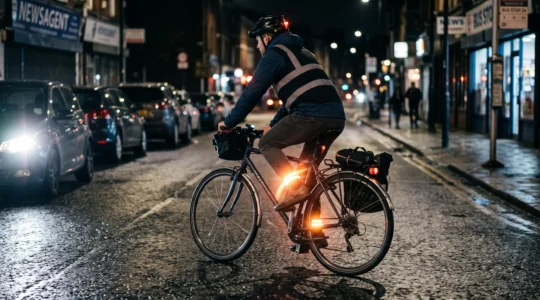
Do Reflective Ankle Bands Make You Noticeably More Visible Than a Reflective Vest
Reflective ankle bands can make a cyclist noticeably easier for approaching drivers to recognise at night than a reflective vest worn alone. Their advantage is not simply brightness. By highlighting the repeated movement of pedalling legs, they provide a recognisable…
Lire la suite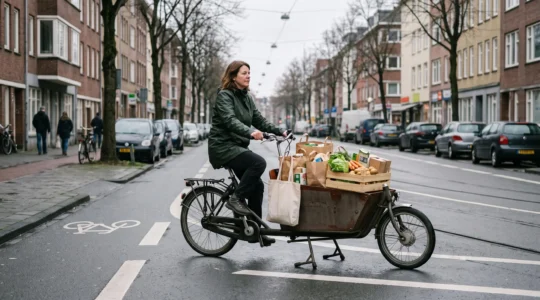
Which Cargo Bicycle Works Best for a Weekly Grocery Haul Without Feeling Tippy
The best cargo bicycle for a weekly grocery haul is not necessarily the one with the biggest box or strongest motor. It is the one that remains predictable when loaded, fits through your everyday entrances, and can be parked securely…
Lire la suite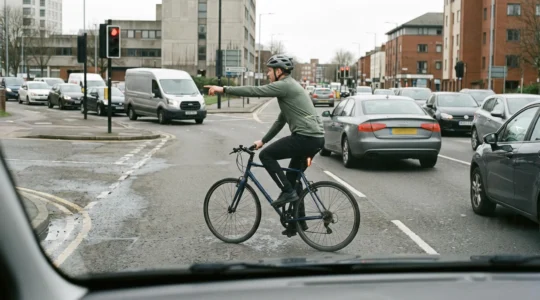
How to Use Cycling Hand Signals So Drivers Actually React in Busy Traffic
A hand signal is not a guarantee that a driver has seen you, understood your intention or left enough room for you to manoeuvre. In busy traffic, the safest approach combines a clear signal with early observation, a predictable riding…
Lire la suite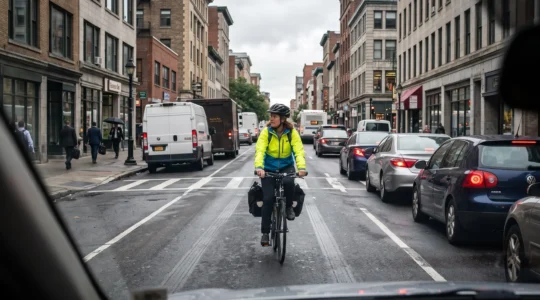
How to Ride in Fast City Traffic Without Getting Squeezed at Pinch Points
A narrow street can change the character of a cycling journey in seconds. Traffic that felt manageable suddenly compresses beside parked cars, a traffic island, or a bus stop. A driver approaches from behind, the available space disappears, and the…
Lire la suite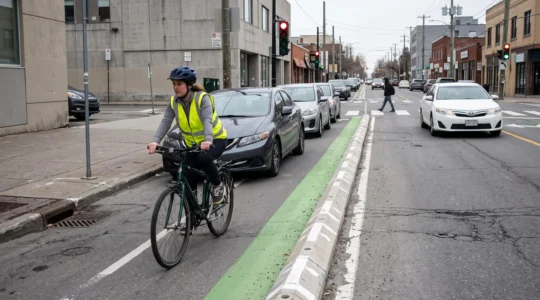
How to Ride Protected Bike Lanes Safely at Driveways and Side Roads Without Close Calls
A protected bike lane can make an urban journey feel noticeably calmer. Concrete curbs, parked cars or flexible posts create separation from moving traffic, allowing cyclists to travel without constantly negotiating space with passing vehicles. Yet that separation becomes less…
Lire la suite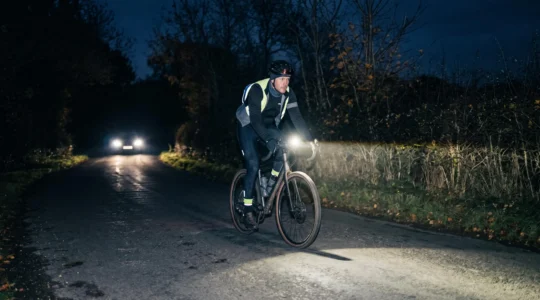
Which Bike Lighting Setup Lets Drivers See You From 150 m Without Blinding Them
A bicycle light advertised as visible from 150 metres is not necessarily a light that allows drivers to recognise a cyclist at that distance. Nor does a powerful front beam automatically make an unlit road safer. The effectiveness of a…
Lire la suite