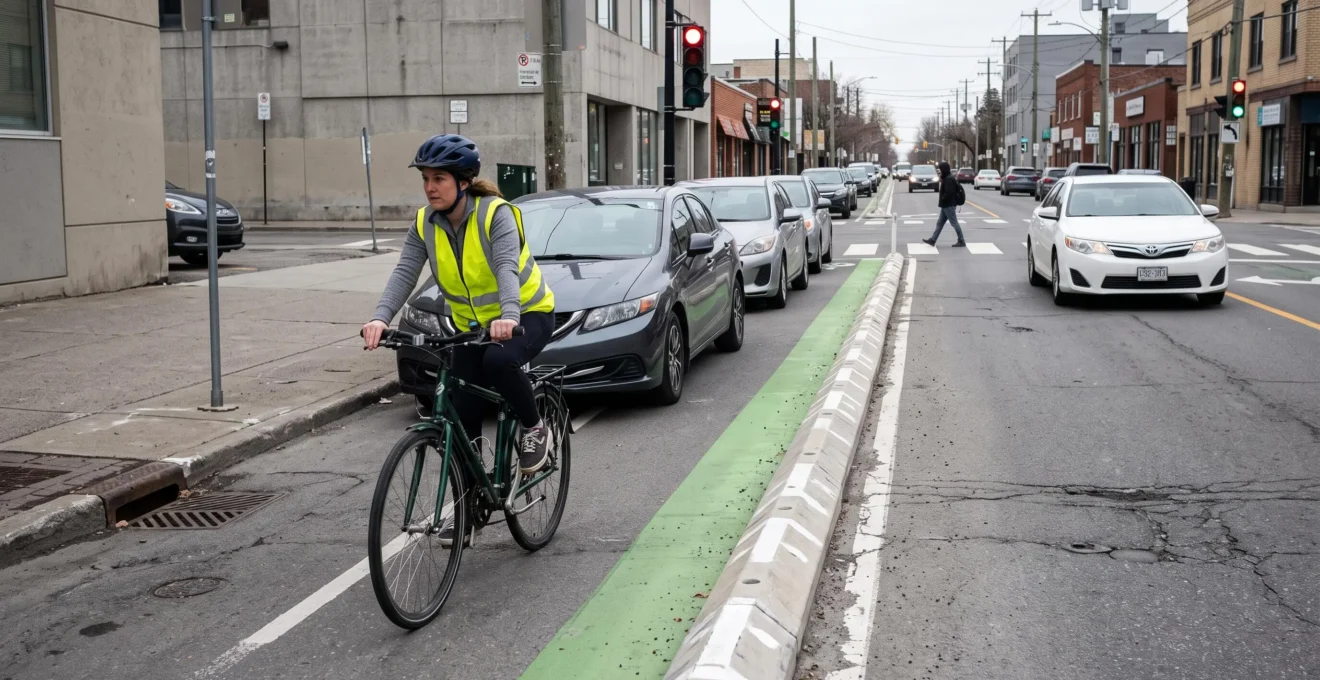
A protected bike lane can make an urban journey feel noticeably calmer. Concrete curbs, parked cars or flexible posts create separation from moving traffic, allowing cyclists to travel without constantly negotiating space with passing vehicles. Yet that separation becomes less straightforward wherever a driver needs to cross the cycling route.
Driveways, side roads, intersections and roundabouts are places where the cyclist’s path and a vehicle’s turning movement may overlap. A driver who has not noticed an approaching rider can enter the crossing even when the cyclist has priority. Physical protection along the street does not automatically resolve this turning conflict.
The practical answer is to treat each crossing as a new visibility and positioning problem. Look beyond the lane markings, identify vehicles that might cross your path, control your approach speed and choose a predictable line. These habits are especially useful on unfamiliar infrastructure or routes with frequent side-road interruptions.
The following techniques apply broadly to urban cycling in English-speaking countries, but traffic rules, cycle-lane obligations, signalling conventions and priorities vary by jurisdiction. Always follow the local signs, signals and applicable road rules.
Protected bike lane safety: essential habits
- Look for turning vehicles before every driveway or junction, even when the bicycle crossing appears protected or marked.
- Choose a visible, predictable riding position and approach at a speed that leaves room to stop if a vehicle crosses your path.
- Avoid overtaking near conflict points, assess junction design before merging and prefer routes with manageable crossings rather than judging protection by distance alone.
- Why Do Protected Bike Lanes Still Produce So Many Left/Right-Hook Near-Misses?
- How to Approach Side-Road Crossings in a Protected Lane Without Being Invisible?
- Which Should You Do: Stay in the Protected Lane or Merge Early Before a Junction?
- The Overtake Move That Causes Most Collisions in Protected Lanes
- When Should You Detour 1 km to Stay on Protected Lanes Instead of Taking the Direct Road?
- How to Position Yourself 30 Metres Before an Intersection So Drivers Don’t « Miss » You?
- Which Hand Signal Works Best at Roundabouts: Traditional or More Assertive Cues?
- How to Cross Mixed-Traffic Intersections Without Getting Cut Off by Turning Cars
Why Do Protected Bike Lanes Still Produce So Many Left/Right-Hook Near-Misses?
Protected bike lanes can still produce turning conflicts because separation along a road does not eliminate the places where vehicles must cross the cyclist’s path. Parked cars, curbs and other barriers may also restrict mutual visibility until a junction is close. A rider can therefore be legally proceeding straight ahead while a turning driver fails to notice them.
A hook conflict occurs when a motor vehicle turns across the path of a cyclist travelling in the same general direction. In countries where traffic keeps right, this commonly involves a right-turning vehicle and a cyclist travelling on its right. In left-driving countries, the equivalent conflict commonly involves a left-turning vehicle.
The underlying problem is the relationship between vehicle turning paths and the cycling route. A driver may be watching oncoming cars, traffic signals or pedestrians while a cyclist approaches along a route that has been visually separated from the main carriageway.
Three common protected-lane designs create different visibility conditions:
- Parking-protected lanes: parked vehicles can conceal approaching cyclists and restrict drivers’ views when entering or leaving side roads. Gaps in parking may improve sightlines, but their location matters.
- Curb-separated lanes: a continuous curb provides clear physical separation, although corners, landscaping and roadside objects may obstruct the view of crossings.
- Flexible-delineator lanes: posts usually allow greater visibility through the buffer, but they do not physically prevent every vehicle from crossing or entering the cycling space.
No single design is automatically the most dangerous. Visibility depends on the position of obstacles, turning speeds, setback distances and how the crossing is arranged.
NACTO‘s intersection visibility guidance explains why cyclists and drivers need clear mutual sightlines before their paths conflict. Its recommended approach visibility zones vary with driveway type, turn calming and intersection geometry, rather than relying on one universal distance.
1.5–15 metres
Range spanning several approach visibility-zone recommendations in NACTO guidance, depending on the type of driveway or intersection and its turning conditions. These are infrastructure design measurements, not prescribed cyclist braking distances or a universal conflict window.
National Association of City Transportation Officials, Urban Bikeway Design Guide.
The final approach to a crossing can be understood as a conflict-zone window: a period during which the cyclist needs to shift attention from steady riding to possible turning movements. On some streets, this critical area may extend roughly 10–15 metres before the junction; on others, the relevant distance is substantially different. The figure is a practical illustration, not a fixed safety rule.
A fresh green light also deserves attention. A cyclist may have permission to proceed while a driver is simultaneously permitted to turn across the route. Dedicated signal phases can prevent that overlap, but an ordinary green signal does not always mean all crossing movements are excluded.
Eye contact is not a reliable substitute for checking vehicle movement. Even if a driver appears to look toward a cyclist, that does not establish recognition or a decision to yield.
Neither a driver’s duty to yield nor a cyclist’s responsibility to ride predictably should be confused with a guarantee that the crossing is clear.
The next step is to turn that understanding into a repeatable approach technique for driveways and side-road crossings.
How to Approach Side-Road Crossings in a Protected Lane Without Being Invisible?
Approach a side-road crossing by scanning for vehicles that could enter the bike lane, reducing speed when visibility is restricted and choosing a predictable position with the clearest available sightline. Watch the front wheels and movement of waiting vehicles instead of relying on eye contact. Be prepared to stop whenever the space ahead is not visibly clear.
Start scanning before reaching the crossing. Look for a vehicle waiting at the side road, a car approaching the driveway or a gap in parked vehicles that could conceal a turning movement.
When a stopped vehicle is visible, its front wheels can provide useful information. Wheels beginning to rotate, the vehicle’s nose shifting forward or its body changing position may signal that the driver is preparing to move.
Engine sounds can supply additional clues, particularly on quieter streets, but they are unreliable when traffic noise is high or an electric vehicle is involved. Shadows and reflections may sometimes reveal an approaching vehicle before its full body becomes visible, although they should never replace a direct visual check.
Aim for a position that gives both parties the best available view. On a sufficiently wide one-way protected lane, this may be approximately the centre of the usable cycling width. Avoid automatically hugging the curb when that places you behind parked vehicles or roadside obstacles.
However, the exact position depends on lane width, passing space, surface conditions, directional markings and the geometry of the junction. Moving toward the traffic-side edge is not advisable if it places the bicycle outside the protected facility or closer to turning vehicles.
Crossing surfaces also change how the approach should be managed:
- Raised crossings: observe the ramp, pavement transition and potential changes in grip. Keep the bicycle stable and avoid abrupt steering on uneven surfaces.
- At-grade crossings: watch for drainage grates, debris, worn markings and irregular pavement where the protected lane meets the carriageway.
- Crossings with restricted visibility: slow sufficiently early to remain able to stop within the clear, visible space ahead.
A particularly difficult situation occurs when a driver creeps forward from behind a row of parked cars. The driver may be trying to see approaching traffic, but the vehicle’s front end can begin occupying the cycling crossing before the driver has a clear view of the bike lane.
In this situation, reduce speed according to the distance you can actually see. Stay within the usable cycling space, leave lateral clearance where possible and avoid trying to squeeze through a narrowing gap beside the vehicle.
If the driver continues advancing, stopping before the crossing is preferable to assuming they will recognize you at the last moment. Do not enter a vehicle’s blind spot simply because the lane marking indicates that bicycles have priority.
Once the crossing is visible and its immediate risks are understood, the next decision is whether the protected lane itself remains the best place to ride through the junction.
Which Should You Do: Stay in the Protected Lane or Merge Early Before a Junction?
Staying in the protected bike lane is generally the appropriate starting choice when the facility continues through the junction and its crossings are clearly controlled. Merging into general traffic can sometimes be an option when the lane ends or a turn requires it, but only where the manoeuvre is legal, practical and safe. Neither approach is universally safer.
The decision depends on four important variables: the protected lane’s continuity, the speed and volume of adjacent traffic, the rider’s ability to merge confidently, and whether bicycle-specific traffic signals separate turning movements.
Well-designed protected intersections aim to maintain separation while improving visibility and controlling vehicle turns. NACTO’s protected bike lane design guidance recommends carrying protected lanes through intersections and driveways rather than routinely requiring cyclists to merge into motor traffic.
That matters because merging introduces another set of conflicts. A cyclist leaving the protected lane may need to negotiate a gap among vehicles moving at a higher speed, increasing exposure to passing, sideswipe or rear-approach hazards.
The following comparison helps distinguish situations where each option may be appropriate.
| Junction condition | Stay protected | Consider an early merge |
|---|---|---|
| Bike signal separates vehicle turns | Usually preferable; follow the bicycle signal | Normally unnecessary |
| Raised or setback cycle crossing | Use the marked route with appropriate caution | Generally offers no clear benefit |
| Protected lane ends abruptly | Follow the designated continuation if provided | May be necessary where permitted and a safe gap exists |
| Fast, multi-lane motor traffic | Often avoids a difficult merge, but inspect crossing conflicts | May introduce substantial exposure and may be inappropriate |
| Left or right turn across traffic, depending on driving side | Two-stage turn or dedicated cycle facilities may help | Possible only where lawful and safely achievable |
On unfamiliar roads, do not move into traffic merely to avoid a possible turning conflict. A merge should be planned early, with a shoulder check, appropriate signalling and a genuinely usable gap. If the conditions do not permit it, continue to a safer crossing arrangement or stop where appropriate.
A practical middle option is often overlooked: remain in the protected lane but reduce speed before the junction. This gives more time to identify turning vehicles and respond without introducing the separate risks of merging.
Speed reduction is not a replacement for visibility, priority rules or safe infrastructure. It is simply one of the variables cyclists can directly control when uncertainty increases.
Whether you remain protected or merge where permitted, keeping your path predictable becomes especially important when another cyclist is travelling nearby.
The Overtake Move That Causes Most Collisions in Protected Lanes
Overtaking another cyclist immediately before a driveway or intersection can create a serious visibility conflict. A turning driver may see the cyclist ahead but fail to notice a second rider emerging alongside at higher speed. The safer practical habit is to postpone passing until both riders have cleared the crossing and there is enough visible space to overtake.
This section describes a hazardous overtaking pattern, not a statistically established leading cause of collisions. The available source material does not rank protected-lane overtaking manoeuvres by collision frequency.
Consider a hypothetical situation: two cyclists approach a side road in a parking-protected lane. The driver of a turning car notices the first rider and waits. The second cyclist accelerates past just as the driver begins the turn.
The driver may have correctly identified one cyclist without recognizing that another rider is passing alongside. Meanwhile, the overtaking cyclist may have a restricted view of the turning vehicle because the first bicycle, parked cars or roadside geometry obstructs the approach.
That creates a double-observation problem: the driver is monitoring one visible rider, while the faster cyclist is relying on a crossing that may already be changing.
Treat visible junctions, driveways and crossing points as no-overtake areas whenever passing could create a conflict. Wait until the crossing is behind you, then assess available width, sightlines and approaching cyclists before moving out.
When following a slower cyclist, leave enough distance to respond independently. A slight stagger within a sufficiently wide lane may improve sightlines, but it should never reduce the other rider’s space, obstruct oncoming cycle traffic or encourage riding side by side through a narrow crossing.
Being overtaken requires a different response. Maintain a steady course rather than abruptly moving toward the curb or the passing rider. If the passing manoeuvre looks unsafe, avoid sudden lateral corrections that could create a collision.
In Great Britain, the UK Highway Code’s rules for cyclists advise checking behind before overtaking or changing position and remaining aware of other cyclists and road users. These provisions provide useful behavioural guidance, although local rules differ internationally.
A missed passing opportunity usually costs little time. A misjudged pass at a junction may place two cyclists in the same conflict at different speeds.
This principle extends beyond individual manoeuvres: the number and arrangement of crossing points along an entire route can influence how demanding a journey becomes.
When Should You Detour 1 km to Stay on Protected Lanes Instead of Taking the Direct Road?
A one-kilometre detour can be worthwhile when it replaces stressful, fast or poorly visible traffic interactions with a more predictable protected route. The additional distance alone does not determine the better option. Compare junction layouts, driveway frequency, crossing visibility, traffic speeds and the conditions of the alternative route before deciding.
A direct road may have fewer kilometres but several complex intersections. A longer route could provide separated cycling facilities, calmer crossings and better visibility. Conversely, a protected route with repeated commercial driveways may require more frequent attention than a quieter direct street.
The useful question is not simply whether the route has a protected bike lane. It is how many significant conflicts the cyclist must negotiate and how manageable those conflicts are.
A practical route audit should record:
- The number of driveways and side-road crossings along each route.
- Whether major junctions have dedicated bicycle signals or conflicting vehicle turns.
- Where parked vehicles or roadside structures obstruct visibility.
- Whether surfaces, lighting and lane continuity remain suitable.
- Whether turning traffic appears frequent or difficult to anticipate.
Counting crossings per kilometre is useful as a screening method, but it is not a validated personal crash-risk score. One high-speed intersection can demand much more attention than several low-speed residential driveways. The severity and complexity of each crossing matter as much as the count.
Hypothetical route comparison
A commuter compares a short direct road with a protected alternative that adds approximately one kilometre. The direct road includes a busy junction and several difficult merges. The detour has continuous separation, clearly marked crossings and slower turning traffic.
The detour may offer a more manageable experience despite the extra distance. However, if its crossings have obstructed sightlines or the route is poorly lit at commuting times, the apparent advantage needs reassessment. This is an illustrative decision scenario, not a measured safety outcome.
Regular commuters can benefit from conducting this audit periodically. Familiar routes are easier to navigate, but familiarity may also encourage automatic habits, especially at junctions where previous journeys have been uneventful.
Before adopting an unfamiliar detour, test it in daylight and relatively calm conditions. Inspect the junction approaches, look for unexpected obstructions and confirm that the route remains practical in the direction and time period you normally travel.
The best route may change when visibility, construction or traffic patterns change. A protected facility should be assessed as part of a complete journey rather than treated as an automatic guarantee.
Once a route is chosen, the remaining challenge is to approach its intersections in a way that makes the cyclist’s position and intentions as understandable as possible.
How to Position Yourself 30 Metres Before an Intersection So Drivers Don’t « Miss » You?
About 30 metres before an intersection can serve as a practical reminder to begin assessing your position, speed and visibility. Check behind before any lateral movement, identify potential turning vehicles and select a predictable line within the cycling facility. The exact starting distance must increase when speed, poor visibility or complex road geometry requires more preparation.
Drivers approaching a junction divide their attention among signals, pedestrians, vehicles and possible turning gaps. Cyclists travelling behind parked cars or at the edge of a protected corridor may be harder to detect until they emerge near the crossing.
The goal is to arrive where other road users have the best opportunity to see you, without leaving a safe, designated riding area solely to attract attention.
A useful pre-intersection sequence begins before any sudden braking or change of direction.
- Look ahead: identify the crossing, turning vehicles, traffic signals and any obstruction that reduces sightlines.
- Moderate your speed: allow enough stopping distance for the clear space ahead and avoid accelerating toward an uncertain crossing.
- Check behind: use a mirror where fitted, or a shoulder check when it can be performed safely, before changing position.
- Choose your line: remain within the usable protected lane and position yourself where visibility and clearance are best.
- Communicate when needed: signal a turn or lateral movement when appropriate and safe, then keep the bicycle stable as you approach the crossing.
The 30-metre reference is a planning cue rather than a scientifically established universal rule. At higher cycling speeds, on downhill approaches or where vehicles can turn quickly, decisions may need to begin much earlier.
Roadside landmarks can help make preparation consistent. A driveway entrance, a parking gap or a change in lane markings may act as a reminder to reassess the junction ahead. These cues should never override the actual visible stopping distance.
Rain, dusk and low sunlight further complicate the approach. Reflections can obscure markings, wet surfaces may reduce traction, and glare can make a cyclist harder for a driver to recognize. Begin slowing earlier and avoid assuming your visibility equipment guarantees that you have been noticed.
Five checks for your next protected-lane intersection
- Identify the first possible vehicle crossing point and confirm where the bike lane intersects the turning path.
- Identify the clearest available sightline and note any parked vehicle or obstruction blocking your view.
- Complete a safe rearward check before changing lateral position, confirming whether another cyclist or vehicle is approaching.
- Select a stable approach speed and identify a clear stopping point before entering the crossing.
- Confirm the applicable signal or priority control and observe whether any vehicle is moving into your path before proceeding.
This routine is most effective when it becomes a deliberate habit rather than an exact-distance manoeuvre repeated regardless of road conditions.
Positioning and speed also matter at roundabouts, where drivers and cyclists must communicate intentions while moving through a changing pattern of entry and exit conflicts.
Which Hand Signal Works Best at Roundabouts: Traditional or More Assertive Cues?
Conventional, locally recognized hand signals are generally the clearest starting point at roundabouts. More emphatic gestures, such as pointing toward an exit, may sometimes help communicate intent but can also be misunderstood. Signal close to the relevant manoeuvre, avoid holding a misleading gesture through several exits and prioritize stable bicycle control whenever signalling would compromise safety.
Roundabouts differ from ordinary intersections because riders continually change orientation while vehicles enter and leave at multiple points. A signal that appears clear at one entry may communicate something different to a driver approaching the next exit.
For this reason, signals should relate to an actual decision: preparing to enter, choosing a lane where permitted or leaving the roundabout.
Three signalling styles serve different communication purposes:
- Conventional arm signals: use familiar left- or right-turn indications according to local rules. These are generally the most recognizable gestures for drivers.
- Pointing toward an intended exit: may communicate an immediate direction, but it is not a standardized substitute for legally required signals and can be ambiguous from some angles.
- Extended signals held through circulation: may help express an intention in some situations, but an arm held too long can suggest a turn that the cyclist does not actually intend to make.
Roundabout design is as important as the gesture. On a compact single-lane roundabout, cyclists may need to choose a clear lane position while monitoring entering and exiting vehicles. At multi-lane roundabouts, traffic movements are more complex, and a separated cycling route may offer a preferable alternative.
Protected-lane roundabouts introduce another arrangement. The bicycle route may circulate outside the motor-vehicle roadway, crossing each approach at a designated location. In such designs, geometry, signs and priority markings communicate much of the movement pattern, potentially reducing the need for signals used in mixed traffic.
Nevertheless, riders must assess each crossing separately. A vehicle exiting the roundabout can still cross the cycling route, and priority depends on local signs and laws.
For example, the UK Highway Code includes specific cyclist guidance on lane position, signalling and negotiating roundabouts. These conventions should not be generalized automatically to the United States, Canada, Australia or other jurisdictions.
One failure mode deserves special attention: holding an arm outward while passing several exits can make an approaching driver believe the cyclist is about to leave. That misunderstanding can affect how drivers position themselves or respond to other traffic.
Signal for the manoeuvre you are actually about to perform, then return your hand to the bars when appropriate. A clear riding line and careful observation remain necessary even when the signal seems understood.
The same principle applies when protected facilities lead into mixed-traffic intersections: clear communication helps, but the real objective is to manage crossing paths before vehicles and bicycles reach the same space.
Key takeaways before crossing a mixed-traffic junction
- Identify potential turning conflicts before entering the junction, even when the traffic signal allows cyclists to proceed.
- Use a lawful, predictable position and avoid accelerating into an uncertain gap alongside a turning vehicle.
- For complex turns, compare dedicated bicycle facilities, two-stage turns and pedestrian crossing options before choosing a route through the intersection.
How to Cross Mixed-Traffic Intersections Without Getting Cut Off by Turning Cars
Cross mixed-traffic intersections by identifying turning vehicles early, following the applicable signals and choosing a predictable path through the junction. Adjust speed before the crossing rather than trying to outrun a vehicle that may turn across your route. Where dedicated cycling facilities are available, use their intended movement pattern and reassess potential conflicts throughout the crossing.
At a mixed-traffic intersection, the important task is understanding which road users could enter the same space during your crossing. These may include vehicles turning from behind, traffic approaching from the opposite direction or drivers entering from a side road.
Begin by reading the signal and lane arrangement before reaching the stop line. Determine whether bicycles have a dedicated phase, share a phase with other traffic or must follow ordinary vehicle signals.
The crossing sequence can then be organized into four decisions:
- Read the controls: identify the applicable traffic lights, signs, lane markings and any separate bicycle crossing.
- Choose the correct approach: follow the designated cycling route or select a lawful traffic-lane position appropriate to your intended movement.
- Check turning vehicles: pay particular attention to cars indicating, slowing, waiting to turn or positioning themselves near the crossing.
- Proceed at a manageable speed: enter only when permitted and when the visible movement of traffic allows you to cross safely.
A common cut-off pattern begins before the cyclist reaches the conflict point. A driver starts turning across the intended route, leaving the cyclist with progressively less room. Braking at the final moment may be insufficient when the situation has already narrowed.
The more useful response is earlier speed management. Avoid positioning yourself alongside a vehicle that appears ready to turn across the cycling line. If the turning movement becomes uncertain, reduce speed and leave room to stop rather than attempting to pass through the shrinking space.
Signalized intersections can reduce this complexity when bicycle and vehicle movements are separated. NACTO’s signalized intersection design strategies describe using protected approaches, corner islands, setbacks and separate signal phases to manage turning conflicts.
A leading bicycle interval may allow riders to establish their position before certain motor-vehicle movements begin, but it is important not to mistake an initial advantage for guaranteed separation throughout the crossing. The actual signal sequence and authorized turning movements determine whether a conflict is possible.
Turning across the opposite side of the road deserves particular planning. Depending on the country’s driving side, this may mean a left turn or a right turn across approaching traffic.
Three approaches may be available, subject to local rules and infrastructure:
| Turning method | Best suited conditions | Main consideration |
|---|---|---|
| Turn from a general traffic lane | Where legally permitted and safe positioning is possible | Requires confident merging and assessment of opposing traffic |
| Two-stage turn | Junctions with designated turning boxes or suitable staged-crossing arrangements | Allows the cyclist to complete the turn in separate movements without a direct merge across traffic |
| Dismount and cross on foot | Complex junctions or conditions where riding through is uncomfortable or unsuitable | Follow pedestrian controls and local crossing rules |
A two-stage turn can be particularly useful because it separates the manoeuvre into simpler movements. Where a designated box is provided, follow its markings and signal controls rather than assuming the same procedure applies at every intersection.
For major intersections with heavy turning traffic, protected geometric design and separated signal operations are important safeguards. Individual cyclist technique cannot compensate fully for poor visibility, unsafe turning speeds or inadequate infrastructure.
On your next ride, choose one familiar intersection and observe its turning movements before entering. Identify where vehicles cross the bicycle route, where sightlines become restricted and which permitted path offers the clearest crossing. Building that habit across everyday journeys is more valuable than relying on any single manoeuvre to prevent a close call.
Does a protected bike lane always give cyclists priority at driveways?
No. Priority depends on the jurisdiction, signs, markings and crossing arrangement. A protected lane may continue across a driveway without changing the applicable yielding rules. Check local traffic controls, and do not assume that physical separation or coloured pavement guarantees that a turning driver will yield.
Are two-way protected bike lanes more difficult to navigate at side roads?
They can introduce additional crossing conflicts because drivers may encounter cyclists approaching from either direction. NACTO identifies bidirectional facilities as requiring careful intersection and driveway design, including appropriate visibility and separation of turning movements. Riders should check both the crossing layout and the direction from which drivers may approach.
Should cyclists make eye contact with drivers before crossing?
Eye contact can provide an additional clue, but it does not prove that a driver has recognized the cyclist or intends to yield. Vehicle position, wheel movement, approach speed and the available stopping distance provide more actionable information. When the driver’s intentions remain unclear, slow down and be ready to stop.
What should cyclists do when a protected bike lane suddenly ends at an intersection?
Follow the lawful continuation indicated by signs and markings. Look for a marked bicycle crossing, a designated transition into traffic or another permitted route. If merging is required, assess traffic well in advance and move only when a safe gap exists. Where the continuation is unclear or unsafe, stopping and using an appropriate alternative crossing may be preferable.
Does bright clothing make protected bike lane crossings safe after dark?
Bright or reflective clothing can help visibility, but it cannot eliminate hidden sightlines, turning conflicts or driver error. Use the lights and reflectors required locally, reduce speed where visibility is limited and watch for vehicles entering or crossing the lane. Clear positioning and sufficient stopping distance remain important after dark.