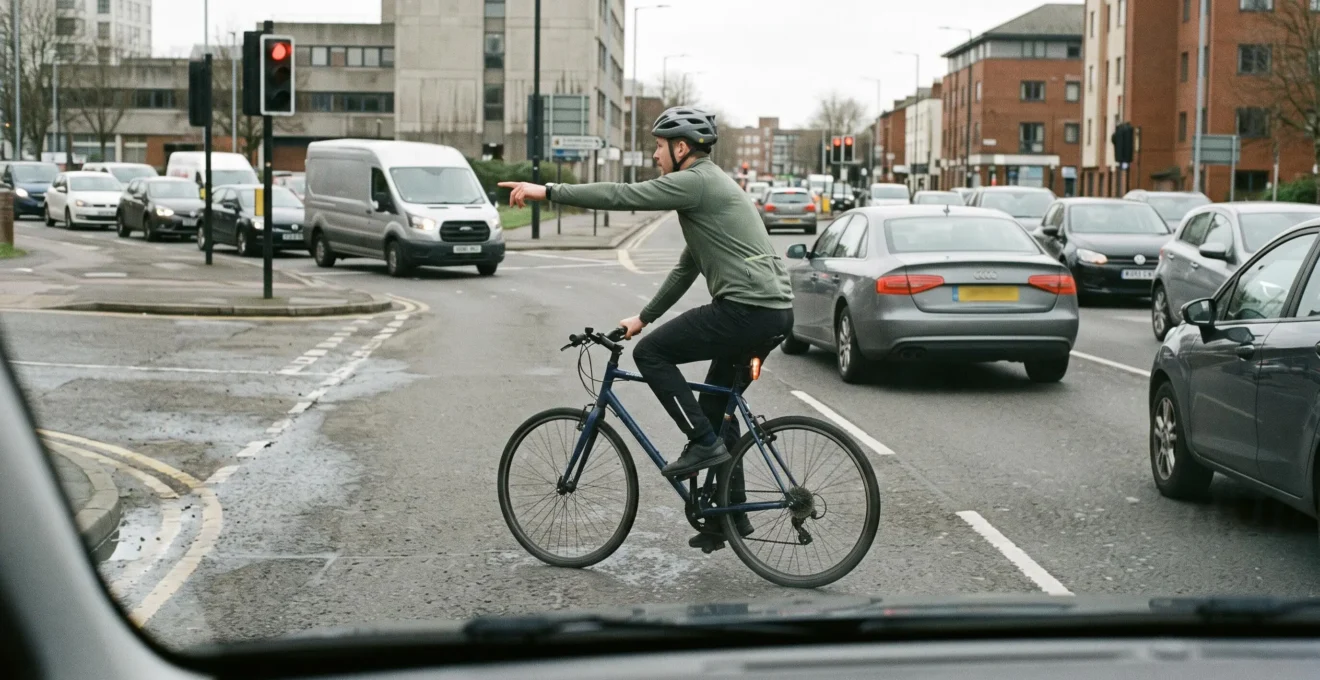
A hand signal is not a guarantee that a driver has seen you, understood your intention or left enough room for you to manoeuvre. In busy traffic, the safest approach combines a clear signal with early observation, a predictable riding line, appropriate speed and a willingness to wait when the gap is unsafe.
The problem is rarely just the arm movement. A driver may be watching oncoming traffic, looking for a gap to turn across your path or approaching from an angle where parked vehicles obscure you. Even a perfectly executed signal can fail if your road position contradicts it or you move before checking whether the manoeuvre is possible.
Effective signalling therefore starts before the arm rises. Choose a position that makes your intended movement understandable, check behind and around you, communicate early enough to be useful, and continue observing throughout the manoeuvre. Never assume that a signal gives you priority or that a driver will respond correctly.
The essentials of effective cycling hand signals
- Make your intention clear with a recognised signal, a consistent riding line and timely observation.
- Check behind before signalling, check again before moving, and abandon the manoeuvre if the available space is unsafe.
- At junctions, roundabouts and road narrowings, prioritise visibility, positioning and control over completing a signal at all costs.
- Why Do Drivers Still Pull Out Even When You Signal Clearly?
- How to Signal and Move Across a Lane Without Wobbling or Losing Control
- Which Hand Signal Works Best at Roundabouts: Traditional or More Assertive Cues?
- The “Late Signal” Mistake That Creates the Most Dangerous Overtakes
- When Should You Practise One-Handed Riding Before Using Hand Signals in Heavy Traffic?
- How to Approach Side-Road Crossings in a Protected Lane Without Being Invisible?
- How to Choose Your Lane Position With Fast Traffic Without Feeling Like a Target?
- How to Reduce Close Passes When You Must Ride With Fast Motorised Traffic
Why Do Drivers Still Pull Out Even When You Signal Clearly?
Drivers may pull out despite a clear cycling hand signal because they have not seen it, have misinterpreted your intention or are concentrating on another traffic conflict. A signal communicates what you intend to do; it does not prove that another road user has noticed you, understood the message or can react safely.
Visibility, timing and context determine how useful the signal is. A brief arm movement can be difficult to distinguish from normal riding, especially against a complicated background of vehicles and junctions. Extending the arm clearly and holding the signal while it remains safe to do so makes the intended direction easier to identify. There is no established universal recognition threshold of one or two seconds, however, and a longer signal cannot compensate for an obstructed sightline.
Drivers also divide their attention. A driver turning across your route may be judging a gap in oncoming traffic rather than looking for a cyclist approaching alongside the kerb. A queue of vehicles can hide you from a driver waiting at a junction, while sunlight, tinted windows, roadside vegetation and parked vehicles can further reduce visibility.
Think of a signal as one part of a communication package: your position, speed, direction of travel and arm movement should tell the same story. If you intend to continue straight, avoid a position or gesture that suggests an imminent turn. If you are turning, establish the intention early enough for other road users to recognise it without being forced into an immediate decision.
Eye contact can help establish that a driver may have noticed you, but it is not proof of comprehension or a promise to yield. A driver looking in your direction may be watching another vehicle, and a dark windscreen can make their attention impossible to assess reliably.
Before relying on a signal, ask yourself whether a driver approaching from the relevant direction could physically see your arm. If a vehicle, corner, hedge or blind approach blocks the view, change your speed or position where safe, increase the margin for error and prepare to stop. Never treat an apparently friendly gesture as permission to enter a conflict point.
The British government‘s guidance in the Highway Code’s guidance on signalling emphasises clarity, appropriate timing and checking that a signal will not mislead other road users. These principles are useful beyond Britain, but local traffic rules and recognised signals must be checked in the country where you ride.
When a signal does not produce the response you expected, the practical lesson is to reassess the situation rather than repeat the gesture more aggressively. The next decision should be based on the actual space available, the driver’s movement and your ability to remain in control.
A signal makes your intention clearer, but safe riding still depends on what happens around you. That is why the next priority is learning to signal without allowing the bicycle to drift into the path of traffic.
How to Signal and Move Across a Lane Without Wobbling or Losing Control
The safest general sequence for a lane change is to check behind, signal, check again and move only when the space is clear. This order lets you assess the traffic before communicating your intention, then verify that the situation has not changed before steering. If the gap closes, keep your line and wait rather than forcing the manoeuvre.
Observation must come before the arm movement. Looking behind first establishes whether a lane change is realistic and gives you an opportunity to identify an approaching vehicle. Signalling before this check can create an expectation that you are about to move even when the traffic leaves no safe space.
- Check behind. Look over your shoulder while keeping the bicycle as steady as possible. Assess the speed and position of following traffic, not just whether a car is present.
- Signal clearly. Use the recognised signal for your intended movement where it is safe to do so. Avoid a sudden arm flick or a gesture that you cannot maintain without losing control.
- Check again. Confirm that the gap remains available and that no vehicle has accelerated into it. A signal is not an instruction that makes a driver stop.
- Move smoothly. Make a controlled steering adjustment only when there is sufficient space. Avoid a sharp swerve or an abrupt change in speed.
- Re-establish your line. Return your hand to the handlebar when the signal is no longer needed and continue checking the surrounding traffic.
One-handed riding is a separate skill from lane changing. Practise holding a straight line with one hand while keeping your shoulders relaxed, your core stable and your steering inputs small. A tight grip or a sudden shift in upper-body weight can transmit movement to the handlebars.
Braking also needs practice. Removing a hand can reduce your control and your ability to operate the brakes. Do not assume you can brake effectively with the remaining hand under every condition, particularly on a steep descent, loose surface or wet road. Avoid signalling if doing so would compromise control.
There is no single lane-change sequence that makes every traffic situation safe. On a wide road with a clearly available gap, signalling before moving may be appropriate. If your current position is unsafe and the only available safe movement is to adjust your line within the same lane, prioritise control and observation. If the lane is occupied or a following vehicle is closing rapidly, wait for a better opportunity.
Pay particular attention to the vehicle behind you. A car that is gaining quickly may close the gap while your arm is extended. Wheel angle, gradual creeping and changes in closing speed can be useful practical clues, but they do not reliably establish a driver’s intention. If you cannot confidently judge the gap, do not commit.
Five steps to verify your lane-change readiness
- Practise a shoulder check on a quiet road and record whether your front wheel stays on a straight line.
- Hold a recognised hand signal while riding steadily and note any visible steering deviation.
- Repeat the exercise at a comfortable speed and confirm that you can return your hand to the handlebar without wobbling.
- Practise controlled deceleration separately with each hand only where safe, recording which conditions make braking difficult.
- Before attempting a real lane change, identify the following vehicle, confirm that the gap remains clear and be prepared to abandon the manoeuvre.
Good technique makes your movements more predictable, but it does not eliminate traffic conflicts. At roundabouts, where drivers approach from several directions and may be looking for an exit gap, the meaning and timing of the signal need particular care.
Which Hand Signal Works Best at Roundabouts: Traditional or More Assertive Cues?
At a roundabout, a recognised directional signal is generally the clearest way to communicate an intended turn or exit, provided it is used consistently with the applicable local rules. More assertive gestures may be misunderstood, and no hand signal can guarantee that a driver will yield. Lane choice, visibility, speed and the geometry of the roundabout remain critical.
Conventional signals communicate a defined intention. The official British Highway Code illustrates recognised arm signals for turning left, turning right, slowing down and stopping. Its illustrations are a useful reference for riders in the United Kingdom, but signal conventions and legal requirements may differ in other English-speaking countries.
An extended arm used as an improvised cue to mean “I am taking the lane” is different from a recognised turn signal. A driver may interpret it as a turn, a change of position or an unclear gesture. A 45-degree arm position sometimes used in cycling instruction is not established by the supplied official guidance as a universally recognised alternative. Neither gesture should replace a clear road position and appropriate observation.
The most useful approach depends on the roundabout’s layout.
| Roundabout context | Practical approach | Main limitation |
|---|---|---|
| Small, single-lane roundabout | Choose a position consistent with your intended route, use the locally recognised directional signal and watch for entering vehicles. | Drivers may focus on traffic coming from another direction rather than on a cyclist already circulating. |
| Multi-lane roundabout | Plan the route and lane choice before entering. Signal when safe and consistent with local rules. | A signal cannot resolve an unsafe lane crossing or compensate for a driver who has insufficient time to react. |
| Roundabout with a cycle lane or two-stage crossing | Follow the designated layout and markings, and use a separate safe crossing stage where the design requires it. | Drivers may overlook a cyclist travelling in a separated lane or misread the intended route. |
Entry and exit communication are separate tasks. A signal used to enter or circulate does not automatically tell an entering driver when you intend to leave. Where the local rules and your riding situation call for an exit signal, give it when your intended exit is clear and you can do so without compromising control. Keep observing vehicles that may cross your path.
At a fast, multi-lane roundabout, do not assume a driver can react to an arm signal at the last moment. If the layout leaves no safe path, use an appropriate alternative route or designated crossing where available. A two-stage crossing or dismounting may be safer than attempting a difficult manoeuvre in moving traffic.
The British government’s Highway Code’s illustrated arm signals provide a reference for recognised gestures. They do not establish that an improvised lane-claiming signal is more effective than a conventional signal, or that any gesture guarantees protection from a vehicle.
Roundabouts reward planning more than improvisation. The same principle applies to ordinary junctions: a signal is useful only when it arrives early enough to be understood without misleading the driver about where you will actually go.
The “Late Signal” Mistake That Creates the Most Dangerous Overtakes
A late signal gives following drivers too little time to understand your intended movement and adjust their approach. If you indicate only when you are already turning or moving across a lane, a driver may continue an overtake that is no longer safe. Signal early enough to communicate your intention, but not so early that it suggests a manoeuvre at the wrong junction.
Imagine approaching a junction on a road where a car is following closely. If you begin turning before the driver has recognised your intention, the driver may brake abruptly, steer around you or attempt to pass through a shrinking gap. The risk comes from the combination of timing, road geometry, speed and the available escape space; the supplied guidance does not quantify how often late signals cause close passes.
Use a contextual timing rule, not a fixed number of seconds. Consider the road speed, the driver’s sightline, the distance to the decision point and the complexity of the manoeuvre. A signal needs to be visible before the driver must decide whether to slow, wait or change position. Higher speeds and restricted sightlines generally leave less opportunity for a late correction.
Equally, an excessively early signal can confuse other road users. A driver may assume you are turning into an intervening side road, while you intend to continue to the next one. The British Highway Code explicitly warns against signalling at a time that could mislead others and advises cancelling a signal when it is no longer needed.
A practical approach is to identify the actual decision point before you reach it. For a turn, establish your intention while you are still able to ride steadily and observe the surrounding traffic. For a lane change, make the signal part of the observation sequence rather than an automatic movement that commits you to a gap.
Do not judge timing only by the nearest car. A second vehicle may follow closely behind the first, and its driver may have a different view of your position. That possibility is a reason to make your intentions clear and maintain a predictable line, not evidence that every vehicle in a queue will behave in the same way.
After the manoeuvre, stop signalling when it no longer communicates your current intention. If the route changes or the first signal has become misleading, reassess the situation before giving a new one. Never preserve a signal simply because you started it earlier.
Timing becomes reliable through practice, but practising in heavy traffic is not the right starting point. First establish that you can ride one-handed, brake and maintain a straight line without allowing the signal itself to destabilise the bicycle.
When Should You Practise One-Handed Riding Before Using Hand Signals in Heavy Traffic?
Practise one-handed riding on a quiet, predictable road or in an appropriate traffic-free area before relying on hand signals in heavy traffic. You are ready to progress when raising and lowering your arm no longer changes your line or speed, and you can observe behind you without losing control. If the bicycle wanders or braking becomes unreliable, return to easier practice.
One-handed riding requires more than lifting an arm. You must maintain a stable upper body, make small steering corrections and keep enough control to respond to the road surface. Your ability can change with speed, fatigue, weather, luggage and the position of your hands on the bars.
Build the skill progressively:
- Stage 1: Straight-line stability. Ride slowly in a traffic-free area, remove one hand briefly and return it to the bar. Check whether the front wheel remains on a consistent line.
- Stage 2: Controlled arm movement. Lift and lower the arm without a visible change in direction or speed. Repeat on a smooth surface at a comfortable pace.
- Stage 3: Sustained signalling. Hold the recognised signal for several seconds while maintaining a straight line. Stop the exercise if you need to make large steering corrections.
- Stage 4: Observation and signalling. Practise a shoulder check followed by a signal, then look forward and reassess the space around you.
- Stage 5: Controlled deceleration. Only in a suitable safe setting, practise reducing speed and understand how much braking control remains when one hand is off the bar.
Passing these stages does not automatically make you ready for every traffic condition. Gusty crosswinds, wet or uneven surfaces, steep descents and heavy braking zones can make one-handed riding substantially harder. If the signal would compromise your ability to steer or stop, do not attempt it. Use a controlled road position, reduce speed where appropriate and wait until communication is safe.
Progress from quiet roads to low-speed junctions, then to more complex environments only when the basic movement remains stable. Do not introduce several new challenges at once. A busy junction, a fast following vehicle and a one-handed lane change demand more attention than a simple signal on a quiet street.
Richmond Council‘s safe cycling guidance emphasises looking behind before communicating an intention or changing road position, and checking that there is sufficient time and space to move. This practical advice supports the observation-first approach, although it does not establish precise performance thresholds for readiness.
Confidence should come from repeatable control rather than from forcing yourself to signal in every situation. Once your technique is stable, the next challenge is recognising that even a skilled rider can be difficult to see in a protected cycle lane.
How to Approach Side-Road Crossings in a Protected Lane Without Being Invisible?
A protected cycle lane can improve separation from moving traffic while leaving cyclists less visible to drivers emerging from side roads. Kerbs, parked cars, planting and the angle of the junction can obstruct the driver’s view. Approach these crossings expecting that a driver may not have seen you, use a clear signal when appropriate and reduce speed enough to respond safely.
The central problem is the sightline. A driver preparing to enter a main road may look for vehicles in the motor-traffic lane without fully checking the separated cycle track. A cyclist travelling behind a row of parked cars or vegetation can appear suddenly at the crossing point, even when the cyclist has been visible from farther away.
Before reaching the junction, look for evidence that the driver is approaching the crossing. A vehicle creeping forward, an angled front wheel or a bonnet beginning to overhang the crossing can be useful warning signs. These are observations, not reliable predictions: a stationary car may move, and a moving car may stop.
If you intend to continue straight through the crossing, a clear left-arm signal may communicate that intention where the signal is appropriate under local conventions. It must not suggest that you are turning into the side road. More importantly, it cannot make an obscured cyclist visible or force a driver to give way.
Adjust your speed to the visibility available. If you can see the driver but cannot tell whether the vehicle will enter your path, prepare to slow or stop. Where a vehicle is already crossing your route, do not rely on the signal to carry you through the remaining gap. Wait until the conflict has cleared.
Parked vehicles create a particularly difficult variation. They can block the driver’s view of the cycle lane while also reducing your own view of the junction. Where the lane design and local rules permit, a position with a better sightline may help. Do not move outside a protected lane into moving traffic merely to become more visible unless the manoeuvre itself is safe and lawful.
Be cautious when a cycle track bends away from the carriageway near a side road. The changing angle can make you less obvious to a turning driver. A predictable line, an appropriate speed and early observation provide more useful protection than assuming that physical separation guarantees visibility at every crossing.
In some situations, stopping is the correct decision. If the sightline is severely obstructed, a vehicle is edging across the cycle lane or you cannot establish that the crossing is clear, pause before the conflict point. A signal-and-hope approach transfers the decision to a driver whose attention and intentions you cannot verify.
Visibility at a junction depends partly on the road layout and partly on the cyclist’s approach. On roads without protected infrastructure, the position you choose in the lane can also determine whether drivers recognise you as a road user with a predictable path.
Key takeaways
- Choose a road position that makes your path predictable and gives you room to respond to hazards.
- Use the centre of the lane when the available width, a junction or a narrowing makes an overtake unsafe, provided doing so is safe and appropriate.
- When faster traffic can pass safely, allow room where possible without moving so close to the kerb that you lose visibility, control or an escape route.
How to Choose Your Lane Position With Fast Traffic Without Feeling Like a Target?
Choose your lane position according to the space available, traffic speed, visibility and the likelihood of a safe overtake. Riding too close to the kerb can invite drivers to squeeze past within an inadequate gap, while taking the centre of the lane can make an unsafe overtake less feasible. Neither position is right for every road; consistency and active observation matter.
Your road position communicates before your hand signal does. A clear, steady line helps drivers anticipate where you will be. A cyclist who repeatedly moves between the kerb and the lane centre without an obvious reason may be harder to predict, even when each movement is individually intended to improve safety.
Consider four factors before choosing a position:
| Factor | Position to consider | What to assess |
|---|---|---|
| Wide lane with good visibility | A position that permits a safe pass while maintaining a usable safety margin. | Whether the driver can overtake with sufficient room without forcing you towards the kerb. |
| Narrow lane or road narrowing | A more central position may be appropriate if passing within the lane would be unsafe. | Whether a following driver must wait until the road widens or another safe passing opportunity appears. |
| Junctions and side roads | A position that makes your intended route visible and avoids inviting a dangerous pass at the conflict point. | Turning traffic, blocked sightlines and whether you can maintain a predictable path. |
| Clear stretch with faster following traffic | Where safe, allow faster vehicles to pass without surrendering necessary space. | The speed difference, road width, surface condition and whether moving aside would create a new hazard. |
The British Highway Code’s cycling guidance supports this conditional approach. It advises riding in the centre of the lane in circumstances such as junctions, narrowings and slower-moving traffic when overtaking would be unsafe. On busy roads with faster traffic, it advises allowing overtaking where safe while maintaining separation from the kerb. These are British guidelines, not universal legal requirements for every English-speaking country.
Fear can encourage riders to hug the kerb, but that position may leave little room for drainage covers, debris, potholes or parked-car doors. A deliberate position should preserve the space you need to ride predictably and respond to hazards. The appropriate clearance from the kerb depends on the road and local conditions; no single distance is suitable everywhere.
Position changes should be deliberate. Check behind before moving laterally, communicate the intended movement when safe and make the adjustment smoothly. If the road narrows, establish an appropriate position before the pinch point rather than waiting until a vehicle is already alongside you.
Taking a central position is not a guarantee that every driver will wait, and it should not be used to provoke a confrontation. If a safe passing opportunity becomes available, allowing traffic through can be sensible. The objective is to make a safe overtake possible when conditions permit, not to hold a particular position regardless of the circumstances.
Confidence develops when you can explain why you are in a particular position. Instead of asking whether a driver behind you is annoyed, ask whether there is enough room for a safe pass and whether your current line gives you the control and visibility you need. If the answer changes as the road changes, a controlled position change may be appropriate.
Positioning makes your intentions easier to anticipate, but it cannot remove every close-pass risk. At narrow sections, bridges, bollards and traffic islands, the next task is to manage the available passing space without making an unsafe gesture or sudden movement.
How to Reduce Close Passes When You Must Ride With Fast Motorised Traffic
To reduce close passes on roads with fast motor traffic, make your riding line predictable, preserve the space needed to remain in control and avoid inviting an overtake where the available width is inadequate. Signal early before a narrowing when appropriate, observe following traffic and wait for a safer passing opportunity rather than relying on an arm gesture to create protection.
A close pass can occur when a driver misjudges the space needed, overlooks the cyclist or attempts to overtake in a location that does not provide enough room. Communication can help, but not every close pass is a communication failure, and no signal can guarantee that a driver will behave safely.
Use a layered approach. First, choose a line that gives you room to ride without weaving around the edge of the road. Second, look ahead for pinch points where a vehicle cannot pass safely alongside you. Third, observe the traffic behind and avoid making a sudden lateral movement into a space that a vehicle is already occupying.
At a bridge, traffic island or bollard narrowing, the key decision is often whether the road offers enough room for a safe pass at all. If not, an appropriate lane position may make it clearer that the driver needs to wait. Establish that position before the road becomes narrow, provided the movement is safe. A late move can surprise a following driver and leave both road users with fewer options.
An extended arm is not a proven physical barrier against an overtaking vehicle. It can be misunderstood, and extending it sideways may place your hand close to traffic. Use recognised signals for their intended meanings, not as a guarantee that a driver will leave extra room. When the road is too narrow for a safe pass, road position and an early, predictable approach are more important than an improvised gesture.
After a close pass, prioritise control. Maintain a steady line if you can do so safely; avoid an abrupt brake application or a retaliatory gesture that diverts your attention. If the vehicle has forced you into an immediate hazard, take whatever controlled evasive action is necessary to avoid a collision. Once safe, note the location and conditions that contributed to the incident.
Use that observation to improve the next ride. If a particular road repeatedly produces close passes at a pinch point, consider a different route, a different time or a safer way to approach the narrowing. If reporting is appropriate, follow the relevant local procedure and record factual details rather than assumptions about the driver’s intentions.
The practical goal is not to make every driver react perfectly. It is to make your intentions easier to understand, preserve enough room to stay in control and recognise when the safest choice is to wait or take another route. Review one difficult section of your regular journey at a time, and practise the relevant skill in a quiet environment before applying it in faster traffic.
Should I hold my arm out until a driver reacts?
No. Hold a clear, recognised signal while it remains safe and useful, but do not interpret a lack of response as a reason to keep your arm out indefinitely. Keep observing the road, maintain control of the bicycle and proceed only when the manoeuvre is safe. Return your hand to the handlebar when the signal is no longer needed.
Does giving a hand signal mean I have priority?
No. A hand signal communicates your intended movement; it does not automatically give you priority over other road users. Check the applicable road rules, assess the available gap and confirm that the manoeuvre can be completed safely before moving.
What should I do if I cannot signal without wobbling?
Do not force the signal if it compromises your control. Practise one-handed riding in a suitable quiet area, starting with brief arm movements and a steady straight line. In traffic, prioritise a controlled speed and predictable position, and wait for a safer opportunity to communicate and manoeuvre.
Should I ride in the centre of the lane to stop drivers overtaking closely?
A central lane position can be appropriate when the road is narrow, at a junction or where an overtake would be unsafe. It is not the right choice in every situation. Consider road width, traffic speed, visibility, obstructions and local rules, and allow faster traffic to pass when doing so is safe.
Are cycling hand signals the same in every English-speaking country?
No. Recognised gestures, legal requirements and road conventions can differ between countries and jurisdictions. Use the official cycling guidance applicable where you ride, and do not assume that a gesture shown in the British Highway Code has identical legal status everywhere.