A cyclist loses balance at a junction, tips sideways and strikes the road at a modest speed. Another rider crashes downhill, hitting the ground much harder. Which rider benefits more from a MIPS helmet?
The answer is not simply the slower rider. MIPS, a helmet technology designed to help manage rotational motion during certain angled impacts, can be relevant in either situation. What matters is how the helmet contacts the surface, how the head moves during impact and how the complete helmet performs under those conditions. Bicycle speed alone cannot predict rotational loading or injury severity.
That distinction matters when deciding whether to spend more on a rotational-impact liner. A properly fitted conventional helmet may be a better purchase than a poorly fitting MIPS model. Conversely, when two suitable helmets offer comparable comfort and conventional protection, additional rotational-impact management can be a sensible reason to choose one over the other.
The practical decision is therefore less about buying a particular badge and more about assessing helmet performance, fit, coverage and the situations in which a rider actually cycles.
MIPS helmets: the essential points
- Low-speed falls can produce substantial rotational head motion, but MIPS is not inherently more effective at low speeds than at high speeds.
- A certified helmet that stays correctly positioned and fits comfortably should take priority over an optional feature that compromises fit.
- Independent helmet testing, thoughtful replacement decisions and consistent riding habits provide a stronger basis for choosing protection than marketing demonstrations alone.
- Why Are Rotational Impacts So Common in « Simple » Falls at Low Speed?
- How to Tell if a MIPS Helmet Fits Properly Without Creating Hot Spots?
- Which Should You Choose on a Budget: Better Fit and Coverage or MIPS?
- The Safety Tech Assumption That Makes Some Riders Take Bigger Risks
- When Does It Make Sense to Upgrade to MIPS if You Mostly Ride on Cycle Paths?
- How to Fit-Check a Helmet at Home in 3 Minutes Without Special Tools?
- Why Are Moving Reflectors Seen So Much Earlier Than Reflective Panels?
- Which Helmet Protection Features Matter Most if You Ride in Traffic 5 Days a Week?
Why Are Rotational Impacts So Common in « Simple » Falls at Low Speed?
Low-speed bicycle falls often involve angled contact between the helmet and the ground. When that contact produces friction and changes the head’s direction of motion, the head can experience rotational acceleration as well as a linear impact. Even a relatively slow fall can therefore involve rotational loading, although its magnitude depends on the complete crash circumstances.
Consider a hypothetical rider travelling at 15 km/h whose front wheel slips across a wet metal cover. The bicycle moves sideways, the rider falls and the helmet contacts the road at an angle. The interaction between the helmet surface and the road can generate a turning force on the head.
A second rider travelling faster might strike a surface at a different angle or experience a combination of sliding and direct impact. The faster crash may involve greater overall danger, but travelling speed alone does not establish which impact generates greater head rotation.
Two physical quantities need separating:
- Linear impact loading: influenced by the velocity of the head at contact, impact direction, surface properties, helmet deformation and the dynamics of the fall. The rider’s fall height can contribute substantially, but bicycle speed is not irrelevant.
- Rotational loading: influenced by tangential forces, contact geometry, friction, head motion and how forces act around the head’s centre of mass.
This is why a sudden loss of balance at a pedal clip, an emergency braking manoeuvre or a wheel catching in a tram track can generate an oblique impact without an especially high travelling speed. However, neither a universal percentage of oblique cycling impacts nor a consistent equivalence between slow and fast crashes can be established from these examples.
MIPS addresses part of this problem through a low-friction mechanism intended to permit relative movement during certain angled impacts. The manufacturer’s technical explanation of its low-friction safety system describes approximately 10–15 mm of relative movement under relevant impact conditions. This is an impact-design characteristic, not a fitting-test requirement or a guaranteed movement distance in every crash.
Independent testing offers an additional perspective. Virginia Tech‘s independent bicycle helmet ratings assess complete designs using 24 laboratory impacts, incorporating both linear acceleration and rotational head motion in their evaluation. The methodology does not demonstrate that MIPS matters more at low speed than at high speed.
Rotational protection deserves consideration at any riding speed, but it should be judged as part of the complete helmet. The next question is whether that helmet actually fits the person wearing it.
How to Tell if a MIPS Helmet Fits Properly Without Creating Hot Spots?
A properly fitted MIPS helmet should feel secure, level and comfortable without concentrated pressure on the forehead, temples or other areas. The shell should not slide loosely around the head during ordinary movement. The internal slip mechanism is designed primarily for impact conditions, so visible movement during a shop fitting is not a reliable measure of its effectiveness.
Begin by trying the helmet in the intended size, with the retention system loosened enough to position it correctly. Place it level on the head, then adjust the rear retention dial according to the manufacturer’s instructions.
The helmet should contact the head evenly rather than squeezing just two points. A rider with a relatively round head may experience temple pressure in a shell designed for a more oval shape, while another may feel excessive pressure at the front or back.
MIPS-equipped helmets can have different internal structures, padding arrangements and retention systems. Some riders may notice these differences, but no general rule establishes that MIPS helmets use thinner comfort foam or fit worse than comparable conventional helmets.
During an in-store fitting:
- Check whether the helmet sits level without immediately developing pressure points.
- Adjust the retention system and fasten the straps before performing the final stability test.
- Move the head gently from side to side and check that the entire helmet remains correctly positioned.
- Try another size or shell shape if the helmet shifts excessively or feels uncomfortable.
If possible, wear the helmet for 20–30 minutes as a practical comfort trial. This is a useful shopping precaution, not a clinically validated test duration. Persistent forehead discomfort, temple pressure or noticeable localized redness should prompt reconsideration of the fit.
Do not deliberately loosen a helmet to compensate for painful contact points. That can compromise stability without resolving the underlying shape mismatch.
The low-friction layer should also not be manually altered, removed or repositioned. The relative movement described in manufacturer impact testing cannot be translated into a universal 1–2 mm allowance during normal head movements.
A helmet that remains comfortable and stable throughout normal use is more likely to be worn correctly. That makes fitting especially important when comparing models within a limited budget.
Which Should You Choose on a Budget: Better Fit and Coverage or MIPS?
On a restricted budget, choose a helmet that meets the applicable safety standard, fits securely and provides appropriate coverage before paying extra for MIPS. A rotational-impact feature cannot compensate for a helmet that is routinely worn too loose, sits incorrectly or feels uncomfortable. When both helmets fit equally well, independent impact-test performance can help break the tie.
A comparison between two budget helmets should consider more than the presence or absence of a yellow MIPS logo. Some conventional helmets perform well in rotational-impact tests, while helmets equipped with rotational technology can differ significantly in their overall results.
For example, imagine two equally priced models. Helmet A includes MIPS but produces uncomfortable temple pressure. Helmet B lacks MIPS but fits evenly, stays correctly positioned and offers appropriate coverage. Helmet B is the more practical choice for that particular rider, provided it meets the required safety standard. This does not prove that its impact protection is universally superior.
Rear and side coverage also deserve attention. A shell that extends farther around the lower rear portion of the head may be attractive for urban use, but visible coverage alone cannot establish impact-test performance.
The following comparison is a practical buying framework, not a formally established hierarchy of injury-prevention effectiveness.
| Buying criterion | Why it matters | Practical decision |
|---|---|---|
| Applicable certification | Establishes compliance with a relevant minimum safety standard | Reject helmets without suitable certification |
| Fit and retention | Help the helmet remain correctly positioned | Reject models that move excessively or create persistent pressure |
| Coverage | Determines which areas the shell is designed to cover | Compare coverage while ensuring correct fit and helmet positioning |
| Independent impact performance | Provides evidence about complete helmet behaviour under specific tests | Compare tested models using the same rating methodology |
| MIPS or similar technology | May help manage rotational motion under certain impact conditions | Consider it when overall protection and fit remain satisfactory |
Certification requirements differ across English-speaking markets. In the United States, bicycle helmets are subject to the Consumer Product Safety Commission standard. Other markets may use standards such as EN 1078 or AS/NZS 2063, depending on the country and applicable regulations.
A clearance promotion also deserves scrutiny. Check the manufacturer’s dating information, product condition, safety documentation and replacement guidance. An older discounted model is not automatically unsafe, but the presence of a rotational liner should not distract from its age, fit or history.
Buying the right helmet is only part of the decision. The protection it offers should not change how much avoidable risk a cyclist is willing to accept.
The Safety Tech Assumption That Makes Some Riders Take Bigger Risks
The risky assumption is that a helmet with advanced protection technology makes dangerous riding behaviour acceptably safe. This reflects the concept of risk compensation, in which people may adjust their behaviour in response to perceived protection. However, there is no basis here for claiming that MIPS users generally ride more aggressively or that buying a rotational-impact helmet necessarily increases risk-taking.
Consider a hypothetical commuter who purchases a new helmet and starts following vehicles more closely, believing that better helmet technology makes a collision less consequential. The behaviour has changed, but the helmet has not made the surrounding traffic safer.
The same mistake could occur when entering intersections without sufficient observation or descending faster than the rider’s visibility and stopping distance allow.
MIPS is designed to manage a component of head motion during certain angled impacts. It does not eliminate linear impact forces, prevent collisions or make a rider immune to concussion, skull fracture or other injuries.
Laboratory demonstrations are useful for explaining a mechanism. Instrumented headforms, high-speed video and computational modelling can help examine rotational behaviour under controlled conditions. But those demonstrations should not be interpreted as observed reductions in concussion incidence among everyday riders.
The manufacturer itself acknowledges that its technology cannot prevent every concussion or other injury. Independent helmet ratings likewise do not guarantee the outcome of any individual crash.
A useful self-check is to ask: What riding behaviours changed after buying the helmet?
- Are following distances shorter because the helmet feels more protective?
- Has downhill speed increased without any corresponding improvement in visibility or control?
- Are junctions approached with less caution?
- Is the helmet being used as justification for situations previously considered too dangerous?
These questions are intended for personal reflection, not as a validated test of risk compensation. A rider who has not changed their behaviour can simply treat the additional helmet technology as another possible layer of protection.
A helmet should mitigate consequences when prevention fails, not replace prevention. That distinction becomes especially relevant for riders who spend most of their time on apparently quiet cycle paths.
When Does It Make Sense to Upgrade to MIPS if You Mostly Ride on Cycle Paths?
Upgrading to MIPS can make sense for cycle-path riders when their existing helmet needs replacing, when a new MIPS model fits better or when independent testing favours a suitable alternative. Quiet routes do not eliminate angled falls, but replacing a recent, undamaged, correctly fitting helmet solely to obtain MIPS is not automatically necessary.
Dedicated cycling routes reduce some interactions with motor traffic, yet other hazards remain. Wet leaves, loose gravel, abrupt steering, unexpected pedestrians and poorly designed surface transitions can all contribute to a fall.
These incidents may involve angled head contact even at moderate cycling speeds. That provides a physical rationale for considering rotational-impact management, without establishing a specific reduction in real-world injuries for cycle-path riders.
The first question should be whether the current helmet remains suitable. Replacement is appropriate after an impact when instructed by the manufacturer, including cases where damage is not visible. Replacement is also warranted if there are cracks, compromised components or a retention system that no longer works correctly.
Age deserves a more careful assessment. Five years is a common replacement benchmark, but it is not a universal legal expiry date. Manufacturers differ in their recommended service lives, and use, storage and condition matter. Consult the instructions for the specific model rather than treating every fifth anniversary as automatic evidence of failure.
A practical decision sequence is:
- If the helmet has sustained a relevant impact or shows damage, replace it according to manufacturer guidance.
- If it no longer fits correctly or its retention system is compromised, seek a suitable replacement.
- If the helmet is approaching or beyond its manufacturer’s recommended service life, assess replacement accordingly.
- If replacement is already justified, compare appropriate helmets with and without rotational-impact technology.
- If the existing helmet remains serviceable and fits well, consider whether other safety needs deserve attention first.
Price premiums vary between brands, shops, models and promotions, so a universal MIPS surcharge would be misleading. Compare actual local prices for models with similar specifications rather than assuming the rotational liner explains every difference.
For a frequent commuter with inadequate lighting, spending available money on effective bicycle lights may address a more immediate visibility problem. A rider who already has suitable lighting and a replacement helmet budget may reasonably place greater value on a model with good independent impact-test results and rotational-impact technology.
Before committing to any upgrade, a short fitting check can establish whether a new or existing helmet is positioned securely enough for normal use.
How to Fit-Check a Helmet at Home in 3 Minutes Without Special Tools?
A three-minute helmet check can identify common positioning, retention and strap-adjustment problems without specialist equipment. Position the helmet level, adjust its rear retention system, check the side and chin straps, then test whether it rocks excessively. The goal is stable positioning without discomfort, using the helmet manufacturer’s instructions as the final reference.
The US National Highway Traffic Safety Administration provides official bicycle helmet fitting instructions covering helmet position, side-strap adjustment, chin-strap tension, stability and replacement after a crash. Its guidance provides the basis for the following practical check.
First 30 seconds — position the helmet. Place it level on the head rather than tipped backward. Its front edge should sit approximately one or two finger-widths above the eyebrows. Check the position in a mirror.
Next 30 seconds — adjust the retention system. Tighten the rear dial or other fitted adjustment mechanism until the helmet feels secure but not painfully tight. If it requires excessive pressure to remain stable, the shell shape or size may be unsuitable.
Next 45 seconds — arrange the straps. The side straps should form a V just below and slightly in front of each ear. Fasten the chin strap and adjust it so that no more than one or two fingers fit beneath it, following the manufacturer’s specific instructions.
Next 45 seconds — test stability. Gently try to rock the helmet forward and backward. It should not move excessively or expose the forehead. Open the mouth widely; the correctly adjusted chin strap should produce a noticeable downward pull on the helmet.
If the helmet rocks backward, check its position and front strap adjustment. If it rocks forward into the eyes, check the rear strap adjustment. If it shifts excessively sideways, reassess the retention system, shell size and strap arrangement rather than assuming that turning the dial alone will always solve the problem.
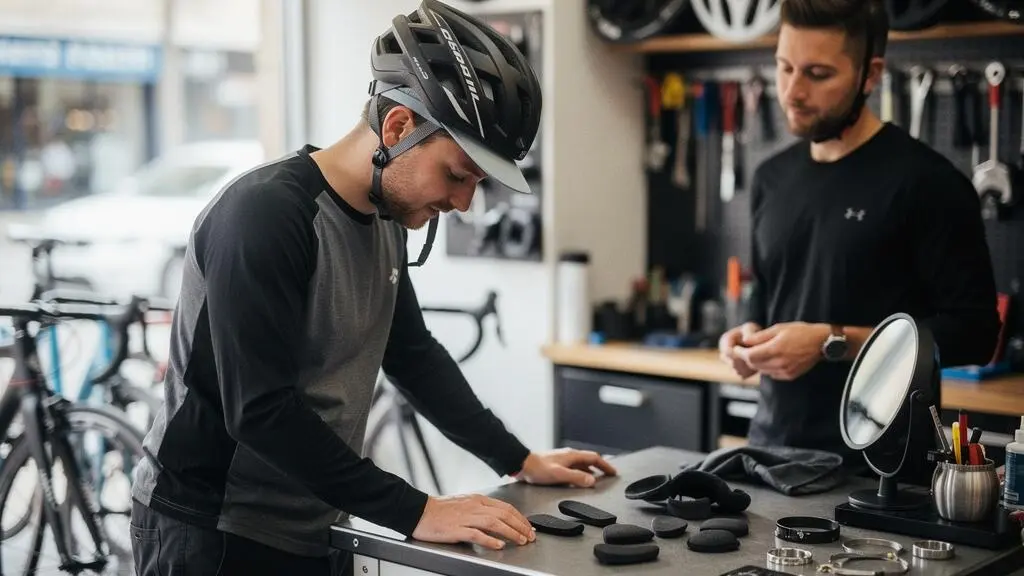
For clarity, the final stability and open-mouth tests should be completed with the chin strap correctly fastened, even though the supplied editorial image depicts unbuckled straps. An unfastened strap cannot demonstrate whether the complete helmet is adequately retained.
Perform the same check on a MIPS-equipped helmet. Movement within the low-friction mechanism during impact does not justify a loose shell or unstable retention system during ordinary wear.
Your five-point helmet fit-check checklist
- Position the helmet level and verify in a mirror that its front edge is approximately one or two finger-widths above the eyebrows. Result: the helmet is not tipped back.
- Adjust the rear retention system and gently turn the head. Result: the helmet remains stable without uncomfortable pressure.
- Arrange both side straps into a V below and slightly in front of each ear. Result: neither ear is obstructed by an incorrectly positioned strap junction.
- Fasten and adjust the chin strap, then open the mouth widely. Result: the strap is snug and creates a downward pull on the helmet.
- Perform gentle forward, backward and sideways stability checks. Result: the helmet does not rock excessively or shift out of position.
Repeat the check periodically, particularly after adjusting the straps, changing padding or returning to a helmet stored for an extended period. Avoid excessive heat and follow the manufacturer’s storage guidance.
Once helmet fit is reliable, attention can turn to measures that help other road users recognize a cyclist before a collision occurs.
Why Are Moving Reflectors Seen So Much Earlier Than Reflective Panels?
Reflective markings on moving parts of a cyclist can make the rider easier for approaching drivers to recognize at night because their movement provides information about human motion. Research supports this effect for specific lower-leg reflector arrangements, but moving reflectors are not universally detected earlier than all static reflective surfaces. Visibility depends on lighting, positioning, viewing direction and road conditions.
A stationary reflective panel returns light toward its source when illuminated from a suitable direction. A reflector attached to a moving ankle or pedal changes position as the cyclist moves, potentially creating a recognizable pattern.
That pattern can help an approaching driver interpret what they are seeing as a person cycling rather than an unidentified reflective object.
A 2022 experimental study on cyclists’ night-time visibility examined recognition by 15 young licensed drivers on a closed road at night. The cyclist pedalled in place while facing approaching vehicles.
The researchers compared configurations involving bicycle lighting and reflective clothing. Retroreflective lower-leg markings improved recognition distances relative to the tested vest-only arrangements. The effect also depended on the lighting configuration.
15 drivers
The number of young licensed drivers participating in the controlled night-time recognition experiment. The findings describe detection under specific test conditions, not a representative estimate of collision prevention across all road users.
Wood, Black and Tyrrell, Transportation Research Part F: Traffic Psychology and Behaviour, 2022.
This is evidence for the potential benefit of highlighting biological motion, not proof that any rotating wheel reflector will outperform every static panel. Nor does it establish a universal ranking of steady lights, moving reflectors and fixed reflective clothing.
Front and rear bicycle lights serve a different and often legally required role from retroreflectors. The appropriate combination depends on the country, light conditions, traffic direction and local equipment rules. Reflective features should supplement required lighting rather than replace it.
Helmet-mounted reflective materials may also help visibility in some circumstances. The helmet’s movements differ from the regular pedalling motion of the lower legs, but that distinction does not make reflective helmets ineffective.
For riders exposed to traffic throughout the working week, visibility and impact protection belong in the same purchasing conversation, while addressing different stages of crash risk.
Key takeaways for frequent commuters
- Evaluate helmets as complete protective systems: applicable certification, secure fit, appropriate coverage and independent impact-test performance.
- Choose the additional protective technology that fits the intended use without compromising comfort or daily wearability.
- Maintain lighting, visibility equipment and riding discipline because preventing a collision addresses risks that a helmet cannot eliminate.
Which Helmet Protection Features Matter Most if You Ride in Traffic 5 Days a Week?
For someone cycling in traffic five days a week, the most useful helmet is one that meets the applicable safety standard, fits securely, provides appropriate coverage and is comfortable enough to wear consistently. Independent impact-performance results can guide the choice between suitable models. MIPS is a worthwhile feature to evaluate, but it should not outrank fundamental fit and helmet condition.
Frequent commuting creates repeated exposure to road conditions, vehicle interactions and routine equipment wear. It does not establish that commuters experience predominantly low-severity or multiple-impact crashes, but it does make regular inspection and reliable daily use especially relevant.
Urban riders may encounter angled falls, direct impacts and complex collisions involving more than one contact. No helmet can be expected to manage every possible sequence equally well.
A practical shopping hierarchy for this profile is:
- Applicable safety certification and serviceable condition. Confirm that the helmet is suitable for cycling in the relevant market, has no known damage and remains within the manufacturer’s recommended usage conditions.
- Fit, retention and coverage. Select a shell that can be adjusted comfortably and stays in position during normal movement.
- Independent impact-test performance. Where available, compare complete helmet designs under a consistent methodology that includes rotational as well as linear impact assessment.
- Rotational-impact technology. Consider MIPS or another tested design feature when it improves the available options without undermining the fundamentals.
- Commuter conveniences. Evaluate compatible lights, reflective details, weather protection, ventilation and other features according to actual riding conditions.
This is a practical editorial decision framework, not an established scientific ranking showing that every lower item prevents fewer injuries than the one above it.
One distinction is particularly important: ordinary bicycle helmet certification should not be confused with certification for repeated impacts. Conventional cycling helmets are generally not intended to be reused after an impact that may have compromised their protective structure. A product should not be described as certified multi-impact protection unless its specific standard and intended use support that description.
That is why regular commuters should inspect helmets following incidents and follow replacement instructions even when the outer shell appears intact.
The same care applies to comfort. An excessively warm or poorly fitting helmet may encourage inconsistent use or repeated loosening of its retention system. Ventilation and weight therefore remain legitimate purchasing considerations, even when impact protection is the main priority.
A commuter comparing two equally comfortable certified helmets can use independent performance data to identify meaningful differences. A MIPS-equipped option that performs well in relevant tests may be attractive, but the logo alone cannot reveal how it compares with a conventional alternative.
Before buying, compare two or three correctly fitting helmets, check their applicable safety markings and review available independent ratings. Select the one that combines reliable protection, comfort and practical daily use rather than paying for a technology label in isolation.
Does a MIPS helmet prevent concussions?
No helmet can guarantee concussion prevention. MIPS is designed to reduce rotational motion transferred to the head during certain angled impacts. Laboratory measurements may show improvements under specified conditions, but these should not be presented as guaranteed reductions in individual concussion risk.
Can a helmet without MIPS provide good rotational-impact protection?
Yes. The rotational behaviour of a helmet depends on its complete construction, materials and interaction with the impact surface. A conventional helmet may perform well in independent oblique-impact testing. Compare complete helmet ratings rather than assuming the presence or absence of MIPS determines every result.
Should a MIPS liner move when the helmet is shaken by hand?
Not necessarily. The low-friction mechanism is intended to function under particular impact conditions, and its advertised relative movement is not a normal fitting-test measurement. The complete helmet should remain stable when correctly adjusted. Avoid manually forcing or modifying its internal components.
Is a five-star helmet rating equivalent to a guaranteed level of injury prevention?
No. Virginia Tech’s STAR ratings compare helmet performance under specified laboratory conditions. Lower STAR scores indicate better performance within that testing system, and the laboratory recommends four- and five-star models. Ratings do not predict the outcome of an individual crash or establish an exact percentage reduction in real-world injuries.
Can a MIPS helmet be reused after a minor fall?
Do not assume that a minor-looking collision leaves the helmet safe to reuse. Protective structures can be damaged without obvious external signs. If the helmet has experienced an impact, follow its manufacturer’s replacement guidance. A rotational-impact liner does not make a standard bicycle helmet automatically reusable after a crash.