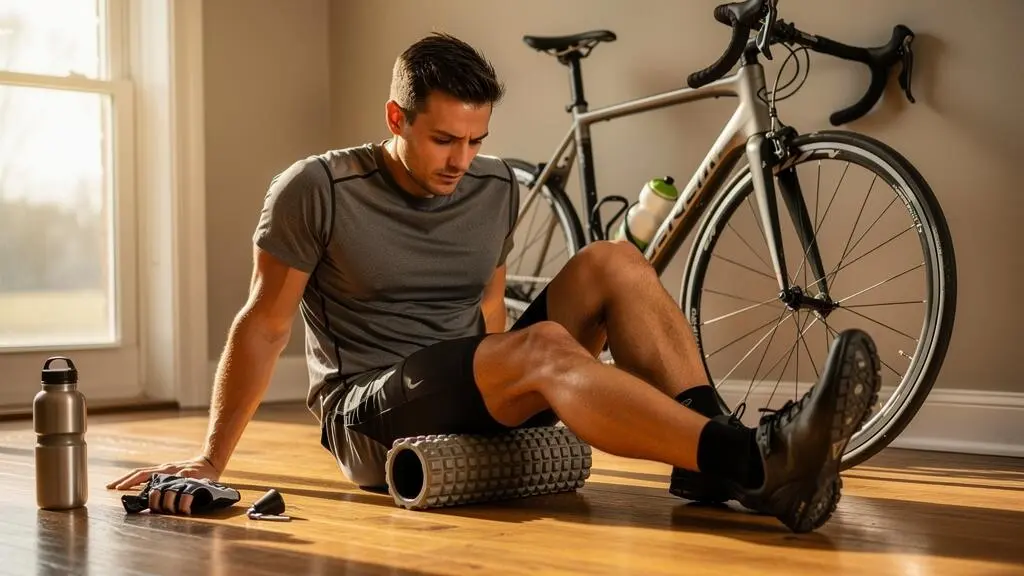
After a long ride, tight quadriceps, heavy calves and stiff hips can make sitting down feel easier than getting back up. A foam roller may offer some relief, but spending twenty painful minutes grinding through every muscle is not necessarily better than a few comfortable passes.
For most cyclists, five to ten minutes is a practical starting point, with an eight-minute routine providing enough time to address the main muscle groups without turning recovery into another workout. This is a suggested routine, not a scientifically established optimal duration. Some rides call for less rolling, and others call for none.
The useful question is not how much pressure your muscles can tolerate. It is whether gentle rolling leaves you moving more comfortably without causing additional tenderness, skin marks or lingering pain. The approach below combines a manageable routine with realistic expectations about muscle soreness, next-day cycling and the warning signs that should make you put the roller away.
Post-ride foam rolling: the essentials
- Start with five to ten minutes. Use slow, controlled movements and moderate pressure. Eight minutes is a convenient routine, not a mandatory target.
- Aim for comfort and movement. Foam rolling may modestly reduce perceived soreness, but it does not guarantee faster muscle repair.
- Never chase pain. Avoid direct pressure on bones, an irritated outer knee, visibly bruised skin or any area producing sharp or worsening symptoms.
- Why Does Foam Rolling Feel Like It Works Even Though It’s Not Removing Lactic Acid?
- How to Do an 8-Minute Foam Rolling Routine After Riding Without Guesswork?
- Which Should You Choose After a Hard Ride: Foam Rolling or Easy Spin?
- The Foam Rolling Mistake That Can Irritate Your IT Band Area for Days
- When Should You Foam Roll if You Ride in the Evening and Sleep Feels Restless?
- How to Reduce DOMS Enough to Ride Again Tomorrow Without Forcing It?
- How to Tell Normal DOMS From a Problem if Your Legs Hurt 24–48 Hours Later?
- How to Build Foam Rolling Into Your Week Without Making Recovery a Second Training Session?
Why Does Foam Rolling Feel Like It Works Even Though It’s Not Removing Lactic Acid?
Foam rolling can make your legs feel looser because it may temporarily change how your nervous system responds to pressure, discomfort and movement. It does not work by physically squeezing trapped lactic acid out of sore muscles. Research has identified modest improvements in perceived recovery, but the precise mechanisms remain uncertain, and immediate relief should not be confused with repaired muscle tissue.
After a demanding climb or interval session, muscular discomfort reflects several processes. Immediate fatigue differs from delayed-onset muscle soreness (DOMS), which can develop over the following days. Lactate produced during intense exercise is continuously transported and metabolised; it is not a collection of solid deposits waiting to be broken apart by a roller.
That distinction matters because rolling harder to supposedly flush out metabolic waste can increase pressure on already sensitive tissue without delivering the promised benefit.
A meta-analysis of foam rolling and exercise recovery, published in Frontiers in Physiology in 2019, included 21 studies involving 454 participants. It reported modest improvements in perceived muscle pain after post-exercise foam rolling, while overall effects on performance and recovery were generally small.
6.0%
Reported relative improvement in perceived muscle pain following post-exercise foam rolling in the 2019 meta-analysis. This is an average research finding, not a promised reduction for an individual cyclist.
Frontiers in Physiology, 2019; 21 studies overall, seven examining post-exercise rolling.
There is an important scientific nuance concerning lactate. A small 2024 experimental study involving 18 healthy adults found faster short-term blood lactate clearance after foam rolling than after seated rest. That finding does not demonstrate mechanical removal of lactate deposits or establish faster recovery from DOMS.
For a cyclist, the more useful measures are practical: Can you bend your knee comfortably? Do the stairs feel easier? Is your usual range of movement available without forcing it? These observations help assess comfort, although they do not establish how quickly muscle fibres are repairing.
If rolling feels pleasant but your legs remain tired, that is not necessarily a failure. The intervention may have improved your immediate experience without substantially changing your physiological recovery.
Once the objective becomes comfortable movement rather than removing imaginary toxins, a shorter and gentler routine makes considerably more sense.
How to Do an 8-Minute Foam Rolling Routine After Riding Without Guesswork?
An eight-minute post-ride routine can cover your quadriceps, hamstrings, glutes, calves and upper outer-hip muscles without requiring elaborate equipment or precise repetition counts. Divide the session into short, controlled blocks, keep enough weight on your hands or supporting leg to regulate pressure, and stop before discomfort becomes sharp or lingering. The aim is easier movement, not deeper pressure.
Use a smooth or moderately firm roller on a stable floor. Move slowly enough to notice changes in tenderness rather than rushing back and forth. A mild, tolerable pressure sensation is acceptable; sharp pain, burning or involuntary muscle guarding is not.
This schedule is a practical example designed around common cycling demands. Research does not establish it as the optimal eight-minute protocol.
| Time | Area | Technique |
|---|---|---|
| 0:00–2:00 | Quadriceps | One minute per leg; roll between the upper thigh and just above the knee, avoiding the kneecap. |
| 2:00–3:30 | Hamstrings | About 45 seconds per leg; support your weight with your hands. |
| 3:30–5:00 | Glutes | About 45 seconds per side; sit slightly angled onto the muscular portion of each buttock. |
| 5:00–6:30 | Calves | About 45 seconds per leg; travel along the calf muscle while avoiding the back of the knee and Achilles tendon. |
| 6:30–7:30 | Upper outer hips | About 30 seconds per side; use light pressure over the surrounding muscles, not the bony hip or outer knee. |
| 7:30–8:00 | Comfort check | Stand, walk and gently bend your knees to assess how your legs feel. |
Keep the roller moving in short, smooth passes. If you find a tender patch, slow down or briefly pause while reducing your body weight on the roller. Avoid holding intense pressure on a painful point in an attempt to force it to release.
Adjust the routine to the ride you have just completed. Following a particularly hard race, reduce the number of areas and use lighter pressure. After an easy recovery ride, two or three minutes—or no rolling—may be sufficient. Following a long endurance ride, consider substituting brief attention to the adductors or soles of the feet if those areas genuinely feel tight; there is no need to keep adding minutes.
Avoid rolling over the shinbone, kneecaps, prominent bony landmarks, visibly bruised or irritated skin, or areas of unexplained swelling. A suitable session should not leave new bruises. Persistent redness, worsening tenderness or soreness caused by the roller itself indicates that the pressure needs reducing or the session should stop.
Your five-step post-ride rolling check
- Choose your priority muscles. Write down the two or three areas that actually feel stiff after today’s ride.
- Set an eight-minute maximum. Prepare a timer with the option to stop sooner.
- Test your pressure. Complete one gentle pass over a large muscle and confirm you can breathe normally without bracing.
- Check for irritation. Examine the treated areas for new tenderness, unusual marks or worsening discomfort.
- Reassess movement. Walk and perform a comfortable knee bend, noting whether movement feels unchanged, easier or worse.
The routine is most useful when it improves comfort without adding fatigue. If your legs need movement more than pressure, a gentle spin may be the better choice.
Which Should You Choose After a Hard Ride: Foam Rolling or Easy Spin?
Choose an easy spin when gentle pedalling feels comfortable and you have time to cool down gradually. Choose foam rolling when your main concern is localized stiffness and a short floor-based routine fits your schedule better. Neither method is universally superior, and there is no need to complete both after every hard ride. Your fatigue, available time and next training session matter more than following a fixed recovery ritual.
A relaxed spin maintains low-intensity muscular activity and circulation while helping you transition from demanding exercise to rest. Foam rolling offers a different stimulus: localized pressure that may temporarily alter how stiff or uncomfortable your muscles feel.
The two approaches can complement one another, but neither replaces adequate sleep, nutrition, hydration or sensible training load management.
| Decision factor | Foam rolling | Easy spin |
|---|---|---|
| Main purpose | Address localized feelings of muscular tightness | Provide gentle movement and a gradual cool-down |
| Equipment | Roller and comfortable floor space | Bicycle or indoor trainer |
| Practical duration | Approximately 5–10 minutes, adjusted to comfort | Several minutes of genuinely easy pedalling |
| Very tired legs | May be shortened or skipped | May feel helpful, but can also be skipped |
| Late arrival home | Convenient if only a few minutes remain | May be impractical once cycling equipment is put away |
If you have another demanding workout scheduled tomorrow, avoid treating extra recovery activity as an opportunity to accumulate training. A spin should stay light enough that it does not become another endurance session. Likewise, foam rolling should not become a test of pain tolerance.
During a heavy training block, a short cool-down before getting off the bike may fit naturally into the session. At home after an evening ride, a few comfortable rolling passes may be more convenient. These are scheduling choices rather than established differences in recovery effectiveness.
After an exhausting race, both options are optional. Food, fluids, rest and a chance to settle down may be more valuable than extending the evening with additional routines.
Whichever you choose, maintaining low intensity is especially important around sensitive structures such as the outside of the knee.
The Foam Rolling Mistake That Can Irritate Your IT Band Area for Days
A common foam rolling mistake is pressing aggressively along the outer thigh, particularly near the outside of the knee, in an attempt to loosen the iliotibial band. The IT band is a dense connective-tissue structure, not a muscle that can simply be rolled into relaxation. Deep pressure over an already painful area may aggravate symptoms rather than relieve them.
The iliotibial band runs along the outer thigh and attaches near the knee. Cyclists can experience lateral knee pain associated with this region, but not every ache on the outside of the leg is an IT band problem.
The distinction is clinically important. A clinical review of iliotibial band impingement syndrome, published in the Journal of Athletic Training, advises against deep friction massage of the distal IT band as a treatment. It emphasizes appropriate assessment, management of aggravating loads and progressive hip-muscle rehabilitation.
For general muscular tightness around the hip, a more conservative approach is to use gentle pressure on neighboring muscles rather than forcing the roller into the painful band. These techniques are comfort strategies, not proven treatments for IT band impingement syndrome.
For the gluteal muscles, sit on the roller and shift slightly toward one buttock, keeping a hand on the floor to control pressure. For the lateral quadriceps, lie partly on your side but rotate slightly toward the front of the thigh so the contact is on muscle rather than directly over the outer knee. Around the tensor fasciae latae (TFL), just below and toward the front of the outer hip, use especially light pressure and avoid the prominent hip bone.
Stop immediately if you experience sharp localized pain, burning, tingling, increasing discomfort or pain that continues after you stand up. These sensations are not evidence that the technique is working.
If rolling has already irritated the area, stop applying direct pressure. Reduce activities that reproduce the symptoms and allow everyday movement to become comfortable before considering any gentle rolling of surrounding muscles. Do not repeatedly test the painful spot to see whether it has improved.
Persistent or recurrent pain on the outside of the knee, particularly when cycling, warrants assessment by a qualified sports physiotherapist or other appropriate clinician. Treatment may need to address training load, hip strength, movement control or other causes of knee pain.
Pressure should remain optional and comfortable. This becomes even more relevant when your recovery routine happens late in the evening and sleep is the next priority.
When Should You Foam Roll if You Ride in the Evening and Sleep Feels Restless?
If you cycle in the evening, try foam rolling shortly after the ride or earlier in your wind-down routine rather than automatically doing it immediately before bed. Keep the session brief and gentle, particularly if pressure feels stimulating or uncomfortable. There is no established universal cut-off time for rolling before sleep, so your response over several evenings is more useful than a rigid rule.
Evening cyclists often face competing priorities: getting home, eating, showering, preparing for the next day and finding enough time to sleep. Adding a lengthy recovery routine can make an already late night even later.
Foam rolling itself is not established as a general cause of delayed sleep onset. However, an intense or painful session may leave some people feeling unsettled, while a comfortable one may help others relax. The practical response is to test timing and pressure rather than assuming everyone reacts identically.
Consider three possible arrangements:
- Soon after the ride: Complete a few gentle passes before showering if your legs feel tight and you have a comfortable place to roll.
- Earlier in the evening: Leave the routine until after eating if that fits better, provided it does not push bedtime later.
- Immediately before bed: Keep only one or two comfortable areas if rolling feels calming. Skip it if it feels activating or painful.
Strong post-ride soreness may itself disturb sleep by making comfortable positions harder to find. In that situation, a short session that genuinely eases discomfort could be worthwhile. The benefit should be judged by how you feel and sleep, not by an assumed sleep-enhancing effect of foam rolling.
Use a simple personal comparison across several evenings. Note when you finished riding, when you rolled, the approximate duration, whether rolling felt pleasant and whether falling asleep or staying asleep was difficult. Look for a repeated pattern rather than attributing one restless night to a single activity.
After an exceptionally late ride or race, doing nothing is a valid recovery decision. A quick shower, something to eat and an earlier bedtime may be more practical than stretching the evening to complete a routine.
Sleep and fatigue also influence how you feel the next morning, especially when delayed-onset soreness appears before another planned ride.
How to Reduce DOMS Enough to Ride Again Tomorrow Without Forcing It?
Foam rolling may modestly reduce the discomfort associated with delayed-onset muscle soreness, but it cannot guarantee that your legs will be ready for tomorrow’s ride. Combine brief, comfortable rolling with gentle mobility and an easy cycling warm-up, then adjust the planned intensity according to how you move. If soreness changes your walking, pedalling or normal movement substantially, resting may be the better decision.
DOMS commonly develops after unfamiliar or demanding exercise, particularly when muscles experience loads they are not accustomed to. It may feel like diffuse tenderness, stiffness or reduced comfort during everyday movements.
Rolling can alter how sore muscles feel, but there is insufficient evidence to treat it as a way to rapidly repair microscopic exercise-related muscle damage. This is why a rider may feel temporarily better after rolling while still lacking the capacity for a hard workout.
Imagine a hypothetical cyclist who completes a long hilly ride on Saturday and wakes on Sunday with heavy quadriceps. Walking is comfortable, but descending stairs feels stiff. Instead of immediately attempting the planned interval session, the cyclist first walks around, bends the knees gently and tries a short, low-resistance spin.
If movement becomes noticeably easier and pedalling remains natural, a relaxed ride may be reasonable. If discomfort increases, movement becomes uneven or the cyclist must alter their technique, continuing into a hard session would be difficult to justify.
Before riding, use three observations:
- Movement: Can you bend and straighten your knees, walk normally and sit on the bike comfortably?
- Everyday discomfort: Are stairs mildly uncomfortable, or does soreness significantly interfere with ordinary movement?
- Warm-up response: Does gentle pedalling make movement easier, leave symptoms unchanged or make them worse?
When these checks are reassuring, begin at very low intensity and stay prepared to shorten or cancel the session. Reduce intensity first rather than trying to preserve a demanding training target. A shorter ride may also be appropriate if fatigue remains high.
Foam rolling can fit around this process as an optional comfort tool. Spend a few minutes on the stiffest large muscles, using less pressure than usual if they are tender. Avoid repeating long sessions simply because soreness returns.
Do not confuse temporary pain relief with readiness for high-intensity training. Your ability to tolerate pressure from a roller does not measure muscle repair or establish that another hard ride is safe.
That decision becomes more important when pain is unusually severe, localized or worsening rather than behaving like ordinary post-exercise soreness.
How to Tell Normal DOMS From a Problem if Your Legs Hurt 24–48 Hours Later?
Normal delayed-onset muscle soreness often develops within the first day after demanding exercise, becomes most noticeable around 24–72 hours and gradually improves. It commonly affects muscles that worked hard and may ease temporarily with gentle movement. Sharp focal pain, substantial swelling, unusual weakness or symptoms that worsen instead of improving deserve closer attention. Severe pain or dark urine after intense exercise requires prompt medical assessment.
For cyclists, DOMS frequently affects the quadriceps, glutes or calves after an unfamiliar workload. Both legs may feel sore, although soreness does not have to be perfectly symmetrical. Its diffuse muscular character and gradual improvement are generally more reassuring than the exact hour it peaks.
By contrast, a sharply painful point near a tendon or joint, a new limp or pain that increases with ordinary movement may suggest a problem other than uncomplicated DOMS.
The following guide helps organize observations. It is not a validated diagnostic score and cannot replace a clinical assessment.
| Observation | More consistent with ordinary DOMS | Reason for caution |
|---|---|---|
| Location | Diffuse discomfort in muscles used during the ride | Sharp, localized pain near a joint or specific injured area |
| Distribution | Similar soreness across heavily worked muscles | Marked one-sided pain, particularly with swelling or loss of function |
| Progression | Gradual improvement over subsequent days | Increasing symptoms, severe pain or no meaningful improvement |
| Movement | Gentle movement is comfortable or temporarily eases stiffness | Movement worsens pain, causes limping or reveals major weakness |
| Other symptoms | Muscle soreness without concerning systemic symptoms | Dark urine, unusual weakness or severe swelling after strenuous exercise |
One important condition not to overlook is exertional rhabdomyolysis, which involves significant muscle breakdown and can affect kidney function. According to CDC guidance on rhabdomyolysis symptoms, warning signs include unexpectedly severe muscle pain, unusual weakness or fatigue and dark urine resembling tea or cola.
If those symptoms occur after strenuous exercise, seek urgent medical evaluation rather than trying to resolve them with massage, extra hydration alone or more exercise. Rhabdomyolysis cannot be confirmed or excluded reliably through symptoms alone; medical testing is needed.
Other concerning patterns, including significant swelling, an inability to bear weight normally, or increasingly localized pain, also justify medical assessment. Persistent soreness that fails to improve over several days deserves professional advice, even without emergency symptoms.
Foam rolling is not a diagnostic test. Feeling better afterward does not rule out injury, and feeling no relief does not automatically indicate one. More importantly, repeatedly pressing into unexplained pain can complicate the situation.
Once soreness is understood and there are no concerning symptoms, recovery can return to a simpler objective: helping you move comfortably without filling every spare moment with rolling.
Key takeaways for your next training week
- Reserve longer rolling routines for rides that leave meaningful, manageable muscular stiffness; easy rides may need little or none.
- Use recurring tenderness, new irritation or growing session length as reasons to reduce pressure and frequency rather than increase them.
- Judge your routine by comfortable movement and how well it fits training, sleep and daily life—not by how many minutes you accumulate.
How to Build Foam Rolling Into Your Week Without Making Recovery a Second Training Session?
Build foam rolling around the rides that actually leave you stiff, rather than treating it as another daily training obligation. A brief session after a long or demanding ride may be useful, while easy days often require little or no rolling. Keep the pressure comfortable, vary the areas according to your symptoms and remove the routine when it stops helping. Consistency should mean sensible decisions, not compulsory daily sessions.
A simple weekly structure can make recovery easier to maintain. The following is an illustrative schedule for a recreational cyclist, not a research-validated prescription or a substitute for individualized training advice.
| Training day | Suggested approach | Reason |
|---|---|---|
| Monday: Rest | No rolling unless a brief session feels useful | Avoid unnecessary pressure on sensitive tissues |
| Tuesday: Hard intervals | Up to 5–8 gentle minutes | Address noticeable quadriceps, glute or calf stiffness |
| Wednesday: Easy ride | Skip or use 2–3 minutes | Keep recovery proportional to the workload |
| Thursday: Steady training | Optional short targeted session | Respond to comfort rather than habit |
| Friday: Rest or light movement | Usually no rolling | Leave time for ordinary recovery |
| Saturday: Long ride | Approximately 5–10 minutes if comfortable | Attend to muscle groups that feel particularly tight |
| Sunday: Recovery ride | Skip or roll one or two areas lightly | Avoid accumulating unnecessary stimulation |
Rather than rigidly following every entry, adjust the week according to actual fatigue, soreness and training demands. A cyclist completing high-volume training may need more rest, not more rolling. Someone returning from time away from the bike may benefit from keeping everything shorter while their muscles adapt.
Watch for three signs that the routine has become counterproductive: you repeatedly develop tenderness from rolling, you feel compelled to increase pressure to obtain the same temporary sensation, or sessions keep expanding despite little lasting improvement in comfort.
In those situations, cut back. Consider whether training load, equipment fit, sleep or other factors contribute to persistent discomfort. Recurrent pain should not be managed indefinitely through increasingly aggressive self-massage.
Foam rolling also works better as a flexible option than as a test of discipline. Missing a session does not erase the benefits of training or automatically delay recovery. Research supports the possibility of modest improvements in perceived soreness, not a requirement to use a roller after every ride.
For a practical measure of success, ask whether your legs feel comfortable enough for ordinary activities after rolling, whether symptoms remain settled later and whether the routine fits naturally into your evening. These observations are more meaningful for everyday decisions than completing a preset number of minutes.
After your next ride, begin with a couple of gentle passes over the muscles that feel stiffest. Stop if discomfort increases, and finish early if movement already feels comfortable. Five useful minutes are better than a prolonged session that leaves your legs more tender.
Can foam rolling cause bruises even if it does not hurt during the session?
Yes. Excessive pressure can irritate or injure superficial tissues, and discomfort may become more noticeable afterward. Bruising is not a desirable recovery response or evidence that the roller has reached deeper muscle layers. Stop rolling bruised areas, reduce pressure in future sessions and seek medical advice for unexplained, extensive or recurrent bruising.
Is a soft foam roller better than a firm one for sore cycling legs?
A softer or smoother roller can make pressure easier to tolerate, especially when muscles are sensitive. A firmer roller is not automatically more effective. Choose a device that allows slow, controlled movement without sharp pain, excessive guarding or skin irritation. Comfortable pressure matters more than roller hardness.
Should you foam roll immediately after cycling or wait until later?
Either can be reasonable. There is no established universal timing requirement for post-ride foam rolling. Choose a convenient moment when your muscles can tolerate comfortable pressure and the routine does not delay more important recovery activities, particularly eating and sleeping.
Can you use a foam roller on the same muscles two days in a row?
Gentle rolling on consecutive days may be tolerable when the area is not irritated, but there is no requirement to do so. Reduce pressure or skip the session if the muscles remain unusually tender, develop marks or become more uncomfortable with repeated rolling. Avoid rolling directly over suspected injuries.
What if foam rolling never makes your legs feel better?
You do not need to keep doing it. Foam rolling has variable and generally modest effects, and not every cyclist experiences meaningful relief. Gentle movement, appropriate training load, rest and adequate recovery habits may suit you better. If stiffness or pain persists, worsens or regularly limits cycling, seek an appropriate professional assessment.