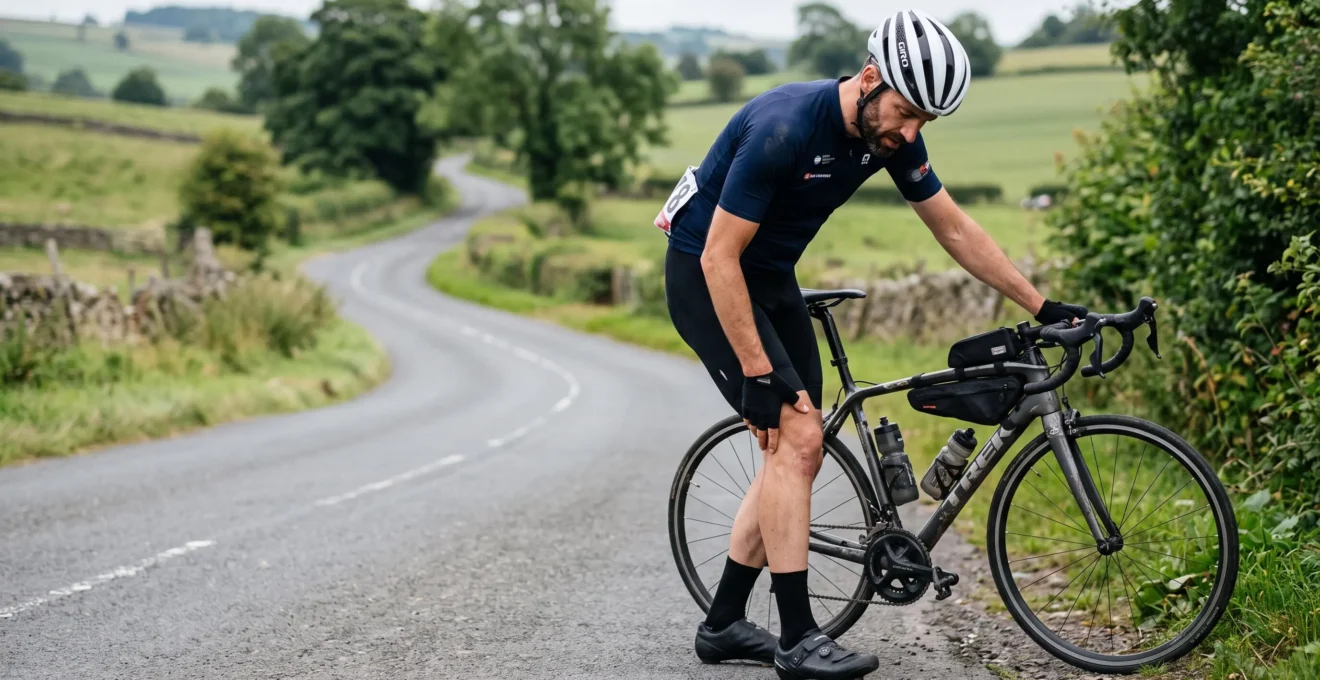
You finally have a cycling routine. Your legs feel stronger, the same hills seem easier, and riding several times a week no longer leaves you exhausted. Then an unfamiliar ache appears around your knee, Achilles tendon or lower back. Nothing dramatic happened, so why does it hurt now?
Cycling overuse injuries often develop when repeated mechanical demands increase faster than the affected tissues can tolerate them. Cardiovascular fitness and confidence can improve while tendons, bones and other structures are still adapting. The result is a mismatch between how capable you feel and how much repeated stress your body currently handles.
The solution is not automatically to stop riding for weeks, buy an expensive bike fit or stretch harder. Early prevention involves recognising symptom patterns, reviewing recent training changes, reducing aggravating stress and rebuilding tolerance gradually. Persistent or worsening pain deserves assessment rather than repeated self-experimentation.
Cycling overuse injuries: the essentials
- Review recent changes in riding duration, intensity, frequency, terrain and bike setup when recurring pain appears.
- Reduce aggravating load early and monitor symptoms during riding and the following morning, rather than repeatedly pushing through worsening pain.
- Use bike-fit adjustments, progressive strengthening and recovery tools selectively; no single intervention explains or fixes every cycling injury.
- Why Does Pain Show Up 2–4 Weeks After You Increase Riding, Not Immediately?
- How to Adjust Training for a Niggle Without Losing All Your Fitness
- Which Is More Likely: Bike Fit or Training Load if Your Knee Hurts After 40 Minutes?
- The Stretching-Only Mistake That Turns a Small Niggle Into a 3-Month Injury
- When Should You Reintroduce Hills and Sprints After an Overuse Flare-Up?
- How to Set Cleats Using a Marker Pen and a 15-Minute Test Ride
- How to Do an 8-Minute Foam Rolling Routine After Riding Without Guesswork
- How Long Should Post-Ride Foam Rolling Take to Help Recovery Without Bruising You
Why Does Pain Show Up 2–4 Weeks After You Increase Riding, Not Immediately?
Pain may emerge two to four weeks after increasing cycling because fitness improvements and tissue adaptation do not necessarily happen at the same speed. Repeated loading can accumulate before symptoms become noticeable. However, this delay is not predictable: an overuse problem may appear sooner or later depending on the tissue, training history and circumstances.
When riding becomes more regular, the cardiovascular system and working muscles may make familiar efforts feel easier. Tendons, bones and other load-bearing structures respond to mechanical stress on different timescales. Feeling fitter therefore does not guarantee that every tissue is ready for the same increase in training.
Consider a hypothetical rider who adds an extra weekly ride, starts climbing longer hills and slightly raises the saddle during the same fortnight. Knee pain appears during the third week. It would be misleading to blame the final ride automatically: several changes may have contributed to the symptoms.
A systematic review of cycling overuse injury risk factors examined 18 studies and identified moderate evidence of an association between cycling load and overuse symptoms. Only three included studies were judged to have a low risk of bias, so individual causes remain difficult to establish confidently.
Look backwards before making changes. Review the previous three weeks of training, recording:
- Total riding time and number of sessions.
- New hills, intervals, sprints or higher-gear efforts.
- Changes to saddle, cleats, shoes or handlebars.
- Recovery days, sleep disruption and additional physical activity.
- When symptoms appeared and how long they lasted.
The next-morning response is particularly useful. Pain that lasts into the following day, becomes more intense or starts earlier on successive rides suggests that the current load may not be well tolerated. These are practical warning signs, not a validated method for diagnosing a specific injury.
Sharp pain, marked swelling, inability to bear weight, neurological symptoms or pain following a significant fall require prompt medical assessment. Persistent focal bone pain also deserves evaluation rather than continued training.
The important question is not whether a particular ride caused the injury, but which recent demands can be modified before an occasional niggle becomes a persistent limitation.
How to Adjust Training for a Niggle Without Losing All Your Fitness
A mild cycling niggle does not always require complete rest. Start by reducing the riding duration, intensity or movements that aggravate the affected area, while preserving tolerable activity. Monitor symptoms during exercise and the following day. If pain escalates, changes your movement or persists despite adjustments, seek clinical guidance.
Training can be modified without treating fitness as an all-or-nothing achievement. For a rider whose knee becomes uncomfortable during longer outings, an easier and shorter session may place less stress on the joint than continuing the usual route. Someone experiencing Achilles discomfort during hard climbing may need to remove high-torque efforts first.
A practical approach is to reduce the most aggravating demands, reassess the response and then modify further if necessary. There is no universally safe percentage reduction because symptoms, tissues and training backgrounds differ.
Alternative exercise can preserve some cardiovascular stimulus, provided it does not aggravate the problem:
- Easy indoor cycling: potentially suitable when a comfortable riding position and low resistance do not provoke symptoms.
- Swimming: an option for some riders with lower-limb loading sensitivity, although particular strokes or kicking movements can still cause discomfort.
- Rowing: useful for some people, but potentially unsuitable when repeated knee bending or lumbar flexion aggravates symptoms.
Relative rest means reducing provocative stress, not ignoring pain while finding another way to reproduce it.
Your five-step early-niggle training audit
- Record the symptom location, onset and severity in a training note; produce a baseline symptom entry.
- List changes in riding time, hills, intensity and equipment from the previous three weeks; produce a short change log.
- Identify and temporarily remove the riding demand that most consistently provokes symptoms; produce an adjusted session plan.
- Record symptoms during the modified session and the following morning; produce a two-point response record.
- Compare successive entries before progressing, maintaining or reducing load; produce a clear decision for the next ride.
Research on patellar tendinopathy supports progressively increasing tendon-loading exercise rather than relying only on rest. A randomised trial of progressive tendon-loading rehabilitation used pain-guided progression within a structured clinical programme. Its specific pain threshold is not a universal clearance rule for every type of cycling pain.
The mistake to avoid is resting until symptoms settle and immediately returning to the exact training demands that preceded them. Fitness maintenance and tissue rehabilitation need to progress together.
If pain remains troublesome even after reducing training, the bike’s position and repeated movement pattern deserve examination alongside the overall workload.
Which Is More Likely: Bike Fit or Training Load if Your Knee Hurts After 40 Minutes?
Knee pain appearing after approximately 40 minutes cannot reliably distinguish a bike-fit problem from training overload. A repeated onset during easy rides may justify checking your setup, while symptoms linked to harder or longer sessions warrant reviewing workload. Both factors can coexist, and the timing of pain alone cannot diagnose the cause.
Bike fit changes joint positions and the way forces are distributed throughout pedalling. Training load determines how frequently and intensely those forces are repeated. An uncomfortable position may become symptomatic only when riding volume increases, but a well-fitted bicycle does not eliminate overuse risk.
The cycling-injury systematic review discussed earlier found inconsistent or insufficient evidence for many conventional fit measurements as reliable predictors of injury. In particular, evidence concerning saddle height was conflicting. That does not make fit irrelevant; it means that common fitting assumptions should not be treated as diagnostic certainty.
Pain location provides useful context for an assessment, but not a definitive adjustment prescription.
| Pain location | Bike and movement questions | Training questions |
|---|---|---|
| Front of knee | Is knee flexion uncomfortable? Have saddle height, saddle setback or crank length changed? | Have climbing, resistance or hard intervals increased? |
| Outside of knee | Do the foot and knee feel constrained? Have cleat rotation or stance width changed? | Does discomfort follow longer repetitive sessions? |
| Back of knee | Does reaching the bottom of the pedal stroke feel excessive? Has saddle position changed? | Have long rides or sustained efforts increased? |
These questions guide investigation; they do not establish a validated relationship between a particular pain location and a specific bicycle adjustment.
If symptoms arise consistently during easy riding, check for recent equipment changes, obvious asymmetry or a movement that repeatedly provokes discomfort. If symptoms mainly follow high-intensity or high-volume days, reduce those demands while reviewing the setup.
For minor, non-progressive discomfort, a cautious fit experiment may involve changing one small parameter at a time and observing several easy sessions. Record the original measurements so the adjustment can be reversed. Avoid large simultaneous changes to saddle height, setback and cleats, which make the response harder to interpret.
Persistent knee pain should be assessed by a qualified healthcare professional; a cycling-specific physiotherapist and an experienced bike fitter can contribute different information. Neither should assume that one measurement explains every symptom.
Once aggravating factors are identified, strengthening and gradual return to loading are generally more useful than attempting to stretch away every recurring ache.
The Stretching-Only Mistake That Turns a Small Niggle Into a 3-Month Injury
Stretching alone can fail to resolve an overuse injury because it does not necessarily change the repeated mechanical stress responsible for symptoms. A tendon problem may require adjusted activity and progressive strengthening rather than additional flexibility work. Continuing the same painful workload while stretching afterwards can allow symptoms to persist, although a three-month outcome is not inevitable.
Consider a hypothetical cyclist who develops recurring Achilles discomfort after increasing hill training. Every evening, the rider stretches the calf, feels temporarily better and repeats the same demanding route the following morning. The stretching may provide a subjective sense of relief, but the underlying workload has not changed.
Tendinopathy is not simply a problem of insufficient flexibility. Tendons respond to mechanical loading, and rehabilitation commonly aims to rebuild their capacity to tolerate it. Aggressive stretching may aggravate certain irritated tendons, especially when it compresses sensitive tissue or reproduces the familiar pain.
Passive stretching and progressive loading serve different purposes. Stretching primarily targets movement tolerance or flexibility. Strengthening exposes muscles and tendons to controlled force so that loading can eventually become more demanding.
The patellar tendinopathy trial cited earlier used a staged programme incorporating isometric exercise, isotonic loading and later energy-storage activities. This supports a progressive rehabilitation framework for that condition, not a universal exercise prescription for every cyclist’s Achilles, knee or back pain.
An appropriate programme depends on the diagnosis, symptom severity and tissue involved. Some people benefit from carefully selected isometric exercises; others need different resistance exercises or movement modifications. Eccentric-only training is not automatically necessary, and no single exercise sequence suits every injury.
A further trap is assuming that pain decreasing during exercise means the tissue has recovered. Symptoms sometimes feel less noticeable once movement is established, yet return later that evening or the next morning. The full response matters more than the most comfortable moment of a ride.
If symptoms persist for several weeks despite sensible workload changes, or worsen sooner, obtain a clinical assessment. Ongoing discomfort may involve factors that stretching or a general exercise plan cannot address.
As symptoms stabilise and capacity improves, the next challenge is restoring demanding riding without reintroducing more mechanical stress than the recovering area can tolerate.
When Should You Reintroduce Hills and Sprints After an Overuse Flare-Up?
Reintroduce hills and sprints after easier riding is consistently tolerated without worsening symptoms during exercise or the following morning. Higher-intensity efforts can create greater peak forces and require more tissue capacity, so they generally belong later in a gradual return. Progress according to response and clinical guidance rather than a fixed number of recovery days.
Steep climbs, low-cadence efforts and explosive accelerations can place substantial demands on the knee extensors, calf muscles and Achilles tendon. Their effects differ with gearing, cadence, technique and individual anatomy, but they should not automatically be treated as equivalent to gentle riding.
A sensible progression for a rider recovering from an uncomplicated overload problem may follow four stages:
- Easy riding: establish that comfortable, low-intensity cycling is repeatable without symptom escalation.
- Controlled tempo: introduce moderately demanding efforts while maintaining smooth technique.
- Seated climbing: test manageable gradients and suitable gearing, avoiding unnecessarily high pedal forces.
- Sprints and hard climbs: restore short, demanding efforts only after earlier stages are tolerated.
This sequence is a practical example, not a scientifically validated universal return-to-sport protocol. The correct order may change with the injury and the rider’s goals. For some conditions, longer easy rides themselves must also be built up gradually.
Check three responses before increasing demand: what happened during the session, whether symptoms returned the next morning, and whether another comparable session can be completed without worsening. Two tolerated sessions can provide useful practical reassurance, but they do not guarantee recovery.
A rider who completes an easy ride comfortably but experiences increased Achilles stiffness the following morning has not necessarily demonstrated tolerance for harder loading. Holding the current level or stepping back may be more appropriate than adding hill repeats.
Keep the first demanding efforts controlled and avoid testing maximal sprints at the end of an exhausting ride. Fatigue can affect movement control and make symptom interpretation more difficult.
If pain returns repeatedly at a particular intensity, seek advice rather than continually testing the same threshold.
Training progression is central, but small equipment changes may also improve comfort when a rider’s foot position feels constrained or pressure develops under the shoe.
How to Set Cleats Using a Marker Pen and a 15-Minute Test Ride
Start cleat adjustment by identifying the ball-of-foot region, marking a reference on the cycling shoe and recording the current cleat position. Make one small change at a time, then use an easy 15-minute ride to check comfort and movement. This is a preliminary self-check, not a validated fitting or injury-diagnosis method.
The first metatarsal head is the bony prominence near the base of the big toe. Locating it provides a reproducible reference when examining fore-aft cleat position, but there is no universally correct requirement that the front edge of every cleat align with that point.
A careful home assessment can follow this sequence:
- Put on the cycling shoe and identify the ball-of-foot area by touch, marking its approximate location on the shoe exterior with a removable marker.
- Record the existing cleat position, including fore-aft placement, lateral position and angle. A photograph can make returning to the original setup easier.
- Check where the pedal axle and cleat sit relative to the marked foot region. Use the shoe and cleat manufacturer’s adjustment instructions.
- If necessary, make a small adjustment to one variable only, with the cleat bolts correctly tightened to the manufacturer’s specification.
- Ride easily for approximately 15 minutes, then record any changes in foot pressure, ankle comfort, knee sensation and perceived freedom of movement.
A short test is intended to identify obvious discomfort or an unsuitable change, not to prove that the position will remain comfortable over longer rides.
Foot pressure concentrated around the forefoot may justify investigating fore-aft position or shoe fit. A twisting sensation at the knee may prompt a review of cleat rotation and available float. Lateral foot positioning can also influence comfort. However, no symptom independently identifies the exact correction required.
A clinical study on cycling cleat position and foot pain examined 21 cyclists reporting discomfort while pedalling. The investigators reported improved pain outcomes after moving excessively forward cleats rearward. Because the study was small and uncontrolled, it does not validate a universal cleat position or establish that the same adjustment prevents knee injuries.
Do not force feet into a visibly symmetrical angle when their natural positioning differs. Ensure the pedal releases reliably and that any change does not compromise clipping in or out.
Persistent knee pain, unusual foot alignment, suspected leg-length differences or marked asymmetry deserve professional assessment. Changing cleats repeatedly while continuing painful rides can obscure the underlying problem.
Once riding position and training demand are reasonably controlled, optional recovery techniques can help manage perceived tightness without replacing the work of rebuilding tissue tolerance.
How to Do an 8-Minute Foam Rolling Routine After Riding Without Guesswork
An eight-minute post-ride foam rolling routine can cover the quadriceps, hamstrings, calves and gluteal muscles with controlled, comfortable pressure. Move slowly across muscle tissue, adjust your body position to regulate pressure and avoid pressing directly on joints or painful bony areas. Foam rolling may support short-term comfort and mobility but does not treat the underlying cause of an overuse injury.
Prepare a mat, a foam roller and enough floor space to change positions comfortably. Start gently, especially after a ride that has already left a particular muscle sensitive.
The following eight-minute sequence is a practical organisational example rather than a research-validated treatment dose.
| Area | Suggested time | Execution cue |
|---|---|---|
| Quadriceps | 2 minutes | Roll slowly over the front thigh muscles, avoiding direct pressure on the kneecap. |
| Hamstrings | 2 minutes | Support the upper body and move gradually across the back of each thigh. |
| Calves | 2 minutes | Use gentle pressure along the calf muscles, keeping clear of the Achilles tendon itself. |
| Glutes and lateral hip muscles | 2 minutes | Shift body weight carefully and avoid direct rolling over the outer knee or prominent hip bone. |
Divide each allocation between both sides and use time to reposition as needed. There is no obligation to spend the entire period rolling if an area already feels comfortable.
For tightness along the outside of the thigh, favour tolerable pressure on nearby muscular areas, such as the lateral quadriceps and gluteal region, rather than aggressively pressing directly along the iliotibial band or outer knee.
The key movement is a slow, controllable pass rather than rapid back-and-forth rubbing. Support more of your body weight with your hands or opposite leg when the roller feels too intense.
A systematic review of foam rolling, recovery and flexibility reported improvements in range of motion and potential benefits for recovery from exercise-induced muscle damage. These findings do not establish that foam rolling prevents cycling overuse injuries, heals tendinopathy or requires an eight-minute session.
Stop if rolling creates sharp pain, tingling, increasing local soreness or a protective muscular spasm. Direct pressure over a known injury is not a substitute for assessing it.
Think of the routine as an optional comfort practice. If your knee continues hurting after every ride, the answer is unlikely to be an additional minute with the roller.
Choosing how long to roll, and when to stop, is more important than completing an arbitrary timer at the expense of comfort.
Key takeaways before your next recovery session
- Use comfortable pressure and short, controlled passes instead of attempting to force tight tissue to release.
- Adjust time to individual sensitivity; an eight-minute routine is an option, not a minimum therapeutic requirement.
- If recurring pain affects your riding, prioritise workload changes and an appropriate assessment over longer recovery sessions.
How Long Should Post-Ride Foam Rolling Take to Help Recovery Without Bruising You
A few minutes of gentle foam rolling can be enough for a post-ride comfort routine. There is no established universal duration that guarantees better recovery or prevents bruising. Use several slow passes per muscle group, reduce pressure whenever you tense up, and stop if discomfort becomes sharp or remains worse afterwards.
Longer sessions are not automatically more effective. The available evidence supports some short-term mobility and recovery benefits, but it does not demonstrate that pressing harder or rolling for longer produces superior tissue adaptation.
An appropriate duration depends on which areas feel tight, how sensitive they are and how comfortably you can control pressure. A brief sequence across several muscles may be preferable to repeatedly concentrating intense pressure on one tender spot.
Use your breathing and muscular response to calibrate pressure. Mild, tolerable discomfort may occur, but the sensation should allow relaxed breathing and deliberate movement. If you hold your breath, brace your entire body or feel compelled to escape the roller, reduce pressure immediately.
There are several ways to adjust a session without forcing it:
- Place more body weight through your hands, elbows or supporting leg.
- Use a softer roller when a firm one feels excessively intense.
- Move to an adjacent comfortable muscle region instead of pressing directly on a painful spot.
- Stop early when the area feels comfortable rather than continuing to satisfy a timer.
- Skip rolling on areas with unexplained bruising, acute injury or symptoms that warrant clinical assessment.
Bruising is not proof that a roller has reached deeper tissue or released a restriction. Excessive local pressure can irritate sensitive structures. Unexplained bruising, particularly in someone taking blood-thinning medication or with a bleeding disorder, should be discussed with a clinician rather than treated by further rolling.
Foam rolling can be a useful addition to an established training routine, but it does not directly correct poor load tolerance, an aggravating movement pattern or an inappropriate return to intense cycling.
It is also unnecessary to roll every muscle after every ride. If recovery feels normal and there is no discomfort, a routine is optional rather than a preventative obligation.
After your next ride, record how your knee, Achilles tendon and back feel that evening and the following morning. Use that information to choose the next training load, and seek professional assessment when pain persists, progresses or disrupts normal activity.
Can cycling overuse injuries happen even if you never ride particularly hard?
Yes. Repeated low- or moderate-intensity riding can still exceed current tissue tolerance when duration, frequency or total workload increases substantially. Intensity is only one component of load. Recovery, individual capacity and mechanical factors also deserve consideration.
Should you see a physiotherapist or a bike fitter first for recurring cycling pain?
For persistent, worsening or unexplained pain, a qualified healthcare professional is the more appropriate first step because symptoms need assessment before being attributed to bicycle geometry. A bike fitter can subsequently help examine position and equipment. In some cases, coordinated assessment is useful.
Does a pain-free day mean you can return to your previous cycling volume?
Not necessarily. Symptom improvement after a rest day does not demonstrate that the affected tissue can tolerate the previous workload. Reintroduce riding gradually, assess the response during and after exercise, and avoid immediately repeating the combination of demands associated with the flare-up.
Is lower-back pain after cycling always a sign of an incorrect bike fit?
No. Lower-back discomfort can have several contributing factors, including prolonged position, recent training increases and individual movement tolerance. Bike fit may be relevant, but symptoms alone do not identify the cause. Seek assessment for persistent pain, and promptly for symptoms such as progressive weakness, numbness or changes in bladder or bowel control.
Can foam rolling prevent Achilles tendinopathy or recurring knee pain?
Current evidence does not establish foam rolling as an effective stand-alone prevention strategy for those conditions. It may help with perceived muscular tightness or short-term mobility. Appropriate training progression, symptom monitoring and condition-specific rehabilitation remain more relevant when overuse symptoms are already present.