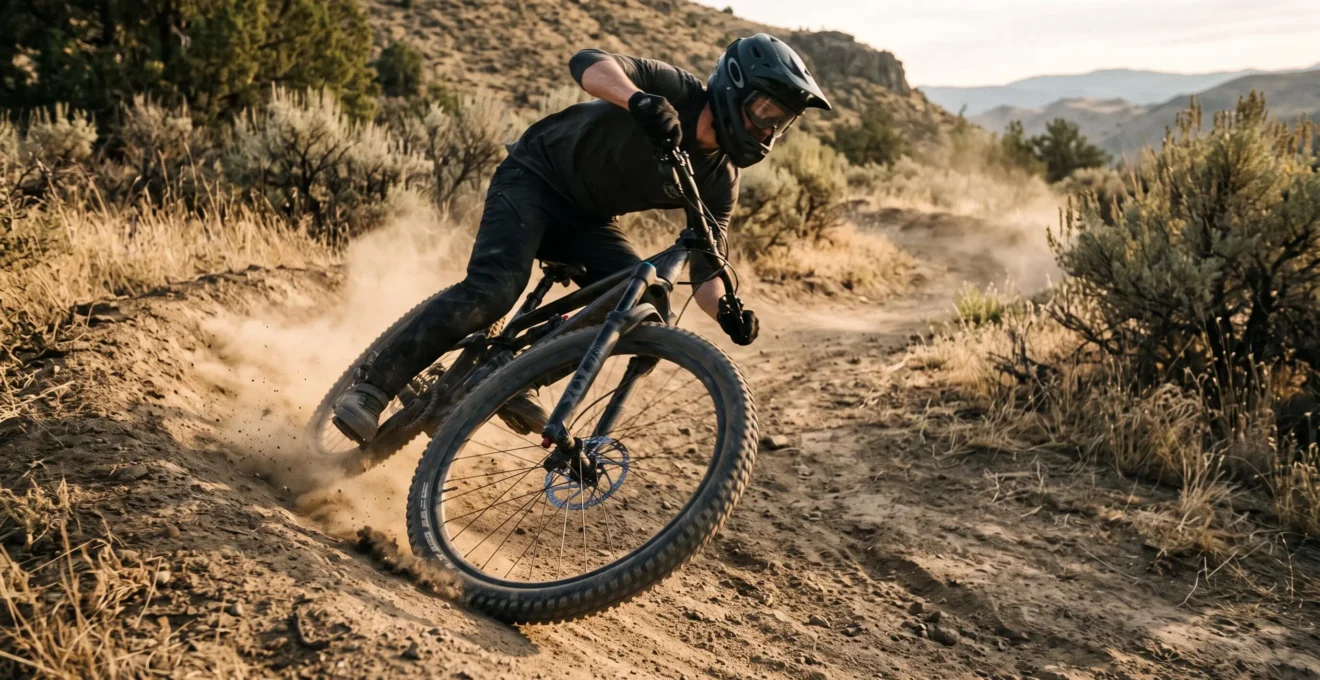
The best aggressive mountain bike tyre for predictable cornering is not necessarily the one with the tallest knobs. On mixed hardpack and loose trails, a tread with supportive shoulder knobs, a usable transition between the centre and shoulders, and a casing suited to your riding pressure can deliver stronger confidence than an extreme mud-oriented pattern.
The critical difference is how grip builds as the bike leans. A tyre may feel secure when upright, become vague at moderate lean, then suddenly catch when its shoulder knobs engage. Another may grip strongly before releasing without much warning. Both can create the unsettling “on-off” sensation, even when the tyre offers substantial peak traction.
Choosing the right pattern means considering the ground beneath the knobs, the balance between front and rear tyres, and the pressure and suspension settings that determine how consistently the tread stays loaded.
The following comparisons focus on what riders can inspect, feel and test rather than treating an aggressive tread label as a guarantee of control.
Predictable MTB cornering grip: the essentials
- Prioritise controlled transitions: supportive shoulder knobs and a reasonably continuous path from centre to edge help reduce vague lean-angle changes.
- Match the terrain: moderate, supported knobs often suit hardpack better than tall, widely spaced mud knobs; loose and muddy ground demands more penetration and clearance.
- Check the complete setup: pressure, casing support, rim compatibility and fork rebound can change grip behaviour as much as an apparent tread difference.
- Why Does Your Tyre Feel Like It Has Grip, Then None, in the Same Corner?
- How to Read a Tread Pattern Photo and Predict Corner Grip in 60 Seconds?
- Which Should You Choose: Aggressive Front Tyre and Faster Rear, or a Matched Set?
- The Tyre Choice That Makes Dusty Trails Feel Like Ice Under Braking
- Fix « Tyre Roll » in Corners Without Buying a New Tyre
- Fix Front-End Washouts by Pairing Tyre Pressure With Rebound Settings
- How to Choose Tread and Casing if You Ride 70% Hardpack and 30% Mud?
- Which Knobby Tyre Works Best in Mud Without Feeling Draggy on Hardpack?
Why Does Your Tyre Feel Like It Has Grip, Then None, in the Same Corner?
An MTB tyre can feel secure and then suddenly lose traction because its grip changes with lean angle, terrain and wheel loading. The transition from centre knobs to shoulder knobs may be poorly supported, the shoulder blocks may flex, or the ground may change beneath the tyre. Excessive casing movement can produce a similar sensation without an actual loss of tread adhesion.
Cornering grip is not a single fixed property. As the bike leans, different parts of the tread engage the ground. On a firm surface, the centre knobs initially support the tyre. At greater lean angles, the shoulder knobs carry more of the lateral load.
If there is a pronounced gap between these zones, the rider may feel an uncertain phase before the shoulder knobs establish a stronger mechanical edge. Tall, widely spaced shoulder blocks can also deform under lateral force, particularly on hard surfaces where they cannot penetrate the ground.
BikeRadar‘s 2026 mountain bike tyre guide distinguishes the stronger edging grip associated with square-profile tyres from the generally more progressive corner entry and sliding behaviour of rounder profiles. This is a useful design trade-off, not a rule that predicts every tyre’s behaviour.
Three different problems can feel like the tyre suddenly giving way:
- Actual tread sliding: the shoulder knobs lose traction on the surface, and the tyre moves sideways across the ground.
- Casing or knob deformation: the tyre feels as though it folds or moves beneath the rim before it necessarily starts sliding.
- Front–rear grip imbalance: the rear tyre breaks traction before the front, rotating the bike into the corner more quickly than expected. This is often described as oversteer and is not automatically caused by an overly aggressive rear tyre.
A tyre that works exceptionally well in penetrable loam may feel nervous on polished rock or dry hardpack. Its tall knobs can produce substantial traction when they dig into soft material but offer a less stable contact platform on a surface that does not yield.
To identify the dominant problem, use a familiar, clear corner with good visibility and no traffic or exposed hazards. Begin at a comfortable low speed and repeat a consistent line, increasing pace only within a safe margin. Note the exact moment the sensation changes: initial turn-in, mid-corner lean, braking, or acceleration.
Repeat without changing multiple settings. If the tyre feels as though it folds before recovering, investigate pressure and casing support. If it slides where loose dust begins, the surface and tread interaction deserve closer attention. If the bike rotates from the rear, examine rear grip and braking inputs.
Once the behaviour is identified, the next step is to inspect whether the tread layout is likely to make that particular transition smoother.
How to Read a Tread Pattern Photo and Predict Corner Grip in 60 Seconds?
To judge MTB cornering behaviour from a tread photo, inspect knob spacing, shoulder shape, the connection between centre and shoulder blocks, and siping. Tall, square shoulders suggest strong mechanical edging on loose surfaces, while supported intermediate knobs can make lean-angle transitions feel more continuous. A photograph offers clues, however, not a reliable measurement of actual grip.
Start with a clear image showing the full tread across the tyre’s width rather than a close-up of a single shoulder block.
- Check knob density. Closely spaced centre blocks usually provide more continuous contact on hard ground, while larger open channels allow loose material and mud to escape. Very open patterns can feel less settled on smooth, firm surfaces.
- Inspect the shoulder knobs. Tall, sharply defined edges are designed to engage loose material. Lower or rounded shoulders may roll into a lean more gradually, although their ultimate bite in soft ground can be lower.
- Trace the centre-to-shoulder transition. Look for intermediate or staggered knobs bridging the two zones. A large unsupported channel can create a distinct change in feel as the bike leans, although it does not guarantee a sudden slide.
- Look for siping and knob support. Cuts within the blocks can permit local flex and help edges conform to uneven surfaces. Their effect depends on knob dimensions, rubber properties and the loads involved.
Pay particular attention to whether a tall shoulder knob has sufficient support behind its biting edge. A prominent edge may offer powerful traction in soil yet twist or fold on hardpack. A smaller-looking knob can feel more consistent if its structure resists excessive deformation.
For a practical comparison, place photographs of two candidate tyres side by side. Ask three questions: which shoulder profile is more likely to engage firm ground smoothly, which layout is more likely to clear the mud you actually ride, and which centre pattern looks better suited to braking and rolling on your dominant surface?
Consider a hypothetical choice between a widely spaced tyre with tall, square shoulders and an intermediate tyre with moderate centre knobs and staggered shoulders. For dry hardpack with occasional loose corners, the intermediate profile is a reasonable starting candidate. For consistently deep, loose soil, the more open tyre may offer the necessary penetration.
Yet a tread photo hides crucial variables. Rubber hardness, knob reinforcement, carcass stiffness and actual inflated profile can alter the result. Tyres with similar tread silhouettes may behave differently under the same rider.
The manufacturer’s compound and casing information, combined with independent riding impressions on comparable surfaces, should therefore confirm or challenge the visual prediction.
A tread that looks promising still needs to work as part of a front-and-rear combination, where the balance of available traction can change the entire bike’s handling.
Which Should You Choose: Aggressive Front Tyre and Faster Rear, or a Matched Set?
Choose an aggressive front tyre and faster rear when rolling efficiency matters and the rear can release traction without becoming difficult to control. For mixed trails with demanding corners, a grippy front paired with an intermediate rear is often a more balanced compromise. A matched or closely matched set makes sense when consistent braking, support and predictable behaviour matter more than outright rolling speed.
The front tyre is particularly important because losing front-wheel grip can make a corner difficult to recover. A more substantial shoulder pattern at the front can provide useful steering confidence, while a lower-profile rear reduces some of the rolling penalty on smoother trails.
This approach is common in performance-oriented cross-country and marathon setups, although tyre pairings vary considerably with rider preferences and course conditions.
The main risk is choosing a rear tyre so fast-rolling that its braking and cornering capacity no longer matches the front.
When the rear releases earlier, the bike can rotate into the corner. Some riders deliberately prefer controlled rear movement, but an abrupt release is particularly unsettling on off-camber ground, dusty hardpack or narrow trails.
The opposite problem is also possible: a rear with substantial traction paired with a less capable front can leave the steering tyre as the first point of failure. Matching patterns does not automatically prevent this, because wheel loads, tyre pressures and rubber compounds may differ.
The choice becomes clearer when the riding conditions and priorities are compared directly.
| Riding conditions | Suggested pairing | Main consideration |
|---|---|---|
| Mostly firm, fast XC trails | Aggressive or intermediate front; faster rear | Rolling efficiency with front-end grip |
| Mixed terrain with committed corners | Aggressive front; intermediate rear | A more manageable balance of steering and rear traction |
| Frequent wet, loose or muddy riding | Matched or similarly capable terrain-specific tyres | Consistent clearing, cornering and braking behaviour |
| Descent-focused trail riding | Matched or closely matched supportive patterns | Braking performance and stability take priority over small rolling gains |
These are starting configurations, not guarantees. Front and rear tyres experience different loads and tasks, so identical tyres may still require different pressures or casing constructions.
For riders who spend more time descending than climbing, the energy saved by a very fast rear tyre may be less valuable than its loss of braking confidence. An intermediate-to-aggressive matched pairing can be a sensible choice when smooth, consistent cornering is the primary objective.
Before changing both tyres, consider whether replacing only the weaker end of the current combination would correct the balance.
Even with a well-balanced pair, the centre tread may become the weak point when braking across a thin layer of dust.
The Tyre Choice That Makes Dusty Trails Feel Like Ice Under Braking
A tyre designed for deep mud or loose soil can feel unexpectedly slippery when braking on dust-covered hardpack. Tall, widely spaced centre knobs may struggle to establish firm contact with the underlying surface, especially when the loose layer is too thin to provide meaningful penetration. For these conditions, supported braking edges, moderate knob height and suitable rubber compliance deserve more attention than extreme tread spacing.
Dust over a compacted base creates a difficult combination. The upper material moves under braking, while the hard surface below offers little depth for aggressive knobs to penetrate.
The result can resemble riding on a low-friction film. The tyre may slide across the dust or shear the loose material without establishing enough purchase on the firmer layer beneath.
It is important to distinguish this from the traction available when cornering. Shoulder knobs govern much of the tyre’s lateral support at higher lean angles, but the centre and intermediate knobs have a major role in braking while the bike is comparatively upright.
A tyre may therefore feel secure in a berm once its shoulders engage yet lock or slide surprisingly easily on the dusty approach.
For predominantly dusty hardpack, consider:
- Moderate-height centre knobs with defined braking edges rather than an extremely open mud pattern.
- Enough centre tread support to limit excessive knob folding under braking.
- A rubber compound selected for grip on firm surfaces, while recognising the wear and rolling-resistance trade-offs of softer compounds.
- Shoulder knobs that remain sufficiently substantial for the loose corners encountered on the same ride.
Closely spaced tread can provide more continuous ground contact, but it is not automatically superior in every dusty condition. If loose material is deep enough for pronounced knobs to penetrate, greater spacing and height may become advantageous.
Trail conditions can also change during a ride. Moisture, repeated traffic and drying can alter the depth and consistency of loose material. A setup that feels well supported on slightly damp soil may demand more caution after the exposed surface becomes powdery.
When this happens, reduce braking demands before the corner, release unnecessary brake pressure as lean angle increases, and favour smooth inputs. Avoid treating a pressure reduction as an automatic solution: excessive pressure may reduce compliance, but lowering it too far can introduce instability and rim-strike risk.
The useful question is not simply whether the tyre has aggressive knobs. It is whether those knobs can work against the surface that is actually supporting the bike.
If the tread seems appropriate but the bike still feels vague while loaded in a corner, inspect whether the tyre itself is moving excessively on the rim.
Fix « Tyre Roll » in Corners Without Buying a New Tyre
Tyre roll occurs when the casing and sidewalls deform excessively under cornering load, making the contact patch feel as though it shifts beneath the rim. Before replacing the tyre, check inflation pressure, tyre-to-rim compatibility and casing support. Small, controlled pressure increases may improve stability, but excessive pressure can reduce compliance and traction on uneven ground.
Tyre roll is not identical to a tread losing adhesion. The rider may feel a delayed response, a sudden squirm or a folding sensation before the tyre begins sliding across the trail.
The effect can be particularly noticeable with high-volume tyres, flexible casings and relatively low pressures. However, the threshold depends on rider load, riding speed, cornering force, tyre construction and rim geometry.
Laboratory work provides useful mechanical context. The experimental study of mountain bike tyre tread and inflation pressure by Andrew Dressel and James Sadauckas measured contact patches, tyre forces and stiffness in several MTB tyre configurations. It found that pressure influences tyre behaviour and showed why overall lateral stiffness involves both the tread knobs and the casing.
The study does not establish a universally optimal pressure or directly measure the subjective sensation of tyre roll in trail corners.
10–50 psi
In one laboratory configuration using a 29 × 2.3-inch knobby tyre on a 25 mm rim, increasing pressure across this tested range reduced contact-patch length, width and area. These are experimental conditions, not a recommended pressure range for riders.
Dressel and Sadauckas, Applied Sciences, 2020.
A useful field test begins with the current pressure rather than an arbitrary internet recommendation. Check the tyre and rim limits, record the existing setup, and repeat a safe corner with one variable changed at a time.
Five checks to diagnose tyre roll
- Record the starting setup: note front and rear pressures, tyre sizes, casing models and whether inserts are fitted. Deliverable: a complete baseline setup record.
- Identify the symptom: on a safe, familiar corner, note whether the tyre feels delayed or folded rather than visibly sliding. Deliverable: a description of where and when the sensation occurs.
- Test a small pressure adjustment: increase the affected tyre’s pressure slightly within manufacturer limits, keeping the riding line and pace consistent. Deliverable: a before-and-after handling note with both pressure readings.
- Inspect mechanical support: check the tyre’s seating, sidewalls and rim compatibility, and look for signs of burping or casing damage. Deliverable: a list of observed conditions or faults requiring attention.
- Confirm the best safe setting: repeat the comparison and record the pressure that offers adequate support without excessive harshness or loss of traction. Deliverable: a documented setup to verify on other familiar trails.
Tyre inserts can sometimes improve sidewall support and add protection against rim impacts, making lower pressures more practical. Their effectiveness depends on insert design, tyre construction and compatibility. An insert does not automatically eliminate casing roll, and incorrect installation introduces its own risks.
If the tyre remains unstable, consider casing stiffness and rim width. A more supportive casing may be appropriate when pressure increases make the ride too harsh. Rim dimensions can also influence the inflated tyre’s shape and sidewall support.
DT Swiss explains that rim inner width changes the effective tyre cross-section and its support, potentially affecting stability and the pressure that can be used safely. Compatibility must be checked against the relevant tyre and wheel manufacturers’ specifications, rather than assuming that wider rims always solve the problem.
When the tyre is stable but the front wheel still skips or washes out over rough ground, fork behaviour may be contributing to the problem.
Fix Front-End Washouts by Pairing Tyre Pressure With Rebound Settings
Front-end washouts can result from poor tyre contact with the ground, not just an unsuitable tread pattern. Excessively fast fork rebound may cause the wheel to bounce after impacts, while excessive tyre pressure can reduce the tyre’s ability to conform to uneven surfaces. Establish correct suspension sag and controlled rebound first, then refine tyre pressure while observing how consistently the front wheel tracks the trail.
The tyre and fork work together as a system. The tyre absorbs smaller irregularities and produces traction through its contact with the ground. The suspension helps manage larger wheel movements and maintain controlled contact as the bike travels over bumps.
If rebound damping is insufficient, the fork may extend too quickly after compressing, contributing to wheel bounce and reduced traction. If rebound damping is excessive, the fork may not recover enough travel before repeated impacts, also compromising control.
SRAM‘s official mountain bike suspension manual describes these consequences of excessively fast and slow rebound and emphasises controlled wheel contact. The guidance establishes a mechanical explanation, but it does not prove that every front-end washout is a rebound problem.
The sensible adjustment order is:
- Confirm the fork is mechanically sound and that its sag is set according to the relevant suspension manufacturer’s guidance.
- Establish a suitable rebound starting point using the manufacturer’s instructions for the fork, spring pressure and rider.
- On safe, repeatable rough terrain, assess whether the fork extends too abruptly or feels unable to recover between impacts.
- Adjust rebound incrementally, documenting each change rather than making large simultaneous adjustments.
- Once fork behaviour is consistent, refine front tyre pressure in small steps to balance contact, casing stability and rim protection.
Do not overlook riding technique. A front wheel that slips on smooth hardpack after aggressive braking may be experiencing traction demand beyond what the surface can provide. A wheel that loses contact just after repeated bumps is more suggestive of a dynamic setup issue.
Similarly, keeping body weight too far rearward during turn-in can reduce front-wheel loading, although simply pushing forward indiscriminately is not a safe universal correction. Braking position, trail gradient and available traction all affect the appropriate body position.
A practical comparison is to repeat the same corner at a conservative pace, separating a smooth entry from a rougher approach. If grip is predictable on the smooth entry but inconsistent immediately after bumps, assess fork control and tyre compliance. If the front consistently slides on the same loose patch, the surface, tread and riding inputs may be more significant.
On fast, rocky trails, high tyre pressure may protect the rim but increase deflection and harshness. Suitable inserts or a stronger casing can sometimes help manage this trade-off, provided the setup remains within the manufacturers’ compatibility and pressure limits.
With wheel contact and support under control, choosing the correct tyre becomes primarily a question of how often the trail surface changes.
How to Choose Tread and Casing if You Ride 70% Hardpack and 30% Mud?
For a riding mix of approximately 70% hardpack and 30% mud, start with an intermediate or semi-aggressive tread designed around the dominant firm surface. Look for moderately sized centre knobs, supportive shoulders and enough spacing to clear occasional shallow mud. Select casing construction according to terrain impacts, rider load and required sidewall stability rather than automatically choosing the most aggressive tread available.
The percentages alone do not reveal how demanding the muddy riding will be. Thirty percent spread across occasional damp patches on routine trails is very different from thirty percent concentrated in deep, slippery conditions on important rides.
Imagine two hypothetical riders with the same annual terrain ratio. One encounters brief muddy sections on otherwise dry trails. The other rides predominantly hardpack but reserves several outings for prolonged wet woodland descents.
The first rider may be satisfied with a single intermediate tyre combination. The second may benefit from a more mud-focused seasonal setup, despite reporting the same overall percentage.
For hardpack-dominant riding, a reasonable initial choice has these characteristics:
- Moderate centre tread: enough braking edges for changing surfaces without unnecessarily tall blocks that can squirm on firm ground.
- Supportive shoulders: clearly defined cornering knobs with enough intermediate support to avoid an abrupt transition into a lean.
- Useful tread spacing: channels that permit some loose material and shallow mud to escape, without the highly open structure of a dedicated deep-mud tyre.
- Appropriate casing: sufficient sidewall stability and impact protection for the rider and trail, while retaining enough compliance for grip.
Carcass construction deserves its own decision. A supple casing can conform to irregularities more readily, but insufficient sidewall support may introduce the vague folding sensation discussed earlier. A stiffer casing may improve stability and protection while reducing compliance in some situations.
Consequently, neither maximum stiffness nor maximum suppleness is universally optimal. The useful construction is the one that balances tyre deformation, ground contact and impact resistance at an appropriate operating pressure.
Budget should follow the actual limitation. If the tread clears occasional mud adequately but the tyre feels unstable when cornering, a casing change may be more beneficial than taller knobs. If thick clay repeatedly fills the tread, changing casing stiffness will not solve the lack of clearance.
A second set of tyres, or a second wheelset, becomes worth considering when muddy rides are frequent and demanding enough that the all-round compromise repeatedly fails. The relevant costs include the equipment, fitting time and, for a second wheelset, compatibility and storage.
For occasional muddy rides, maintaining one carefully chosen setup may be simpler and more economical. For regular severe conditions, separate configurations can reduce the compromises imposed on everyday hardpack performance.
The final distinction is the kind of mud involved, because a tyre that performs well in shallow wet soil may behave very differently in deep or sticky material.
Key takeaways for choosing a mixed-terrain knobby tyre
- Choose for the mud you actually encounter: thin contamination over hardpack, deep wet soil and sticky clay place different demands on the tread.
- Do not sacrifice daily hardpack braking and cornering merely to gain clearance needed on a small number of difficult rides.
- Assess rolling resistance, tread clearing, casing stability and braking behaviour together; no single knob measurement captures the whole compromise.
Which Knobby Tyre Works Best in Mud Without Feeling Draggy on Hardpack?
An intermediate knobby tyre with moderately low, supported centre blocks, pronounced shoulders and sufficient open channels is a practical compromise for shallow mud and hardpack. Deep mud generally requires taller, more widely spaced knobs, with a greater rolling penalty on firm ground. No single tread guarantees both excellent mud clearance and minimal resistance in every condition, so the right choice depends on mud depth, consistency and riding frequency.
The underlying conflict is mechanical. Mud clearance benefits from openings between knobs, allowing material to move through the tread rather than packing into a continuous slick surface. Firm ground rewards a different balance, where stable, appropriately supported tread blocks avoid unnecessary deformation.
A highly aggressive mud tyre can perform effectively when its knobs penetrate soft ground but feel slow or unsettled on hardpack. Conversely, a closely packed cross-country tread can roll efficiently on dry surfaces yet become ineffective when its channels fill with sticky material.
That makes the type of mud more important than the simple category “wet trail.”
| Surface condition | Useful tread characteristics | Likely compromise |
|---|---|---|
| Deep, wet, penetrable mud | Tall knobs and generous spacing for penetration and clearing | Higher rolling resistance and possible knob movement on firm ground |
| Sticky clay | Open channels that resist clogging as much as practical | Even specialist treads may accumulate material and lose effectiveness |
| Shallow mud over hardpack | Intermediate knob height, supported braking edges and moderate spacing | Less penetration than a specialised mud tyre in deeper sections |
| Mostly dry hardpack with damp patches | Moderate, relatively stable centre blocks and defined shoulders | Limited clearance when mud becomes deep or adhesive |
Tyre width adds another dimension. A narrower tyre can sometimes concentrate load into a smaller contact area and penetrate soft material more effectively, reaching a firmer supporting layer beneath. A wider tyre may provide greater volume and comfort, but width does not automatically translate into superior muddy-trail traction.
The outcome depends on soil depth, inflation pressure, tread geometry and the underlying ground. It is therefore misleading to assume either that wider tyres always float or that narrower tyres always cut through mud more effectively.
For riders who mainly encounter shallow mud on compacted ground, an intermediate front tyre and a rear with stable, supported knobs may deliver the desired balance. Those who regularly ride deep, soft conditions have stronger reasons to accept the rolling penalty of an open mud-specific tread.
Before purchasing, prioritise reviews or documented rider experience describing braking and acceleration on surfaces resembling your own. A tyre that accelerates well in deep soil may still brake poorly where mud becomes a thin film over rock or hardpack.
Manufacturer descriptions are useful for identifying the intended terrain, but terms such as “aggressive,” “all-round” and “mud-ready” do not establish how progressively the tyre will release traction.
Ultimately, braking stability, predictable corner entry and controlled acceleration are better indicators of suitability than appearance alone.
On your next safe, familiar ride, record the surface, tyre pressures and exact point where grip becomes uncertain. Compare those observations with the tread’s centre blocks, transition zone, shoulders and casing support. That evidence will make the next tyre choice more useful than simply buying the deepest knobs available.
Can a tyre with large shoulder knobs still feel unpredictable?
Yes. Large shoulder knobs may provide strong traction when fully engaged, particularly in penetrable soil, while the transition from centre tread to shoulder contact can feel vague on firm ground. Knob stiffness, casing construction, tyre profile and pressure also affect the sensation. Large shoulders alone do not guarantee progressive grip.
Does a softer rubber compound always improve cornering grip?
No. A softer compound can improve the ability of tread blocks to conform to firm, irregular surfaces, but grip also depends on tread support, terrain, temperature and construction. Softer rubber may introduce additional rolling resistance or wear. It cannot compensate fully for an unsuitable tread layout or poor tyre support.
Can changing rim width alter how a tyre corners?
Yes. Rim inner width affects the effective tyre profile and sidewall support, potentially altering how the tread sits against the ground when leaned over. However, changing rim width is not automatically an upgrade. Tyre and rim compatibility, manufacturer guidance and existing handling problems must be considered before making the change.
Should front and rear tyres run the same pressure?
Not necessarily. Front and rear wheels experience different loads and perform different steering, braking and driving tasks. Suitable pressure depends on tyre volume, casing, rider load, terrain and wheel setup. Record each tyre’s pressure separately and adjust within manufacturer limits rather than assuming identical values are optimal.
Is a dedicated mud tyre necessary for occasional wet rides?
Usually not for occasional shallow mud on predominantly firm trails. A suitable intermediate tread may provide adequate clearance without the substantial hardpack compromises of an extreme mud pattern. Frequent deep mud or sticky conditions can justify a specialist tyre, particularly when braking and steering control become difficult with the everyday setup.