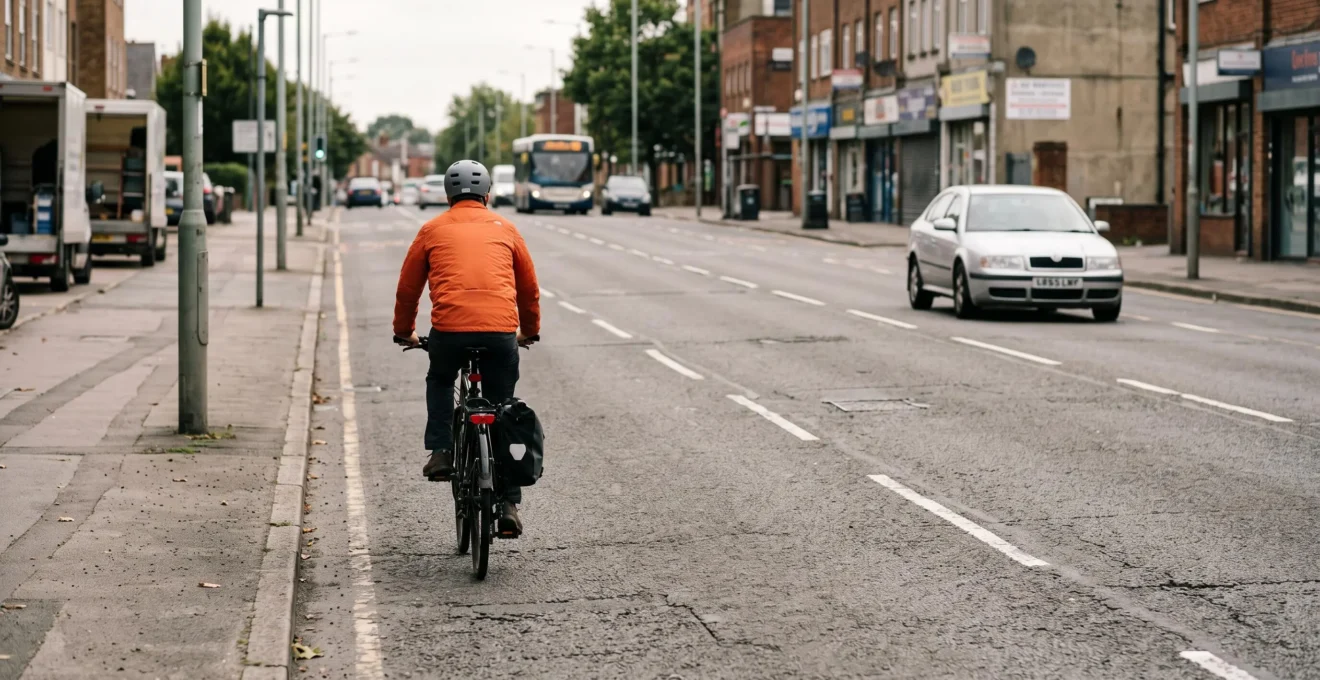
A car approaching at speed can make an ordinary stretch of road feel intimidating. The greatest concern is often not whether the driver has noticed the cyclist, but whether they will leave enough room when overtaking. On rural A-roads and busy urban arterials, a narrow passing gap combined with a substantial speed difference can leave little margin for error.
Reducing close passes starts before the overtaking vehicle reaches you. Choose a predictable road position, move out early where passing would be unsafe, and assess routes according to traffic behaviour rather than distance alone. When a driver does pass dangerously, staying composed and creating separation is generally safer than pursuing a confrontation.
These tactics cannot control every driver’s decisions. They can, however, help make your intentions clearer, discourage attempts to squeeze through unsuitable gaps, and improve your options when conditions deteriorate. The principles apply broadly to road cycling and commuting, although traffic laws, recommended passing clearances and reporting procedures vary between countries.
Close-pass prevention: the essentials
- Own a predictable road position. Stay clear of the gutter and move towards the lane centre before junctions or narrowings where overtaking would be unsafe.
- Reduce exposure intelligently. Compare road layouts, passing behaviour, traffic peaks and visibility before choosing a route or departure time.
- Prioritise separation over confrontation. Hold a controlled line after a frightening pass, disengage from aggressive drivers and use appropriate reporting channels when evidence is available.
- Why Do Drivers Pass Closer on Wide Roads Than You’d Expect?
- How to Choose Your Lane Position With Fast Traffic Without Feeling Like a Target?
- Which Should You Choose: The Direct Busy Road or a 15-Minute Detour With Less Traffic?
- The Reaction That Turns a Close Pass Into a Dangerous Confrontation
- When Should You Schedule Your Ride to Avoid the Worst Traffic Without Losing Your Whole Day?
- How to Take the Lane at Pinch Points Without Starting a Road Rage Moment?
- Which Should You Choose: Reflective Ankle Bands or Reflective Tyres for Night Commutes?
- Do Reflective Ankle Bands Make You Noticeably More Visible Than a Reflective Vest?
Why Do Drivers Pass Closer on Wide Roads Than You’d Expect?
Wide roads do not necessarily make drivers pass closer. Their generous appearance may encourage some drivers to attempt overtakes without changing lanes, while higher traffic speeds can make a marginal passing gap more frightening. However, research has also associated wider lanes with fewer close passes. The important distinction is between the road’s apparent space, its usable width and the driver’s actual overtaking behaviour.
A motorist approaching a cyclist must judge several things simultaneously: the rider’s position, their own vehicle width, oncoming traffic and the amount of room available for overtaking. On a wide-looking carriageway, a driver may believe there is enough space to remain within the same lane. That judgement can become problematic when the apparent width includes a gutter, damaged road edge or space the cyclist needs to avoid hazards.
The absence of clear visual references can make the road’s usable width difficult to interpret. Kerbs, parked vehicles and lane markings can influence how space appears, although the available evidence does not establish that removing a particular reference line directly causes closer overtakes.
Riding at the extreme edge can also create an unhelpful visual invitation: a driver may perceive the remaining part of the lane as a passing corridor. Moving slightly farther out can make the need for a proper overtaking manoeuvre clearer, provided the cyclist chooses a position appropriate to the conditions.
46,769 recorded passes
An Australian observational study involving 162 cyclists identified wider lanes among factors associated with protection against close passing. The findings challenge any general claim that wider roads inherently produce closer passes. Actual overtaking speed was not measured.
PubMed abstract of the Australian passing-distance study, Nolan, Sinclair and Savage, 2021.
The practical lesson is to distinguish passing distance from passing speed. A wide road may provide room for a comfortable overtake while still carrying fast-moving vehicles. Conversely, a narrower road may encourage drivers to wait and change lanes, or tempt an impatient driver to squeeze through.
When assessing a road, look for usable lane width, sight lines, traffic speed, vehicle types and places where the available space suddenly narrows. None of these factors alone tells you how an individual driver will behave.
Once you stop treating wide roads as automatically safe or dangerous, the next decision becomes more useful: where should you ride within the available lane?
How to Choose Your Lane Position With Fast Traffic Without Feeling Like a Target?
Choose your position according to whether a driver can overtake with adequate clearance, not according to how little road space you can occupy. Stay away from the gutter when possible, maintain a steady secondary position where safe overtaking is feasible, and move towards the lane centre when the lane is too narrow for a safe pass. Make these changes early and predictably.
A practical way to understand positioning is to divide the lane into three zones. They are decision categories rather than fixed measurements, and their suitability changes with road width, surface conditions and traffic.
| Position | Typical conditions | Main consideration |
|---|---|---|
| Near-edge position | Only when the edge is usable and sufficient clearance from hazards is maintained | Avoid gutters, debris, drains and unstable road edges |
| Secondary position | Ordinary riding where drivers have enough room to overtake safely | Maintain a consistent line with space to respond to hazards |
| Lane-centre position | Narrowings, junction approaches or lanes where passing alongside would be unsafe | Make unsafe in-lane overtaking less inviting and return to an appropriate position when conditions permit |
For a specific legal reference, Britain’s Highway Code rules for cyclists advise riding in the centre of the lane on quieter roads and when approaching junctions or road narrowings where overtaking would be unsafe. On busy roads with faster traffic, the guidance recommends allowing safe overtaking while keeping at least 0.5 metres from the kerb, and farther out where safer. These are Great Britain recommendations, not universal rules for every English-speaking country.
Visibility involves more than clothing. Your position determines when drivers can see you and whether parked vehicles, roadside objects or road geometry conceal you. Before a junction, moving into a clearly visible position can give approaching drivers more opportunity to recognise your presence.
Eye contact may help you assess whether a driver appears to have seen you, but it cannot prove that they will yield. Watch vehicle movement and keep an escape option rather than relying on a driver’s gaze.
One common mistake is weaving into gaps between parked vehicles and then moving back into traffic. Although the movement may feel courteous, it makes your riding line less consistent and can bring you suddenly into a driver’s path. Follow a smooth line that accounts for parked-car doors and other hazards.
Feeling exposed when leaving the gutter is understandable. Build confidence progressively:
- Practise on a quiet, familiar road with good sight lines.
- Identify a consistent secondary-position reference on the road surface, rather than fixing your wheel to an exact distance regardless of conditions.
- Practise looking over your shoulder while maintaining a straight line.
- Rehearse moving out before a narrowing when traffic is light.
- Progress to busier roads only when you can hold your line comfortably and identify a safe alternative if conditions change.
Confidence comes from making repeatable decisions with clear reasons. If the correct position still leaves a particular road feeling unmanageable, changing the route may offer a better solution than trying to tolerate every difficult overtake.
Which Should You Choose: The Direct Busy Road or a 15-Minute Detour With Less Traffic?
Choose the route with the more manageable overall risk, not automatically the shortest or quietest one. A 15-minute detour may reduce encounters with fast traffic, but it can also add unlit roads, poor surfaces or difficult junctions. Compare the number and character of overtakes, the time exposed to traffic and the hazards on each route before committing to either option.
A direct arterial might carry frequent vehicle movements but have good visibility, consistent road edges and predictable junctions. A quiet alternative could offer long periods without traffic yet include blind bends, narrow lanes or occasional vehicles travelling at substantial speed.
Use the following comparison as a framework, not as a prediction that one type of road is always safer.
| Decision factor | Direct busy road | Quieter detour |
|---|---|---|
| Passing frequency | Potentially frequent overtakes | Potentially fewer overtakes |
| Passing speed | May be high, depending on traffic flow | Can still be high on quiet rural stretches |
| Junction complexity | Possible multi-lane turns and repeated intersections | May have fewer junctions but more restricted sight lines |
| Surface quality | May offer a consistent surface, but with drains or edge debris | May include potholes, gravel or damaged margins |
| Total exposure time | Shorter journey | Approximately 15 additional minutes |
| After-dark conditions | May offer street lighting and greater traffic activity | May include unlit sections and reduced visibility |
The key concept is total journey exposure. A route’s risk cannot be judged simply by counting hazards per kilometre. More minutes on the road can mean more opportunities to encounter vehicles, road defects or adverse conditions. Equally, a longer journey may substantially reduce encounters with uncomfortable passing behaviour.
Neither route length nor traffic volume alone gives a reliable personal collision-risk estimate. What matters for a practical route choice is the combination of conditions and the rider’s ability to manage them.
A hybrid route often makes sense. Use the direct road where it offers clear sight lines and sufficient space, then divert around sections with repeated pinch points or particularly aggressive traffic. Avoid assuming that every minor lane is preferable: a narrow, unlit road without a usable escape margin may be an unsuitable substitute.
Hypothetical commuting decision
A cyclist has a direct 25-minute journey along a busy arterial and a 40-minute alternative using quieter roads. On the direct route, one narrow bridge repeatedly produces uncomfortable overtakes. On the detour, most riding feels comfortable, but the final section is unlit and has poor sight lines.
Instead of treating the alternatives as an all-or-nothing choice, the cyclist identifies a short diversion around the bridge while retaining the better-lit parts of the direct route. This is an illustrative decision method, not a measured safety outcome.
To make the comparison practical, ride each option at representative times when conditions are suitable. Note where passes occur, whether drivers wait or squeeze through, and how much manoeuvring room you have. Revisit the decision after dark if night commuting is part of your routine.
Even a well-chosen route cannot eliminate an unexpectedly close pass. The next skill is knowing how to respond without allowing the incident to develop into a second, avoidable hazard.
The Reaction That Turns a Close Pass Into a Dangerous Confrontation
After a close pass, the most dangerous avoidable reaction is often turning the incident into a confrontation. Swerving, chasing the vehicle, shouting at the driver or approaching the car at the next junction can introduce further hazards. Prioritise keeping control of the bicycle, creating distance and reaching a safe location. If the driving warrants a report, preserve evidence rather than pursuing the motorist.
A close pass can provoke an immediate startle response. A rider may grip the bars tightly, move abruptly towards the kerb or brake without checking what is behind. These reactions are understandable, but abrupt movement can increase danger, especially near potholes, parked vehicles or following traffic.
Where physically possible, hold a controlled line and focus on the road ahead. If you need to slow or stop, do so progressively and move to a safe location when the road environment allows it. You do not need to acknowledge the driver with a gesture or verbal response.
At the next traffic lights, resist the impulse to catch the vehicle and confront its occupant. Following a driver to argue or to identify their destination can escalate an incident, prolong exposure to traffic and create an unpredictable interpersonal situation.
Distinguish between careless judgement and apparent deliberate intimidation without assuming that you can reliably establish intent in the moment. A driver who misjudges clearance and a driver who deliberately threatens a cyclist may require different reporting descriptions, but neither situation is improved by an immediate roadside argument.
If a vehicle appears to be following, threatening or deliberately targeting you, prioritise reaching a populated, safe place and contacting local emergency services when there is an immediate threat. Do not lead a threatening driver to your home.
Once safe, document what you can remember: location, approximate time, vehicle description, direction of travel and the specific manoeuvre. Preserve original camera footage when available. Avoid altering files in ways that might compromise their evidential value.
In England, some police forces operate video-evidence submission processes. For example, Humberside Police‘s Operation Snap submission requirements request reports within seven days, footage showing the complete incident, ideally including one minute before and after, and incident details such as location, date, time and vehicle information. The force limits submitted footage to ten minutes. These requirements are specific to that force and should not be assumed to apply elsewhere.
Depending on the evidence and the authorities’ assessment, reported incidents may result in enforcement action, driver education or no further action. Submitting footage does not guarantee a particular outcome. Available source material also does not establish what proportion of close passes remain unreported.
Five actions after a dangerous close pass
- Regain control: maintain a steady line where possible and identify a safe place to stop. Deliverable: a controlled stop away from moving traffic.
- Disengage: allow the vehicle to leave instead of chasing or confronting the driver. Deliverable: clear separation from the incident.
- Record the facts: note the road, direction, time and what the vehicle did. Deliverable: a short factual incident account.
- Preserve evidence: retain any original camera recording and relevant vehicle details. Deliverable: an unaltered evidence file or written record.
- Check the reporting channel: consult the responsible local authority’s rules before submitting. Deliverable: a report containing the information that authority requests, if the incident is reportable.
Once an incident is safely behind you, consider whether the road or departure time creates recurring exposure to similar conditions. Changing when you ride may be the next practical improvement.
When Should You Schedule Your Ride to Avoid the Worst Traffic Without Losing Your Whole Day?
Start by testing departures 20–30 minutes before or after your usual time rather than making a major schedule change immediately. School-run and commuter traffic often create identifiable busy periods, but their timing varies by route and locality. Record how many vehicles pass, how comfortably they overtake and whether shifting your journey introduces darkness or other hazards.
Traffic peaks are not simply periods when more cars use the road. Congestion can change driver behaviour: some vehicles move slowly but frequently, while other sections allow drivers to accelerate between queues. Frustrated drivers may behave impatiently, although a particular driver’s attitude cannot be inferred from the time of day alone.
Two patterns are worth examining: journeys associated with school starts or finishes, and the broader morning and evening commuting waves. Their overlap can create difficult conditions on roads near schools, employment centres and major junctions.
Rather than assuming a universal rush hour, build a personal traffic calendar for the roads you actually use.
- Choose your current departure time as the baseline.
- On suitable days, try leaving approximately 20 minutes earlier or later.
- Repeat with another small adjustment if your commitments allow.
- Record traffic volume, uncomfortable passes, road conditions and journey duration.
- Compare the observations and choose the slot that offers the best workable balance.
Record the difference between a frequent but comfortable pass and one that forces you to alter your line or leaves inadequate clearance. A simple count of vehicles is not enough to capture the quality of the interactions.
Consider the visibility trade-off. Leaving earlier in winter may exchange congestion for darkness. Delaying an evening ride might reduce traffic while placing the entire journey after sunset. Lower traffic volume does not necessarily compensate for reduced visibility, unfamiliar hazards or an unlit road surface.
Local rules on bicycle lighting must also be considered. For example, Britain’s Highway Code specifies white front and red rear lights at night. Riders elsewhere should check their jurisdiction’s requirements rather than assume British rules apply unchanged.
Weekend patterns may differ substantially from weekday commuting. Recreational traffic, shopping trips and seasonal daylight changes can shift when particular roads are busiest. Retest your preferred slot when the conditions that informed it change.
The result should be a departure time that fits your life, not an impractical attempt to avoid every vehicle. Even at the quietest hour, individual narrowings demand careful positioning.
How to Take the Lane at Pinch Points Without Starting a Road Rage Moment?
Take the lane before reaching the pinch point, not while entering the narrowest gap. Check behind, signal when appropriate and safe, then move smoothly towards the lane centre while approaching drivers still have time to respond. Hold a predictable line through the constriction and move back to a suitable secondary position once the road has widened and overtaking can resume safely.
Pinch points include central traffic islands, narrow bridges, kerb extensions and sections where parked vehicles reduce the usable lane width. These features create a simple problem: there may be enough space for a bicycle or a car to pass through, but not enough for both side by side with safe clearance.
Waiting until the last moment to move out can surprise an approaching driver. An earlier manoeuvre communicates that the available space has changed before the vehicle reaches the constriction.
Use a deliberate sequence: look ahead for the narrowing, check over your shoulder, assess approaching traffic, signal if safe and helpful, then move out smoothly when there is sufficient space. A signal communicates your intention; it does not establish that a driver will yield. Keep both hands on the handlebars when control or braking requires them.
Sometimes the difficulty is not one driver but several. If a short queue develops behind you, the nearest driver may feel pressured to overtake before the gap closes. Trying to accommodate that pressure by squeezing towards the kerb inside the narrow section can remove the clearance you need most.
A short, controlled delay can be safer than inviting an unsafe pass. When taking the lane is appropriate and lawful, maintain your position through the limited section instead of repeatedly yielding and reclaiming space. Once the lane widens, reassess and allow overtaking where safe.
If traffic is building and there is a genuinely safe place to pull over before or after the narrowing, you may choose to let vehicles pass. Do not move into a hazardous gutter, stop inside a restricted gap or make an abrupt manoeuvre merely because someone sounds a horn.
A revving engine or tailgating vehicle can make a cyclist feel pressured to give way immediately. Keep attention on balance, road hazards and a predictable riding line. If behaviour becomes threatening, seek a safe place to disengage rather than trying to enforce your position through an argument.
Think of lane-taking as a bounded manoeuvre with three stages: an early entry, a steady passage and a clear exit. This makes the action easier to plan and avoids remaining unnecessarily in a central position after the hazard has passed.
During daylight, drivers can often interpret these movements through your position and signals. After dark, making your presence and movement recognisable introduces another important layer of safety.
Which Should You Choose: Reflective Ankle Bands or Reflective Tyres for Night Commutes?
Choose reflective ankle bands when your priority is making pedalling movement more recognisable, and reflective tyre sidewalls when you want continuous reflective coverage around the wheels, particularly from the side. They serve different purposes and can complement one another. Neither replaces appropriate bicycle lights, and available evidence does not establish which option produces safer overtaking distances in ordinary night-time traffic.
Human movement provides a distinctive visual pattern. As a cyclist pedals, reflective material on the ankles moves repeatedly through the headlight beam, creating a cue that can help an approaching observer recognise the shape and action of a cyclist.
Reflective tyre sidewalls behave differently. Their reflective material forms a circle around the wheel, producing a visible outline when illuminated from a suitable angle. The wheel’s reflective pattern remains present when the cyclist stops pedalling, unlike the movement cue provided by ankle bands.
Both technologies depend on illumination and viewing geometry. Reflective material returns light towards its source, so its effectiveness depends on the position of vehicle headlights, the observer and the reflective surface.
| Feature | Reflective ankle bands | Reflective tyres |
|---|---|---|
| Primary visual cue | Moving points associated with pedalling | Reflective wheel outlines |
| When pedalling stops | Remain reflective but lose their repeating movement cue | Continue to provide a reflective outline when illuminated |
| Practical flexibility | Can be transferred between bicycles | Remain fitted to the bicycle |
| Side visibility | Provide moving reflective points when visible | Provide a broad wheel-based outline |
| Maintenance concern | Missing, loose or poorly positioned bands | Dirt, wear or damage affecting reflective sidewalls |
The direction from which drivers approach should influence your choice. Frequent crossing traffic makes side-on visibility particularly relevant. On a route dominated by vehicles approaching from behind, reliable rear lighting, an appropriate lane position and any additional reflective cues must work together.
Research supports the value of reflective lower-leg movement for cyclist recognition under specific experimental conditions. However, the available study did not compare ankle bands with reflective tyres, so it cannot establish a measured winner between these products.
Cost and convenience may also affect the decision. Bands are portable and can be worn with different bicycles, while reflective tyres avoid an additional item to remember before each ride. Exact prices and relative cost-effectiveness depend on the products selected and are not established by the supplied research.
Before riding, check that bands are secured over clothing without interfering with the pedals or drivetrain. Inspect reflective tyre sidewalls for dirt, wear and obstruction. Check all required lights separately, because a reflective surface does not emit light on its own.
The next distinction is especially useful for night commuters: being noticed as a reflective object is not necessarily the same as being recognised as a person cycling.
Key takeaways before choosing your night-time visibility gear
- Separate detection from recognition: drivers need to notice your presence and understand that you are a moving cyclist.
- Consider the viewing conditions: street lighting, approach direction and closing speed change which reflective cues are most useful.
- Build a complete visibility system: combine appropriate lights, reflective features and predictable road positioning instead of relying on one garment or accessory.
Do Reflective Ankle Bands Make You Noticeably More Visible Than a Reflective Vest?
Reflective ankle bands can make a pedalling cyclist more recognisable than a vest alone under certain night-time conditions. Experimental research found improved recognition distances with reflective lower-leg markings, including ankle-only markings. That does not mean ankle bands are always better for initial detection, nor does it prove that they reduce close passes. A vest and ankle bands provide different, potentially complementary visual cues.
The difference is between detection and recognition. Detection means noticing that something reflective is present. Recognition means interpreting the object as a cyclist, including the characteristic movement of pedalling legs.
A reflective vest places a relatively large reflective area on the rider’s upper body. It can provide a static visual reference when illuminated by vehicle headlights. Ankle bands create moving reflective points, adding information about the cyclist’s motion.
In a controlled night-time experiment reported by Wood, Black and Tyrrell, 15 young participants drove on a closed road and identified a cyclist pedalling in place while facing approaching vehicles. Reflective lower-leg markings increased cyclist recognition distances compared with vest conditions. Benefits were also observed with ankle markings alone.
The TRID record of the night-time cyclist recognition experiment provides the research abstract. Its findings concern cyclist recognition in a controlled setting, not the distance at which motorists overtake cyclists on public roads or the likelihood of a collision.
Controlled experiment: recognising a cyclist at night
The 2022 study examined how bicycle lights and clothing that highlighted biological motion affected recognition of a cyclist facing approaching drivers at night.
Lower-leg reflectivity improved recognition distance relative to vest conditions, with benefits apparent from ankle markings alone. The experiment involved 15 young observers and did not measure overtaking clearance, rear approaches or crash outcomes.
The practical value of each reflective item depends on the environment. On a road with high closing speeds, providing opportunities for early detection is particularly important. A vest may contribute useful reflective area, but the experiment does not establish a general superiority of vests at higher speeds.
In lit urban environments, moving ankle reflectors may help communicate the pedalling action amid other visual information. On an unlit rural road, the total area and orientation of reflective surfaces may also matter. Neither comparison has been established as a universal ranking by the supplied study.
Active lighting is essential to the broader decision. A functioning front light and rear light provide illumination or visible light without depending entirely on a vehicle’s headlights. Exact legal requirements vary by jurisdiction, and reflective accessories should be considered additions rather than replacements.
Most importantly, visibility cannot guarantee passing clearance. A driver may clearly see a cyclist and still misjudge the available space or choose an unsafe overtaking manoeuvre. Maintaining a suitable road position remains relevant regardless of how much reflective equipment you wear.
On your next night commute, check your lights and reflective equipment before departure, identify the sections where drivers approach from different directions, and choose a predictable road position for each hazard. Combining these decisions provides a more practical approach to reducing close-pass exposure than searching for a single perfect visibility accessory.
Should I pull over whenever a driver follows closely behind me?
Not automatically. First assess whether there is a safe, usable place to pull over and whether moving aside would create a new hazard. Through a narrow section, holding a predictable line may be safer than squeezing towards the kerb. If a safe opportunity to let traffic pass becomes available, you can choose to use it. Avoid abrupt movements or stopping in hazardous locations.
Can a rear-facing cycling camera prevent close passes?
A camera may help document an incident, but the supplied evidence does not establish that wearing one prevents drivers from passing too closely. Its primary practical value in this context is preserving footage that may support a report. Choose a setup that does not interfere with bicycle control and follow local evidence-submission requirements.
What should I do if a road is too narrow for a safe overtake?
Where appropriate and lawful, take a clear position before the narrow section, after checking behind and signalling when safe. Maintain a steady line until the road widens enough for overtaking with adequate clearance. If conditions feel unmanageable or a driver behaves threateningly, seek a safe opportunity to stop, disengage or choose another route.
Does a minimum passing-distance law mean drivers must leave the same gap everywhere?
No. Passing-distance rules and guidance differ between countries and sometimes between regions or road conditions. Do not assume a particular numerical clearance applies everywhere. Check the official road rules for the jurisdiction where you ride, and remember that a legal minimum does not necessarily make every overtake appropriate when visibility, speed or road geometry is poor.
Is riding on the pavement safer than remaining on a busy road?
Not necessarily. Pavements or sidewalks may introduce conflicts with pedestrians, driveways and junction crossings, and cycling on them may be restricted by local law. Where a suitable, lawful cycle facility exists, assess its continuity and junction design. Otherwise, consider a safer alternative route rather than assuming that leaving the carriageway always reduces risk.