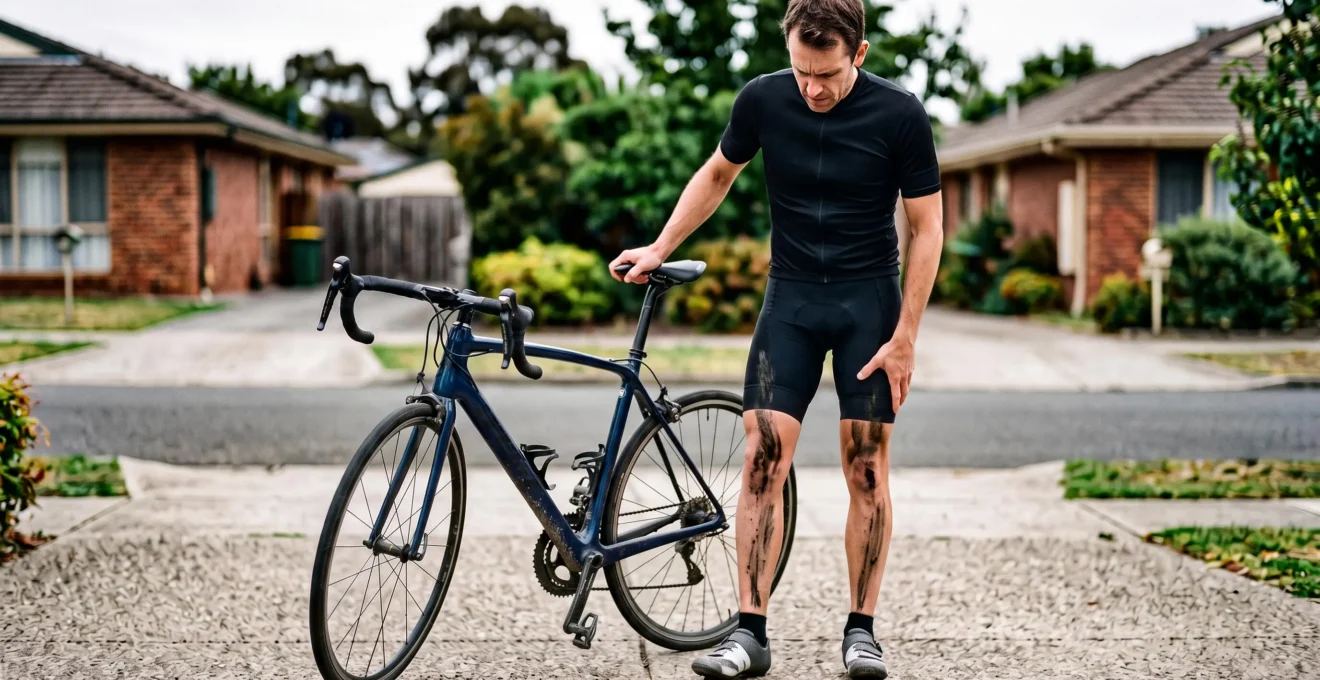
Your legs felt fine when you finished Sunday’s ride. By Tuesday morning, walking downstairs feels awkward, your thighs are tender, and you’re wondering whether those extra hills caused an injury. Should you ride tomorrow, or is your body telling you to stop?
Muscle soreness that develops 24–48 hours after an unfamiliar cycling effort is often delayed-onset muscle soreness (DOMS). It is a common response to training that challenges muscles in a new way, particularly when workload rises suddenly. However, timing alone cannot establish that pain is harmless.
The useful distinction is how the discomfort behaves. Diffuse muscle tenderness that gradually improves is different from sharp knee pain, persistent Achilles discomfort, or pain concentrated over a bone. Recognizing that difference helps you protect recovery without automatically abandoning your next ride.
The goal is not to eliminate every trace of soreness. It is to choose an appropriate training load, identify symptoms that deserve medical attention, and return to hills and longer distances without repeatedly overwhelming your legs.
What cyclists need to know about sore legs
- Normal DOMS follows a recognizable timeline: it commonly begins 12–24 hours after unfamiliar exercise, peaks within 24–72 hours, and gradually settles over several days.
- Location and progression matter more than timing alone: diffuse muscular tenderness is more consistent with DOMS than sharp, worsening, or highly localized joint, tendon, or bone pain.
- Choose recovery based on symptoms: rest or brief, genuinely easy spinning may be appropriate, but neither foam rolling nor a temporary reduction in stiffness proves readiness for hard training.
- Why Does Muscle Soreness Peak at 48 Hours Instead of Right After the Ride?
- How to Tell Normal DOMS From an Injury That Needs Attention
- Which Should You Do When Sore: Easy Ride or Complete Rest?
- The “Push Through It” Mistake That Turns Soreness Into Tendon Pain
- When and How to Add Hills Back After a DOMS Week Without a Repeat
- The 8-Minute Foam Rolling Routine to Use After Riding
- How to Structure 3 Weekly Rides So the Long Ride Gets Easier Within 6 Weeks
- How to Build Endurance for 100 km Rides on Only 3 Workouts a Week
Why Does Muscle Soreness Peak at 48 Hours Instead of Right After the Ride?
Delayed-onset muscle soreness often feels worst around 48 hours after exercise because the response to unfamiliar muscular loading develops gradually rather than immediately. Exercise-related muscle disruption and subsequent biological responses contribute to tenderness and stiffness. However, 48 hours is not an exact deadline: DOMS commonly peaks anywhere between 24 and 72 hours after the effort.
During unfamiliar or demanding exercise, muscle fibers and surrounding structures experience mechanical stress. This can trigger changes in muscle function, local sensitivity, and inflammatory signaling. These processes unfold over time, helping explain why a cyclist may finish a demanding session feeling relatively comfortable but struggle with stairs two mornings later.
A Frontiers in Physiology review of eccentric muscle contractions describes DOMS typically emerging 12–24 hours after unaccustomed eccentric exercise, peaking after 24–72 hours, and generally resolving within 5–7 days. The review also emphasizes individual variability and the complexity of the underlying mechanisms.
24–72 hours
The typical window for peak delayed-onset muscle soreness following unfamiliar eccentric exercise, rather than a fixed 48-hour rule.
Frontiers in Physiology, 2019 review of eccentric muscle contractions.
That delayed pattern differs from the immediate fatigue, burning sensations, or heaviness experienced during a hard ride. Those sensations may fade relatively quickly once the effort ends. DOMS, by contrast, becomes noticeable later and can temporarily make ordinary movements uncomfortable.
Eccentric contractions are particularly relevant. They occur when a muscle generates force while lengthening, such as when controlling a downhill step or resisting a load. Unfamiliar eccentric work is a well-established trigger for delayed soreness.
Cycling itself is dominated by other contraction patterns, so it would be misleading to assume that riding downhill automatically creates the same eccentric stress as downhill running. Nevertheless, new climbing demands, prolonged high-force pedaling, a sharp increase in total workload, or accompanying off-bike activity can leave muscles feeling unusually sore. Holding position or repeatedly getting out of the saddle may also introduce unfamiliar demands.
The location of tenderness can offer useful context. Sore quadriceps after a climbing-heavy ride, for example, may reflect increased muscular work. It does not reliably identify the exact contraction or movement responsible.
Training history changes the response. Muscles accustomed to a particular workload generally tolerate repeated exposure better than muscles encountering that effort for the first time. Age, fitness, individual physiology, and exercise characteristics also influence the soreness timeline.
Timing is only the first clue. The next step is to check whether the discomfort has the muscular, improving pattern expected from DOMS—or characteristics that deserve a different response.
How to Tell Normal DOMS From an Injury That Needs Attention
Normal DOMS is usually diffuse muscle tenderness that appears after unfamiliar effort, peaks over the following days, and then improves. Pain that is sharp, highly localized, progressively worsening, or centered on a joint, tendon, or bone deserves greater caution. No single symptom can diagnose an injury, but the location, behavior, and daily trend help determine whether riding is appropriate.
The most useful self-check combines three observations: where it hurts, what provokes it, and whether it is improving. Both legs may feel sore after a demanding cycling session, but DOMS can also affect one leg more than the other. Symmetry is a clue, not a diagnostic test.
Use the following comparison to decide whether ordinary recovery measures are reasonable or further assessment is needed.
| What to check | More consistent with DOMS | Potential warning pattern |
|---|---|---|
| Location | Broad tenderness in muscle groups such as the quadriceps or glutes | A specific point on a tendon, joint, or bone |
| Sensation | Dull aching, stiffness, or tenderness | Sharp, stabbing, or unusual focal pain |
| Timing | Develops after exercise and gradually settles | Begins suddenly during a movement or keeps intensifying |
| Gentle movement | May temporarily feel more comfortable after warming up | Consistently aggravates pain or causes altered movement |
| Day-to-day trend | Improves after the peak | Worsens, changes location, or fails to follow an improving trend |
| Function | Stiffness without major loss of normal function | Marked weakness, inability to bear weight, or inability to move normally |
Pay special attention to discomfort at the front of the knee, around the Achilles tendon, or over a precise point on the shin or hip. Those areas should not automatically be treated as ordinary muscular soreness. Persistent, localized bony tenderness, particularly with weight-bearing pain, warrants stopping impact or aggravating activity and seeking clinical assessment.
Likewise, pain just below the kneecap during loaded movements may have a different explanation from soreness throughout the thigh. Symptoms alone cannot establish the diagnosis.
A simple 24-hour retest makes the trend easier to judge. Compare everyday movements at roughly the same time on consecutive days: walking downstairs, rising from a chair, and, when appropriate, sitting on the bike or briefly turning the pedals without resistance. The question is whether familiar activities are becoming easier, remaining unchanged, or provoking more pain.
Improvement supports—but does not prove—a routine recovery pattern. Increasing pain, new swelling, or discomfort shifting toward a tendon or joint should prompt a change in plan rather than another hard ride.
Your five-step sore-leg safety check
- Map the discomfort: write down whether it is in the muscle belly, joint, tendon, or a precise bony point. Your result is a short location note.
- Describe the sensation: record whether it feels dull and widespread or sharp and localized. Your result is a consistent symptom description.
- Test ordinary movement: note how stairs, getting up from a chair, and comfortable walking feel without forcing painful movements. Your result is a baseline you can compare tomorrow.
- Compare the next 24 hours: record whether the same activities are easier, unchanged, or worse. Your result is a clear recovery trend.
- Choose and record the next action: select rest, a cautious easy spin, or medical assessment based on the pattern and any warning signs. Your result is a decision made before the next ride.
Some symptoms require urgent medical attention. Severe muscle pain or swelling after an unusually demanding effort, especially alongside dark or tea-colored urine, marked weakness, or unusual fatigue, can indicate exertional rhabdomyolysis. The CDC/NIOSH information on rhabdomyolysis symptoms explains that this potentially serious condition requires prompt medical testing; symptoms alone cannot confirm or exclude it.
Seek urgent assessment for significant unexplained weakness, severe swelling, or dark urine after strenuous exercise. Inability to bear weight, rapidly worsening pain, or concerning neurological symptoms also warrant prompt attention. New numbness or tingling, persistent pain at rest or at night, unexplained bruising, and recurrent focal pain should not be dismissed as ordinary DOMS.
Once serious warning signs have been excluded, the next decision is practical rather than diagnostic: whether gentle cycling offers a reasonable way to stay mobile or whether complete rest is the better choice.
Which Should You Do When Sore: Easy Ride or Complete Rest?
Choose an easy ride only when soreness is mild to moderate, clearly muscular, and improving, and you can pedal normally without provoking pain. Choose complete rest when discomfort is substantial, movement remains difficult, or fatigue is pronounced. Easy spinning may temporarily reduce perceived stiffness, but it still adds workload and does not guarantee faster muscle recovery.
Both options have advantages. Rest avoids another training stimulus while sore muscles recover. An easy spin may feel more comfortable than remaining completely inactive, especially when stiffness improves after gentle movement.
However, feeling looser is not the same as being fully recovered. A temporary reduction in discomfort during a warm-up does not establish that muscle function or exercise tolerance has returned to baseline.
If you decide to ride, set the limits before leaving home. As a conservative example—not a clinically validated DOMS prescription—choose a flat route and a short session of approximately 15–30 minutes. Stay in an easy gear, pedal smoothly, and keep the effort low enough to speak comfortably in full sentences.
A higher comfortable cadence with less pedal resistance may help avoid forceful grinding, but do not force an unusually high cadence or maintain a motion that feels awkward. Stop if discomfort becomes sharp, increases steadily, or causes you to change your pedaling technique.
Your upcoming training schedule also matters. If an important long ride or event is approaching, a short recovery spin or rest day is preferable to testing whether you can still complete intervals. Preserve recovery capacity rather than treating the sore day as an opportunity to gain fitness.
When no key ride is imminent, there is even less reason to rush. Rest, walking within comfort, or a very short spin may be enough.
One common mistake is starting an easy solo ride and joining a faster group halfway through. A few accelerations, a competitive climb, or an unexpected headwind can turn a recovery session into another substantial effort.
Choose your route, duration, and turnaround point in advance. If keeping the ride easy depends on other people slowing down, choose a different session.
The most important boundary is between ordinary muscular discomfort and pain that changes with loading. Crossing it repeatedly, particularly during climbs, can turn a manageable recovery week into a more complicated training interruption.
The “Push Through It” Mistake That Turns Soreness Into Tendon Pain
Hard training through substantial DOMS can become a problem when reduced muscular comfort or function changes how a cyclist handles load. Continuing intense climbs or high-resistance pedaling despite worsening symptoms may aggravate the knee or Achilles tendon. However, DOMS does not automatically cause tendon injury, and a direct transfer of stress from sore muscles to tendons has not been established as a universal mechanism.
The common practical error is assuming that any discomfort appearing after a hard ride must be part of the same harmless soreness process.
Imagine a cyclist who completes an unfamiliar hilly ride on Sunday. By Tuesday, the quadriceps are noticeably sore. On Wednesday, the cyclist feels somewhat better and resumes steep, big-gear climbing. The next day, the thigh tenderness is fading, but a small, specific spot below the kneecap hurts whenever pedaling force increases.
This is a hypothetical example, not proof of a particular injury mechanism. What matters is the symptom change: broad muscular soreness has been replaced or accompanied by localized, load-dependent pain.
Tendons transmit force between muscles and bones. Their responses to exercise depend on the intensity, frequency, and progression of loading, alongside individual capacity. A sudden increase in climbing demands may be poorly tolerated even if the initial DOMS is resolving.
A Dutch multidisciplinary guideline on anterior knee pain and patellar tendinopathy identifies localized pain near the lower pole of the kneecap that changes with loading as an important feature of patellar tendinopathy. It recommends progressive exercise-based management following appropriate clinical assessment, rather than assuming rest alone is always the treatment.
That does not mean every cyclist with front-of-knee pain has patellar tendinopathy. Patellofemoral pain and other conditions can produce overlapping symptoms, and a clinician may need to distinguish them.
Watch for discomfort that repeatedly appears during hills, out-of-saddle accelerations, or high-resistance pedaling; returns at the same location; or becomes more pronounced after each demanding session.
Similar caution applies to new pain around the Achilles tendon, especially if ordinary walking or the next morning’s first steps become uncomfortable.
The day-three or day-four trap is particularly relevant. Soreness may have diminished enough for cycling to feel possible, while normal performance and load tolerance have not fully returned.
Do not use reduced soreness as the sole green light for intensity. Check movement quality, localized symptoms, and the response to an easy ride before bringing back hard efforts.
If tendon or joint symptoms persist or recur, reduce aggravating loading and seek professional assessment. Continuing to push through escalating pain is not the same as the controlled loading used in a structured rehabilitation program.
Once the original soreness has settled and comfortable flat riding has returned, climbing can be rebuilt progressively. The safest progression is based on your response to load rather than the number of days since the uncomfortable ride.
When and How to Add Hills Back After a DOMS Week Without a Repeat
Reintroduce hills when ordinary movement is comfortable, soreness has resolved or become minimal, and at least one easy flat ride has been completed without symptoms during or afterward. Start with short, moderate climbs in easy gears rather than returning immediately to your hardest route. Progress according to how your legs respond over the next day or two, not a fixed recovery date.
Hill climbing increases the force demands of cycling, especially when gradients encourage slower cadences and harder pedal strokes. The problem is not that hills are inherently harmful. It is that a sudden increase in climbing intensity or total training load may exceed what your body has recently adapted to.
It is also important to separate climbing from descending. Downhill cycling is not automatically equivalent to eccentric downhill running. Braking demands, sustained riding position, and muscular stabilization may contribute to fatigue, but a specific cycling-descent DOMS effect cannot be assumed from general eccentric-exercise research.
Before your first hill session, check that you can walk and climb stairs comfortably, begin pedaling without significant stiffness, and finish a flat ride without worsening symptoms later that day or the following morning.
A practical, conservative return could look like this:
- First hill session: choose one or two short, manageable climbs, remain seated when comfortable, use low-resistance gearing, and avoid attacking the gradient.
- Second week: repeat a similar moderate session if the first caused no meaningful symptom recurrence. Increase only a small aspect of the challenge rather than every variable at once.
- Following weeks: add climbing duration or another hill gradually, keeping the rest of the training week manageable.
- Later progression: reintroduce longer climbs, demanding descents, or bigger-gear efforts separately rather than combining them into one abrupt workload increase.
One moderate hill session per week during the first two weeks is a reasonable example of a cautious return, not a research-validated requirement for every cyclist.
The overlooked issue is cumulative workload. A rider may blame Saturday’s hills even though the difficult week included hard intervals on Tuesday, extra commuting, poor recovery, and an unusually long Sunday ride.
When bringing hills back, consider shortening another workout or lowering its intensity. Replacing some existing workload with climbing is usually more controllable than adding a new hill session on top of an unchanged schedule.
Track what happens afterward. If your legs feel mildly tired but return toward normal before the next planned session, the load may be appropriate. If pronounced DOMS reappears or localized pain develops, scale back and reassess.
While training load determines much of the recovery challenge, simple comfort measures can make the quieter days easier. Foam rolling is one option, provided it is treated as a mobility aid rather than a shortcut back to intense riding.
The 8-Minute Foam Rolling Routine to Use After Riding
An eight-minute foam rolling routine can help some cyclists manage temporary stiffness and perceived muscle soreness after riding. Work gently through the quadriceps, calves, glutes, and outer thigh muscles, avoiding direct pressure on joints and bony landmarks. Foam rolling may improve comfort, but it has not been shown to guarantee faster tissue repair or make hard training safe before recovery is complete.
Following your cool-down, place a foam roller on a stable floor and use slow, controlled movements. Pressure should be tolerable enough to allow normal breathing and relaxed muscles. More discomfort is not necessarily more effective.
This sequence is a practical eight-minute example, not a standardized protocol established by clinical trials.
Allow approximately one minute for each side of each area. Keep passes short, pause briefly over tolerably tender muscle tissue if comfortable, and avoid aggressive pressure.
| Time | Area | How to perform it |
|---|---|---|
| 0:00–2:00 | Quadriceps | Roll the front of each thigh slowly for one minute, staying on the muscle rather than the kneecap. |
| 2:00–4:00 | Calves | Roll each calf from above the ankle toward below the knee, avoiding direct pressure on the Achilles tendon and joints. |
| 4:00–6:00 | Glutes | Use a seated position to apply gentle pressure to each buttock, adjusting your support to control intensity. |
| 6:00–8:00 | Outer thigh muscles | Use light pressure over the muscular portion of the outer thigh, avoiding forceful rolling directly along the iliotibial band, hip bone, or outer knee. |
Do not roll an acutely painful area to the point of bracing, holding your breath, or wincing. On particularly sore days, gentler pressure—or skipping the area entirely—may be more appropriate.
There is research support for modest improvements in perceived soreness. A PubMed systematic review of foam rolling and muscle soreness published in 2024 included 16 studies involving 515 participants. The findings support foam rolling as a possible way to reduce perceived post-exercise soreness, with limitations in the evidence and its applicability to particular routines.
16 studies · 515 participants
The evidence base examined in a 2024 systematic review and meta-analysis of foam rolling and exercise-induced muscle soreness. These figures do not validate this specific eight-minute sequence or establish faster muscle repair.
Journal of Bodywork and Movement Therapies, systematic review and meta-analysis published in 2024.
The distinction between comfort and recovery matters. A muscle may feel less tender after rolling without having regained full strength or tolerance for high-intensity work. Using the roller to make the next hard workout feel possible defeats the purpose of managing recovery.
Foam rolling can fit on a rest day or after a low-intensity ride, alongside ordinary movement and adequate recovery. Skip direct pressure over visible bruising, unexplained swelling, a suspected injury, or new focal pain until the cause has been assessed.
Reducing repeated soreness ultimately depends more on how workouts are distributed than on any single recovery technique. A balanced three-ride week creates room for endurance gains without requiring every outing to be demanding.
How to Structure 3 Weekly Rides So the Long Ride Gets Easier Within 6 Weeks
A practical three-ride week combines one longer steady endurance ride, one shorter session with moderate training intensity, and one genuinely easy ride. Over six weeks, hold your workload steady initially, extend the long ride gradually when recovery permits, and include an easier week. If you are returning from substantial DOMS, make all three rides easy in the first week instead of immediately restarting your previous workload.
The aim is to give each ride a distinct purpose. The long ride builds familiarity with sustained pedaling and endurance demands. The shorter moderate ride provides a controlled fitness stimulus. The easy ride maintains comfortable movement without becoming another exhausting session.
Placing lighter days or rest days between more demanding workouts also gives you opportunities to assess the response to training.
For example, a cyclist might ride easily on Tuesday, complete a shorter fitness-focused session on Thursday, and undertake a longer conversational-paced ride on Sunday. Those days are illustrative; the important feature is the separation between the harder demands.
Following a difficult DOMS week, the first week should prioritize comfortable riding over fitness testing. No intense hill repeats, maximal accelerations, or attempts to compensate for missed sessions are necessary.
The following framework is an illustrative coaching progression, not a clinical protocol or a guarantee of a particular six-week result.
| Week | Three-ride structure | Long-ride decision |
|---|---|---|
| 1 | Three easy, manageable rides | Choose a comfortable duration below the workload that triggered pronounced soreness. |
| 2 | One easy ride, one controlled moderate ride if symptom-free, one steady long ride | Maintain a manageable baseline rather than extending automatically. |
| 3 | Easy ride, moderate session, steady long ride | Extend modestly only if the previous week’s recovery was satisfactory. |
| 4 | Reduced overall intensity or duration | Use an easier week to absorb training and reassess fatigue. |
| 5 | Resume the balanced three-ride structure | Return to a manageable long ride, increasing only if recovery supports it. |
| 6 | Easy ride, moderate session, longer steady ride | Consolidate or extend according to symptoms and sustained comfort. |
A useful feedback rule is to compare how your legs feel in the 24–48 hours after the long ride. If substantial soreness is still present on day two, repeat or reduce the duration next time rather than automatically adding distance.
If you are moving comfortably by the next morning and remain symptom-free through the following sessions, a modest increase may be reasonable. Feeling fresh the next day is encouraging, but it is not permission for unlimited progression.
Adaptation is not perfectly linear. Work stress, sleep, previous training, and the demands of each route can all change how an identical ride feels. A six-week plan should therefore be adjusted according to repeated recovery observations, not treated as a contract requiring weekly increases.
For cyclists prone to strong DOMS, the easiest improvement may be reducing how many demanding sessions occur in the same week. Keeping the recovery ride truly easy preserves the purpose of the entire structure.
Once this weekly rhythm becomes sustainable, the same structure can support a longer goal: preparing for a 100 km ride without adding a fourth or fifth workout.
Key takeaways before building toward 100 km
- Establish a long-ride duration you can recover from consistently before increasing distance.
- Keep the other two weekly sessions purposeful rather than allowing every ride to become hard.
- Include lighter weeks and use recurring soreness as a reason to reassess workload, not as a target to overcome.
How to Build Endurance for 100 km Rides on Only 3 Workouts a Week
You can prepare for a 100 km cycling ride with three weekly workouts by progressively building your longest ride while using the other two sessions to maintain aerobic fitness and support recovery. You do not necessarily need to complete 100 km repeatedly in training. However, the distance you should reach beforehand depends on experience, terrain, pacing, fueling, available preparation time, and how consistently you recover.
The long ride is the central endurance stimulus because it builds experience with sustained time in the saddle. It also gives you opportunities to practice drinking, eating, pacing, and managing comfort over longer distances.
The two shorter sessions serve complementary roles. One can provide moderate intensity to maintain fitness; the other stays easy enough to avoid adding unnecessary fatigue before the next long ride.
A common preparation guideline is to build the longest training ride toward roughly two-thirds to three-quarters of the target event distance. For a 100 km goal, that corresponds to approximately 67–75 km. This is a practical planning convention, not a universal evidence-based completion threshold or a guarantee that the final distance will feel comfortable.
Some experienced cyclists can complete 100 km with a shorter longest training ride, while newer riders may benefit from additional distance practice and a longer preparation period. Elevation, weather, accumulated fatigue, and available support can substantially change the challenge.
Fueling practice is equally important. Use progressively longer sessions to discover which foods and drinks you tolerate while riding and whether your planned intake is practical. An endurance ride should not become an experiment with unfamiliar nutrition on the event day.
With only three weekly workouts, there can be a temptation to make every session count by increasing intensity and distance simultaneously. This approach often works against consistent training when recovery is already limited.
Instead, plan a lighter week after roughly two or three more demanding weeks, adjusting the frequency according to your experience and fatigue. A lighter week is a coaching strategy for workload management, not a fixed medical requirement.
Continue using the soreness pattern as a training dashboard:
- If leg discomfort remains diffuse, mild, and improves predictably, monitor recovery and avoid unnecessary jumps in load.
- If pronounced DOMS repeatedly follows each increase, hold or reduce the long-ride duration and review the week’s other demands.
- If new focal knee, tendon, or bone pain appears, stop treating the issue as routine muscular recovery and seek appropriate assessment.
- If normal movement remains unusually difficult or symptoms fail to improve, prioritize evaluation and recovery before distance progression.
The most effective three-ride schedule is one you can repeat consistently. Completing one exceptionally long ride matters less than building a sequence of manageable weeks that gradually expand endurance without recurring setbacks.
Before planning the next training week, review your latest ride, note how your legs responded over the following two days, and choose a long-ride distance you can realistically recover from. Let that recovery record guide the next increase rather than forcing progress through persistent discomfort.
Can you have DOMS in only one leg after cycling?
Yes. DOMS can affect one leg more than the other, especially when muscular demands or pre-existing training differences are uneven. However, one-sided discomfort that is sharp, localized near a joint or tendon, or worsening rather than improving deserves further assessment. Symmetry alone cannot distinguish DOMS from injury.
Does muscle soreness mean your cycling workout was effective?
Not necessarily. DOMS often follows unfamiliar exercise, but its intensity is not a reliable measure of training quality, fitness improvement, or the amount of muscle damage. As your body becomes accustomed to a workload, the same type of training may produce less soreness while still contributing to adaptation.
Should you stretch your quadriceps when DOMS is at its worst?
Gentle, comfortable movement may help you manage stiffness, but forceful stretching is not necessary and should not be used to push through pain. Avoid aggressive stretching over tender muscle tissue or a painful tendon. Stretching is not a substitute for reducing training load or seeking assessment when symptoms are unusual.
Can leg muscles still be recovering after the soreness disappears?
Yes. Perceived soreness and recovery of muscle function do not always follow identical timelines. A cyclist may feel much more comfortable before returning to previous strength or performance. Comfortable daily movement, an easy ride without symptom recurrence, and a gradual return to intensity are more informative than the absence of tenderness alone.
What if your legs are still very sore five days after a ride?
DOMS can last approximately five to seven days after unfamiliar demanding exercise, but it should generally show an improving trend. If soreness remains severe, normal function is substantially impaired, or pain is worsening or becoming localized, seek medical assessment. Severe pain accompanied by dark urine, marked weakness, or significant swelling requires urgent evaluation rather than further exercise.