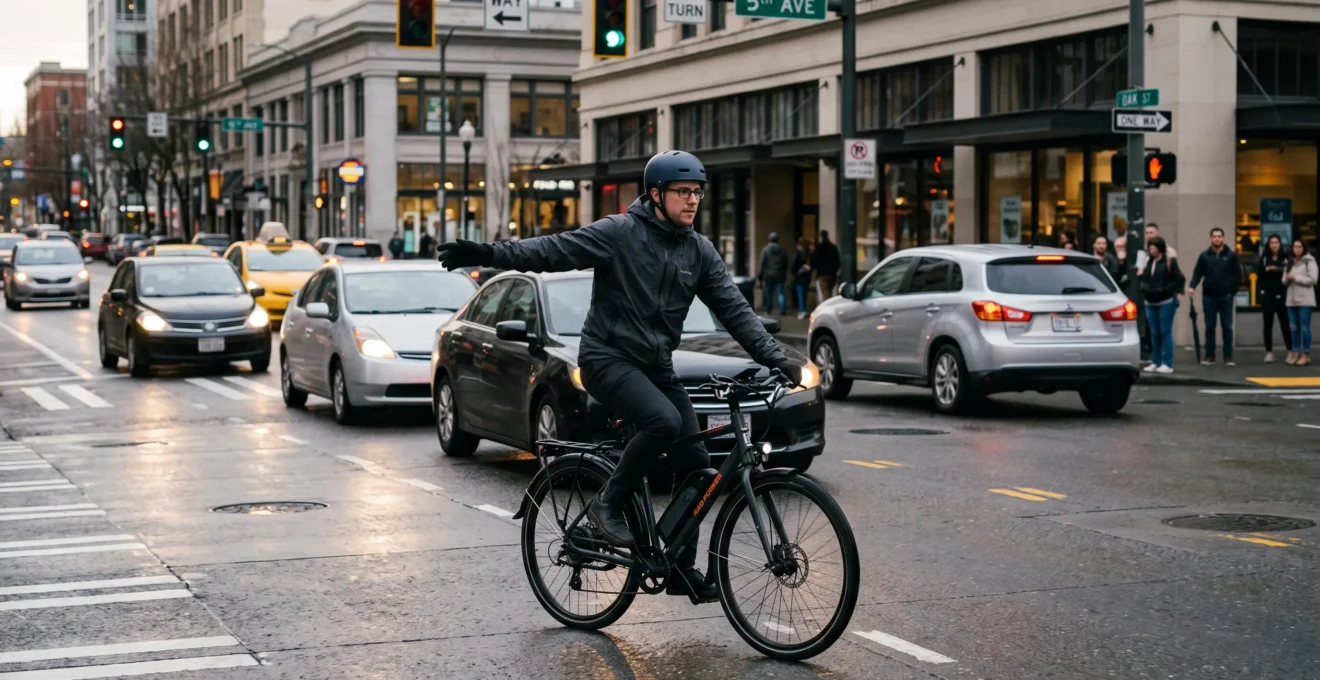
A car draws level with your bicycle just before a junction. Its indicator flashes, its front wheels begin to turn, and suddenly the space you expected to ride through is disappearing. Whether that vehicle is turning left in London or right in a North American city, the underlying problem is similar: your route and the driver’s route are about to cross.
Crossing mixed-traffic intersections safely starts before the stop line. Choose a visible position, reduce speed when intentions are uncertain, communicate early, and keep an escape option. The objective is not to force drivers to acknowledge you. It is to make your movements predictable while avoiding positions where another road user’s mistake leaves you nowhere to go.
The techniques below cover ordinary junctions, multi-lane signals, protected cycle lanes, traffic queues and roundabouts. They apply as defensive riding principles across English-speaking countries, but road rules, lane directions and permitted turning movements vary. Always follow local signs, signals and traffic law.
Safer intersection cycling: the essential decisions
- Choose a visible lane position before entering the junction, not while a vehicle is already turning across you.
- Stay out of turning vehicles’ blind spots, particularly beside buses, vans and trucks.
- Signal before changing position, but treat vehicle movement—not eye contact or indicators alone—as the evidence of what a driver may do.
- Use designated two-stage turns or wait for another signal phase when the available manoeuvre feels rushed or unpredictable.
- Why Are Intersections Where Most Urban Cycling Near-Misses Happen?
- How to Position Yourself 30 Metres Before an Intersection So Drivers Don’t Miss You
- Which Should You Choose: Take the Lane or Use a Two-Stage Turn Box at Big Junctions?
- The Filtering Move That Puts You in a Driver’s Blind Spot at Intersections
- When Should You Wait One Light Cycle to Cross an Intersection More Safely?
- How to Approach Side-Road Crossings in a Protected Lane Without Being Invisible
- Which Hand Signal Works Best at Roundabouts: Traditional or More Assertive Cues?
- How to Use Cycling Hand Signals So Drivers Actually React in Busy Traffic
Why Are Intersections Where Most Urban Cycling Near-Misses Happen?
Intersections concentrate several potential conflicts into a small space: vehicles turn across cyclists, drivers emerge from side roads, and faster traffic approaches from behind. These overlapping movements help explain why junctions feel particularly threatening. However, available British casualty statistics do not establish that most urban cycling near-misses occur at intersections; they measure reported injuries and deaths, not near-misses.
In Great Britain, Department for Transport figures for 2020–2024 show that 52% of adjusted serious cyclist injuries occurred at junctions, compared with 37% of cyclist fatalities. That distinction matters: junctions account for a substantial share of serious injuries, but fatalities also occur frequently elsewhere.
52%
Of adjusted serious pedal cyclist injuries in Great Britain during 2020–2024 occurred at junctions. This figure does not measure near-misses or predict an individual rider’s collision probability.
Department for Transport’s 2024 pedal cyclist casualty statistics
Recognising the conflict type makes the situation easier to assess:
- Hook turn: a vehicle overtakes or draws alongside, then turns across the cyclist’s path. In left-driving traffic this commonly involves a left turn; in right-driving traffic, a right turn.
- Kerbside squeeze: a driver passes where the remaining road width cannot comfortably accommodate both vehicles.
- Emerging vehicle: a driver entering from a side road or driveway crosses the cyclist’s route.
- Crossing or opposing turn: a turning vehicle approaches from another direction and intersects the cyclist’s line.
Each situation requires a different response. An overtaking vehicle turning across you calls for caution about its lateral movement. An emerging vehicle requires attention to whether its front wheels begin rolling into your path.
Some conflicts involve a driver failing to observe or yield. Others are made harder to manage when a cyclist occupies a narrow, low-visibility position or changes direction unpredictably. Positioning can reduce exposure, but it does not transfer responsibility for a driver’s unsafe manoeuvre to the cyclist.
After a near-miss, perform a short personal risk audit. Record the conflict type, where it happened relative to the junction, and what you were doing three seconds beforehand. Were you filtering, braking, signalling, changing lanes or travelling beside a turning vehicle?
Compare several incidents over time. Repeated circumstances may identify an approach worth changing, even without a formal collision analysis.
Once the likely conflict is clear, the next decision is where to place your bicycle early enough for other road users to respond.
How to Position Yourself 30 Metres Before an Intersection So Drivers Don’t Miss You
About 30 metres before a junction is a useful planning reference, not a universal positioning rule. Check behind, assess traffic speed and lane width, then choose a predictable position before reaching the turning area. Use the centre of your lane where overtaking would be unsafe, or a suitable secondary position when adequate passing space exists.
At 15 km/h, a cyclist covers approximately 30 metres in just over seven seconds. At 25 km/h, the same distance takes a little over four seconds. These are illustrative travel-time calculations, not prescribed reaction distances. Faster roads, complex junctions and poor visibility call for earlier decisions.
The UK’s Highway Code’s rules for cyclists recommend a central lane position when approaching junctions where overtaking would be unsafe, provided the rider feels able to adopt it safely.
Two riding positions are especially useful:
- Primary position: near the centre of the chosen traffic lane. This can discourage unsafe overtaking and make the cyclist’s presence more apparent when a lane is too narrow to share.
- Secondary position: toward the side of the lane, while maintaining enough clearance from the kerb, drains, parked vehicles and door-opening zones. This may be appropriate when the lane is sufficiently wide and overtaking can occur safely.
Consider a hypothetical approach where parked vehicles end immediately before a signalised junction. Staying close to the kerb may invite a driver to squeeze past just as the available width narrows. Moving into a suitable primary position earlier, after checking behind and when safe, communicates that the lane cannot be shared through that section.
Look for buses stopping or pulling out, queues changing lanes, and vehicles beginning to turn. An indicator is useful information, but it is not a guarantee. Likewise, a driver looking toward you has not necessarily recognised your speed or intended route.
Read movement rather than apparent eye contact. Front-wheel angle, creeping forward and changes in vehicle speed offer additional clues. None reliably proves that a driver will yield.
Approach at a speed that allows controlled braking if the situation changes. Keep both hands available for braking when necessary, and avoid committing to a narrow gap simply to preserve momentum.
Five checks before entering the junction
- Identify the next potential conflict point; name the turning movement or vehicle that could cross your route.
- Check behind and to the relevant side; establish whether a lane-position change is currently safe.
- Choose a suitable riding position; confirm that your intended path avoids an obvious kerbside squeeze.
- Adjust your approach speed; verify that you can stop within the clear distance ahead.
- Observe the nearest conflicting vehicle; identify whether its wheels and speed indicate waiting, turning or emerging before proceeding.
The principle is preparation, not rigidly occupying the lane centre. At larger junctions, the same assessment determines whether a direct turn or a staged crossing is more suitable.
Which Should You Choose: Take the Lane or Use a Two-Stage Turn Box at Big Junctions?
Choose a direct turn when you can safely enter the correct lane, remain visible and complete the manoeuvre under the applicable traffic rules. Prefer a designated two-stage turn when moving across busy or fast traffic lanes would be difficult. Neither method is universally safer: junction design, signal phases, traffic density and your confidence determine the better choice.
A direct turn involves moving into an appropriate lane before turning through the junction. A two-stage turn separates the manoeuvre into two crossing movements, generally allowing a rider to avoid moving across several active traffic lanes.
In the UK, a marked two-stage right turn provides this arrangement. In right-driving countries, comparable facilities may support two-stage left turns, with markings and signal arrangements varying locally.
The Department for Transport’s technical guidance describes two-stage turns as useful at multi-lane junctions with higher motor-traffic speeds and volumes, while recognising that additional signal phases can increase delays.
Use the following comparison as a decision aid rather than a legal instruction.
| Decision factor | Take the appropriate traffic lane | Use a two-stage turn box |
|---|---|---|
| Traffic speed and volume | More practical when a safe lane change and turning position are available. | Useful where crossing multiple active lanes presents substantial difficulty. |
| Number of lanes | May require several positioning decisions before the junction. | Can avoid a direct move across several lanes. |
| Signal timing | May permit completion in one movement. | Usually involves a separate signal phase and additional waiting. |
| Dedicated infrastructure | Requires a legal and suitable turning lane or position. | Requires an appropriate marked facility and compliance with its signals. |
| Rider confidence | Demands greater comfort with lane changes and surrounding traffic. | May be easier to manage where the designated waiting area is clear and protected from conflicting movements. |
For a properly marked two-stage facility, follow the arrangement shown by local signs and markings:
- Approach in the permitted lane or cycle facility and follow the first movement’s signal.
- Enter the designated waiting area as directed, without blocking an active pedestrian crossing.
- Stop within the marked space and orient the bicycle toward the second movement.
- Wait for the applicable signal before completing the turn.
A common positioning error is waiting outside the designated box, especially in the path of traffic that may turn or proceed during the next phase. Do not assume that a nearby painted area is suitable unless the markings and signals support that manoeuvre.
Without a marked two-stage facility, do not improvise by stopping in an active traffic lane or pedestrian crossing. Where local rules permit an alternative staged movement, use a legal, visible waiting position clear of turning vehicles. Otherwise, consider dismounting and crossing as a pedestrian where permitted.
Two-stage turns also have a trade-off. They can reduce the need for complex lane changes, but involve additional time at the junction and another movement requiring attention to signals and conflicting traffic. A direct turn may be quicker without necessarily being the appropriate choice.
Whatever turning method you choose, the benefit disappears if you stop beside a large vehicle where its driver cannot reliably see you.
The Filtering Move That Puts You in a Driver’s Blind Spot at Intersections
The dangerous filtering move is travelling along the inside of a traffic queue and stopping beside a vehicle just as it prepares to turn across your path. A position near a truck’s cab or rear quarter can be especially hazardous. If you cannot establish a clearly safe route ahead, remain behind the vehicle rather than entering the closing gap.
Filtering means passing slower or stationary traffic within the road space available. Its legality and permitted side vary by jurisdiction. Even where filtering is allowed, approaching a junction changes the risk because vehicles may suddenly turn, move sideways or accelerate.
In left-driving traffic, a cyclist filtering on the left may approach a vehicle about to turn left. The corresponding conflict in right-driving traffic often involves filtering on the right beside a right-turning vehicle.
The most important question is not simply whether the queue is stationary. It is where you will be when traffic starts moving.
Consider a hypothetical queue beside a large delivery truck. As the cyclist approaches the front wheel, the lights change. The truck begins turning, and its path sweeps through the space the bicycle occupies. A few seconds earlier, stopping behind the truck would have avoided entering that turning conflict.
Even if a cyclist is positioned ahead of a truck, that does not guarantee visibility or clearance. Large vehicles have complex blind spots and may follow a turning path wider than expected. Never rely on the presumed mirror view of the driver as proof that your position is safe.
Before filtering, evaluate three conditions:
- Go only when clearly safe and lawful: vehicles are stopped or moving slowly, sufficient clearance exists, and you can reach a suitable position without being trapped.
- Reassess: the queue begins moving, vehicles approach a turning lane, or the available space narrows near the stop line.
- Abandon the move: a large vehicle may turn across your route, an articulated vehicle occupies the gap, or you cannot identify a safe stopping position.
A position well ahead of traffic is only appropriate when a lawful designated area or clearly safe road position is available. Otherwise, stopping behind the relevant vehicle is generally the less complicated option.
The restart deserves equal attention. A cyclist who filters to the front may be tempted to sprint alongside accelerating cars. Instead, observe the applicable signal, wait for conflicting movement to clear and accelerate smoothly while keeping a predictable line. Do not start early or assume other vehicles will remain stationary.
When the queue is unstable or the light is about to change, giving up the filtering opportunity may be the simplest way to avoid a turning conflict.
When Should You Wait One Light Cycle to Cross an Intersection More Safely?
Waiting another signal cycle can be sensible when you reach a junction too late to establish a safe position, when turning traffic is difficult to interpret, or when visibility is poor. The choice is tactical rather than a sign of inexperience. It does not guarantee a safer crossing, but can provide time to reassess without rushing into traffic.
Imagine arriving near the end of a green phase at a multi-lane junction. A queue is moving, drivers are turning, and reaching the correct lane would require a sudden change of position. Attempting the manoeuvre before the light changes adds time pressure to an already complex decision.
Waiting may be appropriate when:
- You cannot enter the correct lane without cutting across moving vehicles.
- Several vehicles are turning across the route you intend to follow.
- A large vehicle obscures the traffic lights or the area you need to cross.
- You would need to accelerate aggressively to clear the junction.
- You cannot establish whether the available waiting or turning area is clear.
During a red phase, use your stationary position to assess the next movement. Move into another lane or designated waiting area only when allowed and safe; a red light does not authorise crossing stop lines, entering prohibited spaces or weaving between vehicles.
The beginning of a green phase also deserves care. A driver may begin turning promptly while a pedestrian is still clearing a crossing. Look for actual movement and comply with the applicable signals rather than assuming that green means every conflict has disappeared.
Starting first may provide good visibility when a designated cycle signal or advanced stop area gives cyclists an appropriate position. In other circumstances, remaining behind a vehicle and allowing it to complete its turn may avoid travelling directly alongside it.
Neither starting first nor starting second or third is automatically safer. The relevant question is which arrangement separates your movement from the vehicle most likely to cross your route.
The added waiting time depends on the junction’s signal cycle; no fixed number of seconds or quantified collision-risk reduction can be promised. A longer wait may nevertheless be worthwhile if it prevents a rushed entry into a poorly understood conflict.
Drivers behind you may appear impatient. That pressure does not make an unsafe manoeuvre necessary. Follow the signals, maintain a lawful position and make your next movement deliberate.
The same willingness to slow down is useful when the cycle lane appears protected but a side road introduces a new crossing conflict.
How to Approach Side-Road Crossings in a Protected Lane Without Being Invisible
Approach a side-road crossing in a protected cycle lane at a speed that allows you to stop if a driver turns or emerges unexpectedly. Stay within the permitted cycle route, choose a visible line where space allows, and watch vehicle movement closely. Physical separation helps along the road, but it does not remove conflicts where turning vehicles cross the cycle track.
Protected lanes introduce a particular visibility problem. A driver travelling parallel to the cycle track may be concentrating on the main traffic lane before turning across the cyclist’s route. A driver emerging from a side road may focus on finding a gap in motor traffic while overlooking someone approaching along a separate cycle facility.
The conflict is therefore different from riding beside a vehicle in an ordinary shared lane. You may have a clearly designated route and still need to anticipate the driver’s movement across it.
For a vehicle turning into a side road, watch for reduced speed, an indicator, wheel angle and movement toward the entrance. An approaching car that slows beside the crossing may be preparing to turn even if no indicator is visible.
For a vehicle waiting to emerge from a side road, focus on its position relative to the cycle crossing. A driver may edge forward while checking motor traffic, then continue when a gap appears. The movement of the front wheels and the distance the vehicle creeps toward your path can provide more useful information than eye contact alone.
Use a controlled approach:
- Identify the point where vehicle movements cross the cycle track.
- Check the relevant turning and emerging traffic, including vehicles approaching from behind where visible.
- Ease off enough to preserve a comfortable stopping option.
- Keep your hands ready to brake and avoid sudden swerves into another traffic path.
- Continue when the route is clear and the applicable priority and signal rules permit.
Where the cycle lane is wide enough, a modest adjustment away from the kerb may improve your visibility and leave some lateral clearance. Do not move outside the designated facility, toward an opening car door or into a motor-traffic lane merely to attract attention.
Visibility is not the same as yielding. A driver may have a clear view and still misjudge a cyclist’s speed or make an unsafe turn. Likewise, cyclists should not automatically surrender legally established priority; instead, maintain a speed and position that allow them to respond if another road user fails to yield.
Paint, raised crossings, dedicated bicycle signals and other junction designs can change the appropriate route. Read the actual markings and follow the local right-of-way rules rather than treating all protected-lane crossings alike.
At roundabouts, the same visibility principles apply, but the changing entry, circulating and exit movements make signalling and lane choice especially important.
Which Hand Signal Works Best at Roundabouts: Traditional or More Assertive Cues?
Use the recognised hand signal for your intended movement, supported by an appropriate lane position. An extended arm is generally easier to interpret than an improvised gesture, although no supplied evidence establishes that a more assertive variation produces better driver responses. At roundabouts, signalling early, adjusting it as your route develops and maintaining control matter more than exaggerating the gesture.
A roundabout presents several different communication problems. Drivers approaching the entry need to understand whether you intend to enter. Drivers circulating behind you need to anticipate your lane position. Vehicles near your exit may need to recognise that you are leaving the roundabout rather than continuing around it.
The Highway Code’s official cyclist hand signals illustrate recognised arm signals, including extending the left or right arm to indicate a turn.
These established gestures provide a useful common language. Their effectiveness still depends on local conventions, viewing angle, the surrounding traffic and whether the rider can signal without losing control.
Three signalling approaches are worth distinguishing:
- Traditional arm-out signal: a clearly extended left or right arm indicating the corresponding direction. This is generally the most straightforward option where it matches local rules.
- Extended arm with a downward-facing palm: potentially a more conspicuous presentation of the same intended turn, but not an independently validated method for making drivers yield.
- Pointing toward an exit or using exaggerated gestures: may attract attention but can introduce ambiguity, especially when several lanes or exits are visible.
A signal cannot explain every aspect of lane use. For example, indicating a future exit does not tell following drivers that there is enough room to overtake safely. A suitable lane position, established without cutting across traffic, can make the intended path clearer.
At a small single-lane roundabout, a concise recognised signal and predictable positioning may be sufficient. At a large multi-lane roundabout, choose the correct lane according to local signs and rules before entering. Avoid attempting a last-second lane change merely to make an exit.
A practical signalling sequence is:
- Assess your exit and any required lane selection before reaching the entry.
- Give the relevant approach signal when safe and required by local rules.
- Return your hand to the bars for braking and steering as necessary.
- Observe circulating traffic and maintain your chosen permitted path.
- Give the appropriate exit signal when it will be meaningful and safe.
In the UK, the Highway Code provides roundabout-specific instructions, including provisions for cyclists using different lane positions. Rules and typical signal timing differ between countries, so this sequence must be adapted to local practice.
Holding an arm out throughout a complicated roundabout is not automatically clearer. The indication may become outdated as your position changes, and prolonged one-handed riding can compromise control.
Good signalling is ultimately a timed communication skill. The same principles apply to lane changes and turns at every busy junction.
Key takeaways before your next ride
- Decide what the next driver needs to understand before making a visible change of position.
- Communicate your intention early enough to allow a response, without assuming that the response will be safe or predictable.
- Return both hands to the handlebars whenever braking, steering or road conditions require full control.
How to Use Cycling Hand Signals So Drivers Actually React in Busy Traffic
Effective cycling hand signals are clear, timely and consistent with your actual movement. Signal before turning or changing position, allow other road users time to notice, then check that the manoeuvre is safe before committing. No hand signal guarantees that a driver has seen you or will yield, so communication must work alongside lane positioning and defensive observation.
Signalling is not simply a matter of knowing which arm to extend. You need enough control to ride predictably while briefly removing one hand from the handlebars, and enough awareness to choose a moment when signalling will not interfere with braking.
Three elements make signals more useful:
- Timing: indicate your intended movement before beginning it, allowing other road users an opportunity to interpret the signal.
- Clarity: use a recognised gesture that can be seen without requiring the driver to guess what you mean.
- Consistency: maintain a predictable line and avoid signalling one movement while immediately performing another.
Consider a hypothetical lane change before a junction. A cyclist checks behind, extends the appropriate arm, returns the hand to the bars, checks again and moves only when there is a suitable gap. This gives following traffic an opportunity to anticipate the intended movement without treating the signal as permission to enter an occupied lane.
The opposite sequence—extending an arm while simultaneously swerving across a lane—offers drivers little time to respond. The signal may be technically recognisable but operationally ineffective.
Duration also matters. Hold a signal long enough to communicate the intended action when safe, but do not sacrifice stability or braking ability to maintain it. There is no universal evidence-based number of seconds in the supplied sources that guarantees driver recognition.
One-handed control is a skill to develop away from heavy traffic. Practise keeping the bicycle straight while briefly extending an arm, then returning the hand smoothly. Build confidence with the handling characteristics of your own bicycle, particularly at low speed or on uneven surfaces.
Braking requires extra care because bicycle brake controls, front and rear brake placement, and rider coordination can vary. Practise controlled braking with both hands available first. Never insist on completing a hand signal when immediate braking or steering is necessary.
A useful progression begins in a quiet, open environment, away from moving vehicles. Practise straight-line riding, shoulder checks and brief arm signals separately. Then combine them on low-traffic roads, before adding lane-position decisions and more complex junctions.
At each stage, judge success by observable actions rather than by whether a driver appears impressed or cooperative. Did you check behind? Was the signal clear? Did you preserve a stable line? Was the intended movement completed only after a suitable gap appeared?
Signals are one part of the wider junction strategy. A central lane position may discourage a close pass; a controlled speed may leave room to stop; abandoning a filtering move may remove a blind-spot conflict. None of these techniques replaces the others.
On your next ride, choose one familiar junction and practise making the positioning decision earlier, checking for turning vehicles and signalling only when you can maintain control. Repeat the sequence until it becomes a deliberate habit rather than a last-second reaction.
Should cyclists always ride in the middle of the lane at intersections?
No. A central position can be appropriate when overtaking would be unsafe, especially near narrow junctions. Where sufficient width exists and local conditions permit, a secondary position may work. Choose based on traffic, road layout, visibility and the ability to adopt the position safely.
Does having priority mean a cyclist should continue when a car is turning?
Legal priority determines who should yield, but it does not guarantee that another road user will comply. If a vehicle begins crossing your path, brake or otherwise avoid the immediate conflict where possible. Local priority rules still apply, and taking defensive action does not excuse the driver’s failure to yield.
Is it safer to stop ahead of a truck rather than beside it?
Stopping beside a truck can expose a cyclist to blind spots and turning movements. A designated waiting area ahead may offer a better position when it is legal, accessible and clearly outside the vehicle’s path. However, being ahead of the cab does not guarantee visibility or safety. When uncertain, remain behind the truck and allow it to turn or move away.
Can cyclists use a two-stage turn when no bicycle turn box is marked?
That depends on local road rules, the junction layout and available crossing facilities. Do not assume that an unmarked space is a lawful waiting area. Where a suitable staged manoeuvre is not permitted or practical, a legal direct turn or dismounting to use an appropriate pedestrian crossing may be preferable.
What should a cyclist do if a driver ignores a hand signal?
Do not force the intended turn or lane change. Maintain a predictable position, control your speed and wait for a genuinely safe opportunity. A signal communicates intention; it does not grant priority or establish that the driver has noticed you. If the manoeuvre cannot be completed safely, reassess the route or wait.